South Sudan's economic stability very likely reliant on Chinese and Emirati activity but weakened by Sudan conflict
Intelligence questions
- How are foreign relations between South Sudan and its key international partners, namely China, Sudan, the United Arab Emirates (UAE), and Uganda, evolving and what impact is this having on political, economic, and social stability?
- How is foreign engagement in South Sudan likely to impact South Sudan’s political transition?
Significance
Political instability has worsened since the South Sudanese government announced in September 2024 that it was postponing the country’s first national elections until December 2026. China, Sudan, the UAE, and Uganda are some of the most prominent foreign actors engaged in political, military, economic, and social activity in the country. Therefore, their activities have implications for the country’s political transition and economic stability, including varying contributions to the likelihood of the full implementation of the 2018 Revitalised Agreement on the Resolution of Conflict in South Sudan (R-ARCSS) peace agreement being achieved before December 2026.
China
Janes assesses that China’s engagement in South Sudan has a positive impact on internal stability in the country and it is very likely that China will play a constructive role in supporting the country’s political transition in the medium term (six to 12 months). This will very likely be achieved through continued Chinese diplomatic engagement with Revitalised Agreement on the Resolution of Conflict in South Sudan (R-ARCSS) parties and be driven by China’s economic interests.
Oil activities
China-South Sudan relations very likely represent South Sudan’s only current source of economic stability because state-owned China National Petroleum Company (CNPC) dominates the South Sudanese oil sector, which accounts for approximately 95% of the country’s total exports. CNPC is a major stakeholder in Dar Petroleum Operating Company (DPOC) and Greater Pioneer Operating Company (GPOC). Janes IntelTrak reports that “CNPC continues to demonstrate commitment to South Sudan’s petroleum industry, providing a necessary economic lifeline.” Malaysia’s Petronas previously held shares in both DPOC and GPOC before announcing its withdrawal from South Sudan in August 2024 citing “divestment initiatives in alignment with Petronas’ long-term investment strategy”. This withdrawal likely enables the expansion and further consolidation of China’s influence over the sector.
Figures provided by China’s Administration of Customs indicate that South Sudan represented 1.97% of China’s total crude oil imports in 2015 but that by 2024 this had further decreased to 0.08%.
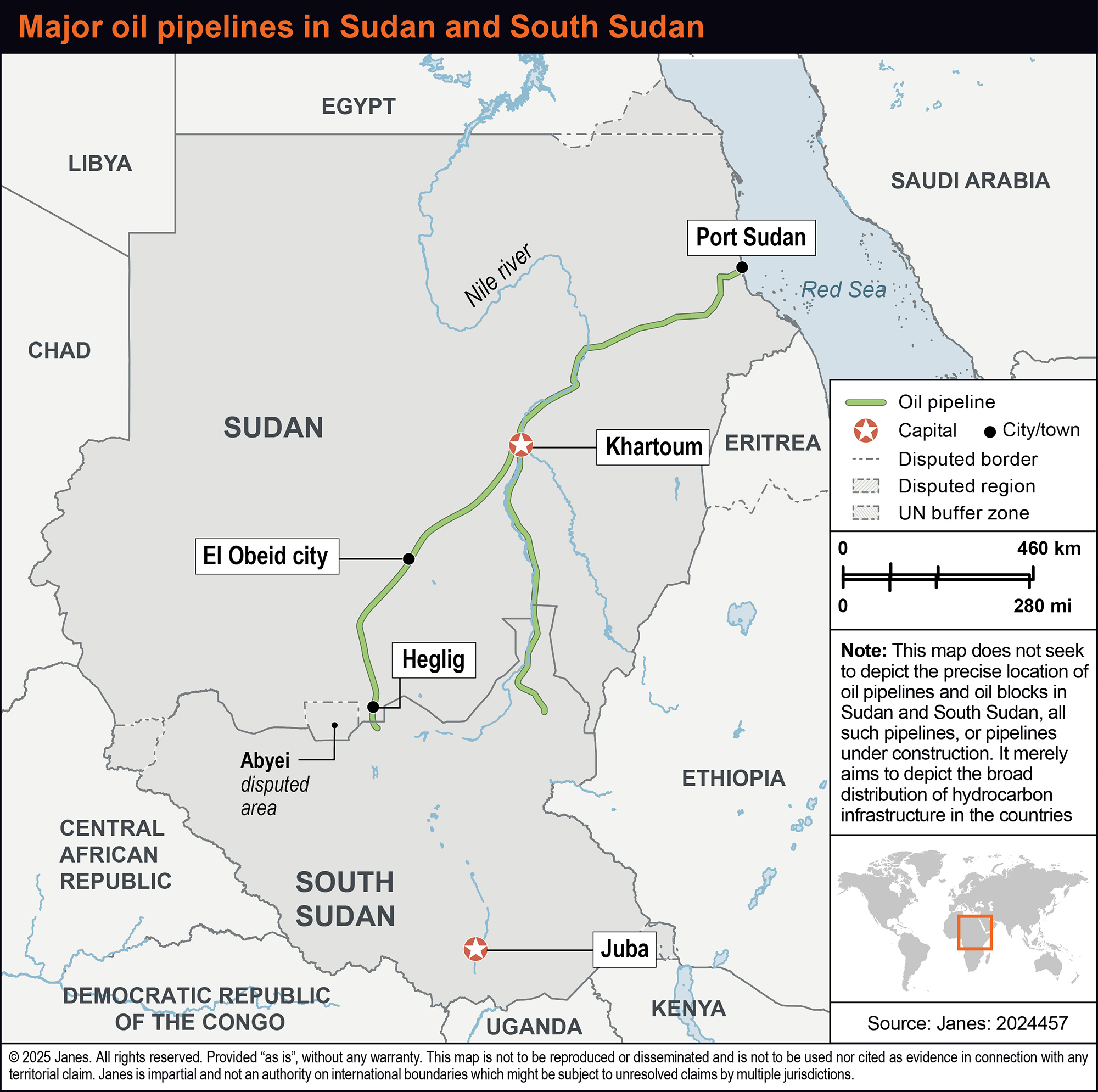 Major oil pipelines in Sudan and South Sudan. Image credit: Janes
Conflict and internal instability in both Sudan and South Sudan pose a very high risk to China’s economic interests in either country. In February 2024, South Sudan’s oil exports were disrupted after conflict in Sudan caused damage to the Petrodar pipeline, which transports South Sudanese oil to Port Sudan. The World Bank’s South Sudan Economic Monitor – Issue 7, published in March 2025, reported that the damage to the pipeline “through which two-thirds of South Sudanese oil was being transported … plunged the economy deeper into recession” and “led to a disruption in the flow of oil exports, which accounts for almost all of the country’s exports”. The report added that production was expected to fall from 122,000 barrels per day (bpd) in 2024 to 66,000 bpd in 2025.
Engagement on R-ARCSS
Disruption to CNPC’s oil export activities very likely accounts for China’s active engagement with key elements of the 2018 R-ARCSS peace agreement and China’s agreement with other United Nations Security Council (UNSC) members that a ceasefire in Sudan remains a top priority.
On 7 July 2025, the Chinese ambassador to South Sudan, Ma Qiang, met with the Chairperson of South Sudan’s Ceasefire and Transitional Security Arrangements Monitoring and Verification Mechanism (CTSAMVM), Major General Yitayal Gelaw, in Juba. According to an 8 July press release from the Chinese Embassy in South Sudan, Ma “commended the important role of CTSAMVM” and said the embassy would continue making “positive contributions to advancing [the] political transition”.
Ma then met Interim Chairperson of the Revitalised Joint Monitoring and Evaluation Commission (RJMEC), Major General George Aggrey Owinow (retd), on 13 October highlighting the potential role for Chinese President Xi Jinping’s Global Governance Initiative (GGI) in providing guidance and support to South Sudan’s political transition. On 14 October, the Chinese Embassy released an article stating that Owinow “expressed appreciation for China’s consistent support” and that the RJMEC “will maintain close communication and co-ordination with the Chinese side to foster further outcomes in the implementation of R-ARCSS”.
Chinese security activities
Janes assesses that if the UN arms embargo against South Sudan is lifted in 2026, then it is very likely that China will use the opportunity to openly supply materiel to the South Sudan People’s Defence Forces (SSPDF) and the integrated Necessary Unified Forces (NUF). Janes has moderate confidence in this assessment because Chinese commercial interests usually act as a driver of Chinese arms sales abroad.
China opposes the 2018 UN arms embargo against South Sudan and, along with Russia, voted against its renewal in May 2025. According to the UNSC’s South Sudan Sanctions: Vote on a Draft Resolution article, published on 29 May as part of its What's in Blue series, “several other members (including China and Russia) argued that sanctions imposed on the South Sudanese government have hindered its ability to build and consolidate its security institutions, secure its borders, and implement key provisions [of R-ARCSS]”.
UN peacekeeping figures from July 2025 show that China contributes to the UN Interim Security Force for Abyei (UNISFA) with 285 military personnel (8.03% of the total mission) and 1,053 military personnel (equivalent to 6.2% of total mission) to the UN Mission in South Sudan (UNMISS). This means South Sudan has the highest number of Chinese peacekeepers deployed to active UN missions globally. China’s willingness to contribute to both missions is likely to be driven by the country’s economic interests in South Sudan.
Outlook
China is very likely to continue advocating for engagement between parties to the R-ARCSS in a bid to prevent a return to civil war in South Sudan. This is because CNPC will maintain its dominance over South Sudan’s oil sector meaning no change to Chinese economic interests in the medium to long term (12–24 months). If CNPC expands its operations because of the withdrawal of Petronas from DPOC in 2024, South Sudan’s economic dependence on China will increase while reducing pressure on South Sudan to diversify away from its reliance on oil exports, which requires the use of vulnerable critical national infrastructure located in a foreign conflict zone.
Sudan
Janes assesses that Sudan-South Sudan relations are having a negative impact on internal stability in South Sudan. Civil war in neighbouring Sudan will continue to undermine South Sudan’s political transition in the medium term because the conflict poses a very high risk to South Sudanese economic and social stability.
Economic interdependence
Sudan and South Sudan maintain a high level of economic interdependence as demonstrated by reliance on Sudanese pipelines and ports. The outbreak of Sudan’s civil war between the Sudanese Armed Forces (SAF) and the paramilitary Rapid Support Forces (RSF) in April 2023 demonstrated that conflict and internal instability in one neighbour has implications for the economic, political, and social stability of the other. An interim report published by the UN Panel of Experts (PoE) on South Sudan on 1 December 2023, had stated that “the prospect of a protracted conflict in the Sudan has serious political and humanitarian consequences for South Sudan, while leaving its economy perilously vulnerable to the evolving military and economic incentives of rival Sudanese factions”. As of October 2025, Sudan accounted for 95% of the 600,000 refugees hosted by South Sudan, according to the UN High Commissioner for Refugees (UNHCR).
Damage to Sudanese pipelines transporting South Sudanese oil, weakens South Sudan’s economic stability. This disruption deprives South Sudan's government of the revenue required to develop public services and fund the requirements of the political transition process. Therefore, Sudan’s civil war is limiting progress on the implementation of the outstanding provisions of the R-ARCSS. The prolonged political transition process has consequently undermined political stability in South Sudan over the previous 12 months.
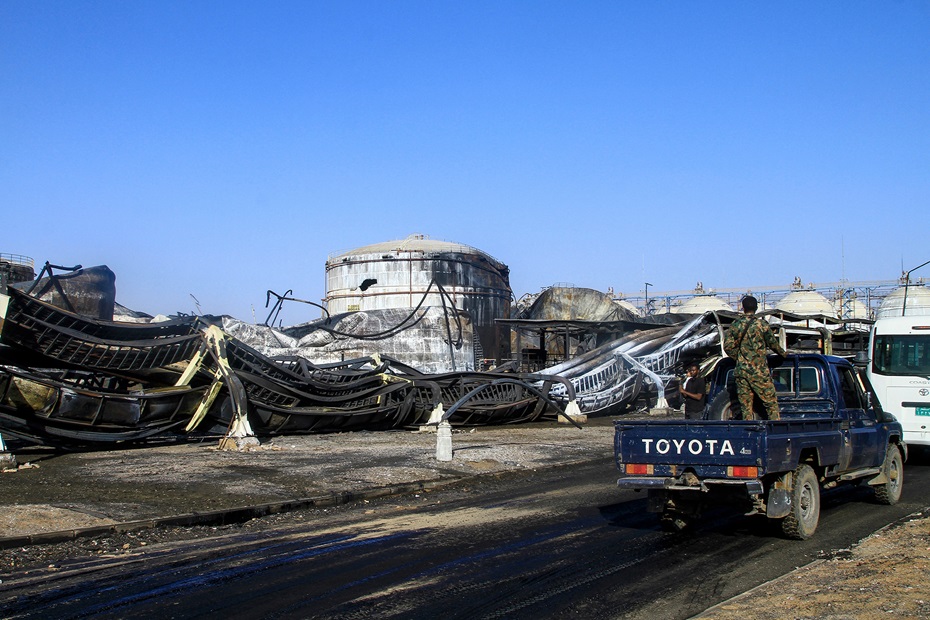
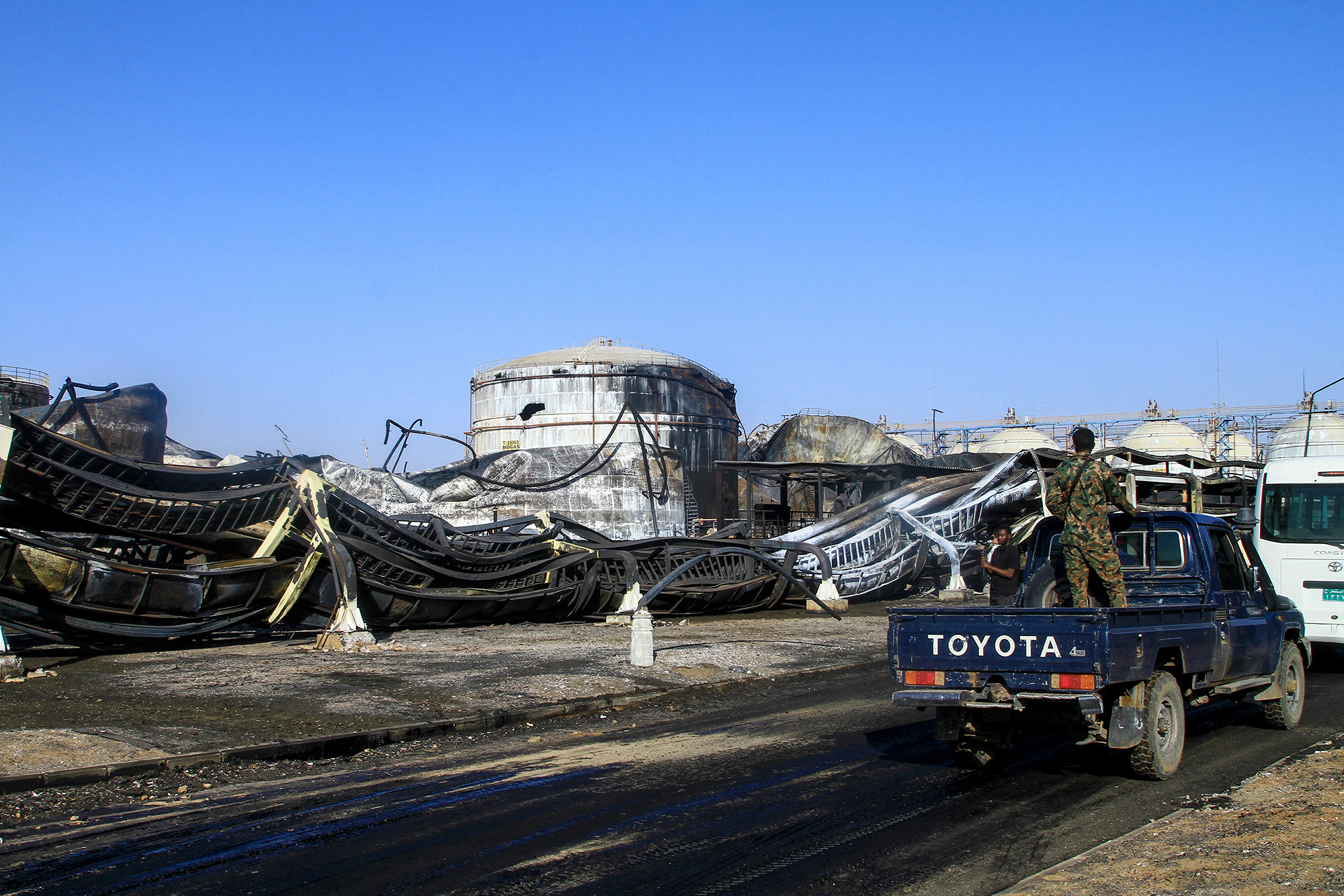 A Sudanese army soldier stands on a truck at the heavily damaged Jaili Oil Refinery, Sudan’s largest, north of the capital Khartoum on 18 March 2025. The refinery, located about 70 km (43 miles) north of Khartoum and considered before the war a vital lifeline for Sudan and its southern neighbour South Sudan, fell into the hands of the paramilitary Rapid Support Forces just days after fighting between the group and the army erupted in April 2023. Image credit: Ebrahim Hamid/AFP via Getty Images
On 7 January 2025, South Sudan’s then Minister of Petroleum, Puot Kang Chol, announced via a post on X that DPOC had restarted operations in two blocks “with the full support of our international partners” and that the decision was the result of “the resolution of pipeline and security concerns”. This came after reports emerged in November 2024 that the South Sudanese government had reached an agreement with the RSF in which the Sudanese paramilitaries agreed not to attack pipeline infrastructure, according to a 1 November 2024 article from the independently run Radio Tamazuj news outlet. Janes assesses the source as B2 for reliability (usually reliable) and credibility (probably true). However, a year later, on 15 November 2025, Radio Tamazuj reported that oil production and exports had been suspended again after the RSF conducted a drone strike on oil facilities in Heglig.
Social and diplomatic tensions
Between 16 and 19 January 2025, Janes Events recorded six protest and riot events compared with no events in December 2024. The unrest came after videos emerged on social media, which showed the SAF killing an unspecified number of South Sudanese nationals accused of supporting the RSF in Wad Madani city after the SAF recaptured it on 11 January 2025.
Protesters targeted Sudanese nationals and businesses heightening the risk of intercommunal tensions and violence. Major urban areas including Aweil, Bor, Juba, Kuajok, and Wau were affected and at least 16 people were killed. This led to a nationwide curfew between 17 and 27 January 2025. It is likely that the alleged agreement between Juba and the RSF reportedly made in November 2024 accounted for the SAF’s suspicion and subsequent targeting of South Sudanese civilians during its operations in Wad Madani.
For more information on the January 2025 social unrest, please see Alleged killing of South Sudanese civilians by SAF in Sudan very likely to cause short-term increase in communal tensions in South Sudan.
Tensions were exacerbated after local media alleged that the RSF was present in South Sudan’s Upper Nile state. On 16 March, the RSF was reported by the privately owned Sudans Post news website (B2 for reliability and credibility) to have engaged in armed clashes in Renk County with the Sudan People’s Liberation Movement/Army – In Opposition (SPLM/A-IO) – an adversary of the SSPDF. The Sudan War Monitor website, which Janes assesses as B2 for reliability and credibility, claimed on 18 March that the RSF were present “likely with the sanction of the SSPDF”. However, Janes was unable to independently verify this claim.
The Assistant Deputy Commander-in-Chief of the SAF, General Yasir al-Atta, responded by threatening to take “retaliatory action against… the corrupt centres of influence in South Sudan” in a 23 March speech.
The Ministry of Foreign Affairs and International Cooperation of South Sudan issued a 24 March statement raising its “strong condemnation” of Al-Atta’s remarks, which it said had included “threats of military aggression against the people and sovereignty of South Sudan”.
Arms flows
Janes assesses that Sudan’s conflict has very likely increased the flow of illicit weapons and ammunition into South Sudan. This assessment is based on information provided by the UN PoE’s July 2025 report, which confirmed that South Sudanese security personnel had seized weapons originating from Sudan.
These included Turkish-made rifles and shotguns, which were believed by the PoE to have been looted by the RSF in Khartoum, and which arrived in Sudan through legitimate arms transfers made before 2023. Photographs seen by the panel included BRG 55, HUSAN Arms MKA 556 and UTAS Defence 5.56×45 mm calibre rifles with the BRG 55 known to be in the possession of some RSF members in 2024. These weapons were assessed by the PoE to have “likely” been smuggled from RSF-held territory into South Sudan’s Northern Bahr el-Ghazal state or the disputed Abyei region with both borders having become increasingly militarised since April 2023. Abyei continues to be claimed by both Sudan and South Sudan.
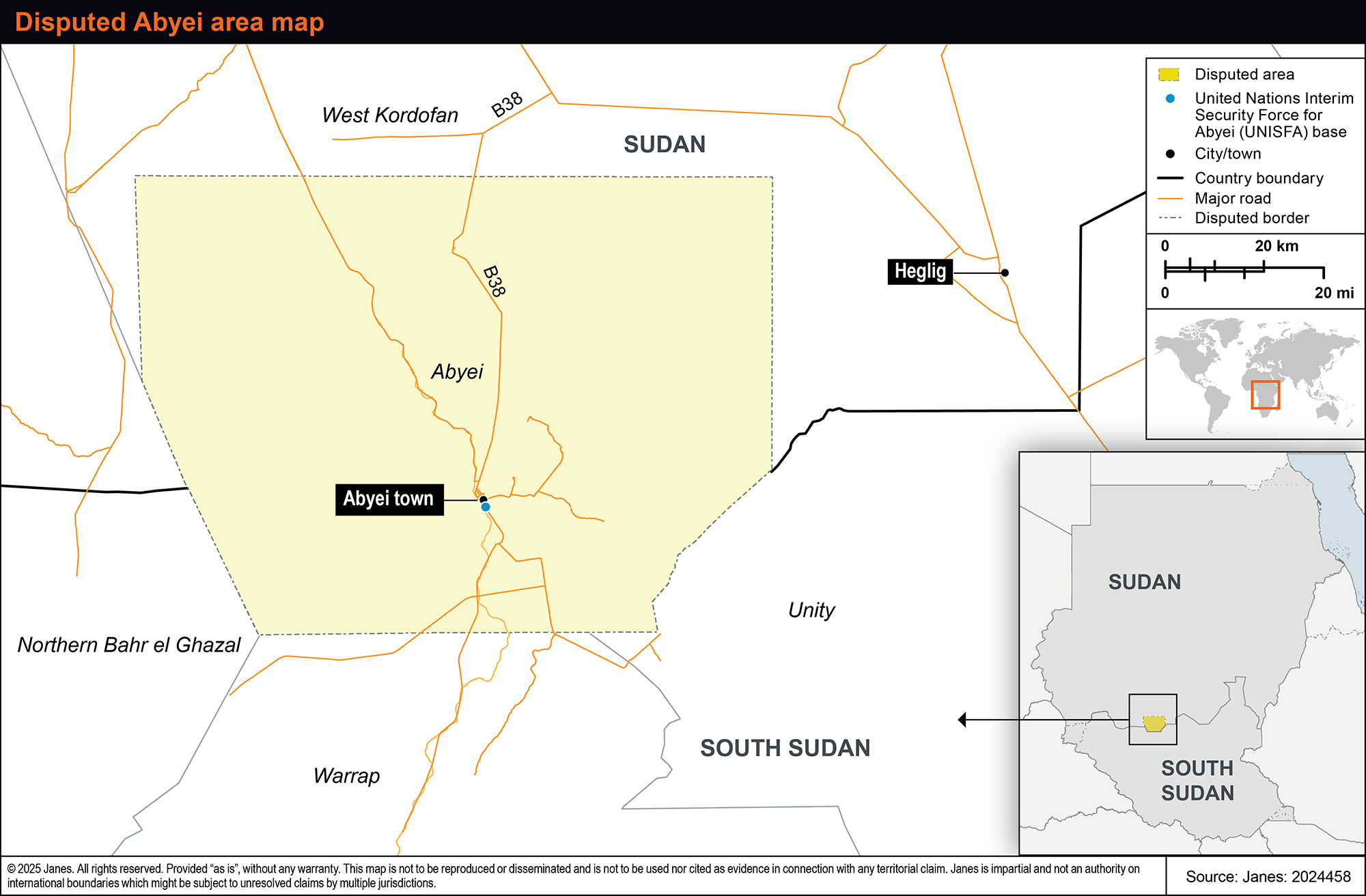 Disputed Abyei area map. Image credit: Janes
Outlook
Sudan’s conflict will almost certainly continue to pose a very high risk to South Sudan’s stability over the medium term and be a central factor influencing Sudan-South Sudan relations. Over the long term (24 months), South Sudan’s economic dependence on Sudan will remain with no alternative route for exporting its oil. Therefore, resolving the Sudan conflict is very likely to be required for the South Sudanese government to adequately fund preparations for December 2026 elections and its long-term economic development.
For more information, please see South Sudan’s economic stability very likely reliant on Chinese and Emirati activity but weakened by Sudan conflict