Ankara summit underscores NATO unity as defence spending risks persist
Event
The 2026 NATO summit was held in Ankara, Türkiye, on 7–8 July.
The summit followed the pledge made by allies at the 2025 summit in The Hague to increase defence and security-related spending to 5% of GDP by 2035, including 3.5% of GDP for core defence expenditure.
The event took place against a backdrop of diplomatic friction within the alliance. This was apparent in media remarks by US president Donald Trump, who expressed dissatisfaction with allied contributions and assistance related to US- and Israel-led action against Iran, the level of burden-sharing within NATO, and US overtures towards Greenland.
Despite these tensions, the summit communiqué, published on 8 July, emphasised unity, stating that “solidarity and collective strength remain the foundation of peace, security and prosperity”.
It also highlighted a greater European contribution to alliance capabilities, referring to a “stronger Europe in a stronger NATO” within a “modernised Alliance”, noting that European allies and Canada were “assuming greater responsibility for the Alliance’s defence”.
The declaration was as brief as the previous year’s text but contained fewer specific objectives. Instead, it underscored progress against existing goals on defence investment, industrial cooperation, and multi-domain capability development. This indicated an effort to preserve consensus while addressing concerns within the Trump administration over burden-sharing and European capability.
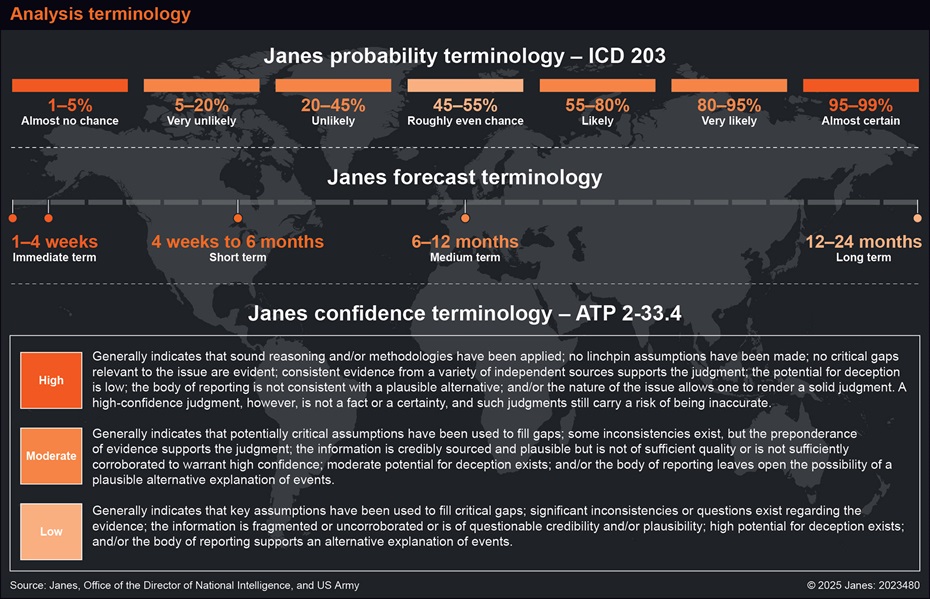
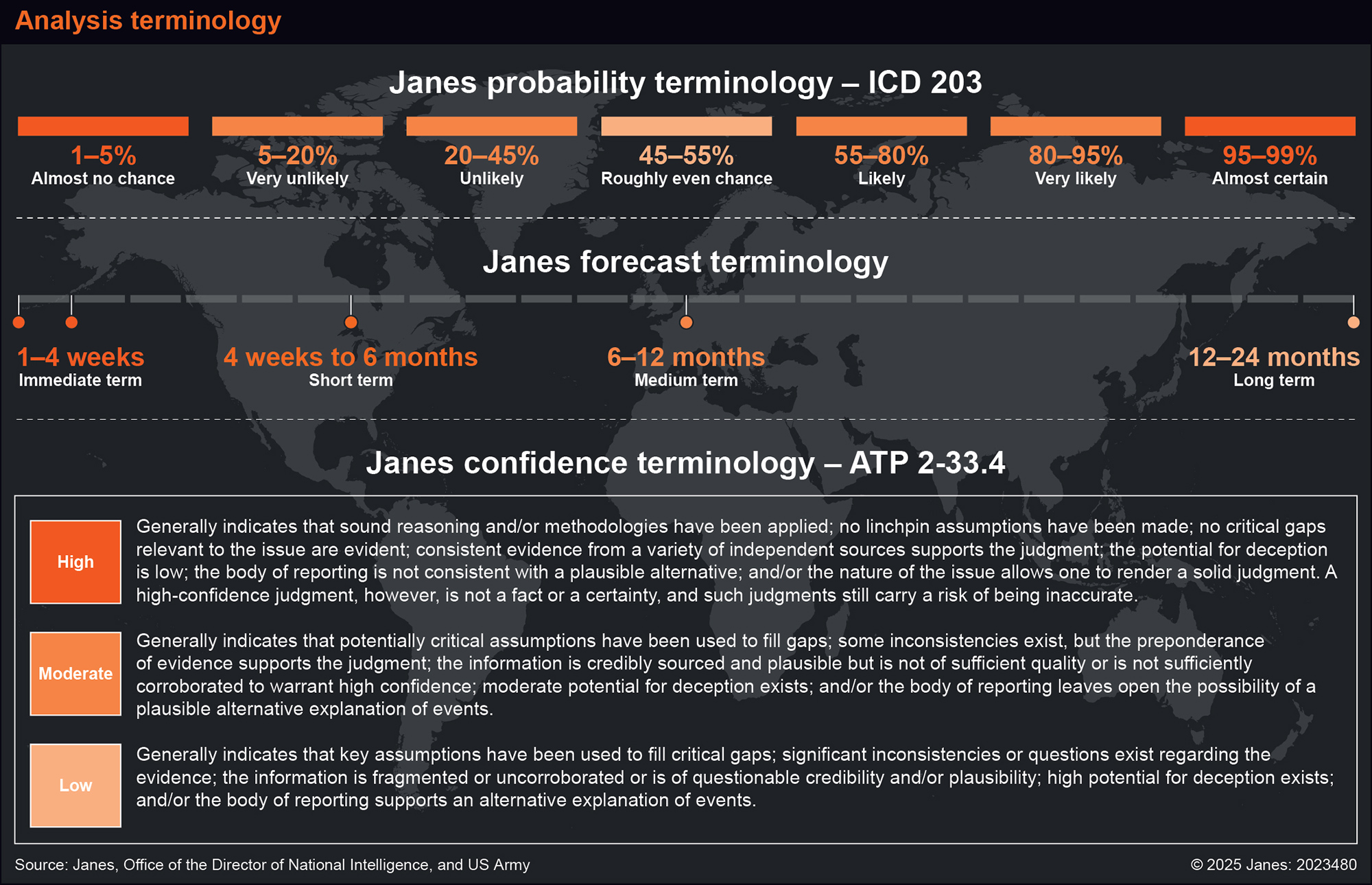 Janes Probability Terminology - ICD 203
Significance
NATO media announcements associated with the summit put significant emphasis on investments by non-US members in new capabilities on a collaborative basis, and cooperative measures to enhance supply of critical goods and to address capability gaps.
Examples include a 12 member NATO project to strengthen supply chains relating to critical raw materials, the launch of the Hybrid Alliance Layered Operations in Space (HALO) space-based capabilities project, the co-development of munitions, and the multi-national acquisition of Saab GlobalEye airborne early warning and control aircraft and Northrop Grumman MQ-4C Triton high-altitude long-endurance (HALE) unmanned air systems.
These initiatives indicate continued movement towards capability development, but they do not resolve the more significant question of whether allies can sustain the pace of defence spending increases required to meet the 2035 objective.
Defence expenditure
Given persistent US concern over burden-sharing, broad failure to maintain a credible trajectory towards spending 3.5% of GDP on core defence by 2035 is very likely to remain a source of intra-alliance tension.
Aggregate NATO defence expenditure stood at USD1.59 trillion in 2026, according to Janes Defence Budgets. Of this total, 41% was attributable to countries other than the US, up from 35% in 2025 and 32% in 2022.
Average non-US NATO core defence expenditure as a share of GDP increased from 2.2% in 2025 to 2.4% in 2026, according to Janes Defence Budgets, although variance within the bloc remained significant.
Estonia and Latvia spent 5.5% and 5.4% of GDP respectively, reflecting proximity to Russia and threat perceptions, while Iceland and Montenegro spent below 1% of GDP.
Janes forecasts average defence expenditure among non-US NATO members to reach 2.5% of GDP by 2030 with a range of between 6.2% (Estonia) and 0.4% (Iceland). If realised, this trajectory would leave most of the adjustment to the final five years ahead of the target date, increasing the likelihood of uneven compliance.
Obstacles to defence spending growth
Real defence spending growth among non-US NATO members averaged 10% per year between 2022 and 2026, although Janes forecasts growth will moderate to low single digits to 2030.
Comparable growth is likely to be constrained by fiscal capacity in a low-growth environment, varying political will, limited absorption capacity in smaller high-GDP-per-capita states, and the rising annual allocations required to meet the 2035 target after years of lower spending.
Borrowing costs are also elevated and the cost of sovereign borrowing in Europe has increased substantially since 2022. Indeed, Germany’s 10-year government bond yield, a common benchmark for European borrowing costs, rose from 1.86% in 2022 to 2.59% in 2025, while the EU-wide Maastricht-criterion bond yield increased from 2.46% to 3.51% between 2022 and 2023 and remained well above pre-2022 levels.
In a low-growth environment, higher debt-servicing costs are likely to crowd out other areas of expenditure.
Fiscal capacity in Europe is also highly uneven. Within the European Union, whose members account for 72% of NATO countries, state debt has been rising again since 2023 and reached 81.7% of GDP in 2025, according to Eurostat data.
European support for Ukraine creates a parallel fiscal burden. The Ankara Declaration noted the alliance’s “unwavering support” for Ukraine and welcomed the EU’s passing of the Ukraine Support Loan earlier in 2026.
This loan, agreed by the Council of the European Union in February 2026, will provide USD90 billion towards Ukraine’s 2026–27 budget shortfall, covering around two thirds of its needs.
Funded through central EU borrowing and existing budget headroom, it will add to wider security-related debt obligations, including the EUR150 billion SAFE fund. This is very likely to limit future fiscal capacity for additional EU defence expenditure, although security-related support to Ukraine counts towards the NATO defence spending objective.
For more, please see Ankara summit underscores NATO unity as defence spending risks persist