United States’ capture of Venezuelan leadership very unlikely to alter China’s approach to Taiwan
Event
On 4 January, the Chinese Ministry of Foreign Affairs published a short statement condemning the US operation on 3 January, which included airstrikes targeting multiple locations in Caracas and the capture of Venezuelan President Nicolás Maduro and First Lady Cilia Flores. The Chinese ministry accused Washington of “violating international law and Venezuela’s sovereignty“.
Speaking from the seventh round of the China-Pakistan Foreign Ministers’ Strategic Dialogue on 4 January, Chinese Minister of Foreign Affairs Wang Yi stated that “China has consistently opposed the use or threat of force in international relations”.
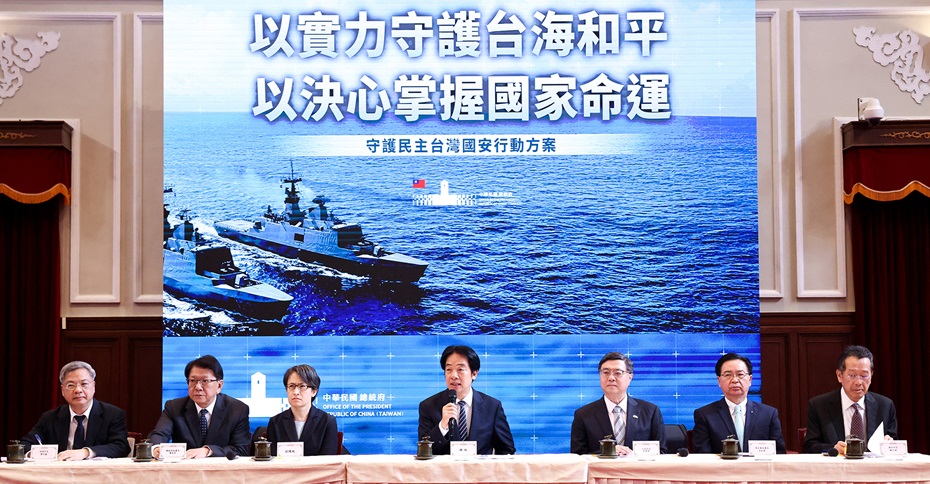
On 5 January, Taiwanese Vice-Minister of National Defense Hsu Szu-chien, answering media questions before a Legislative Yuan session, stated that the Republic of China Armed Forces included a decapitation operation against the Taiwanese presidency in their regular drills. Hsu explained that, in co-ordination with other, unnamed agencies, the Taiwanese military has emergency responses ready to protect and evacuate the president in such an eventuality.
Significance
The US operation in Venezuela is very unlikely to alter the Communist Party of China (CPC) leadership’s calculus regarding Taiwan. Incorporating Taiwan into the People’s Republic, including by force if necessary, has been a political objective of the CPC since it took power in 1949. Current strategies to both persuade Taiwanese citizens to embrace the mainland and coerce them not to support independence are the result of years of strategic discussions and long-term economic, military, political, social initiatives; domestic dynamics; and perceived risks.
In addition, there are three specific factors that weigh against such an operation against Taiwan:
- The People’s Liberation Army (PLA) does not enjoy the same capability advantage over Taiwan as the US armed forces have over Venezuela. The US benefited from a deep divide in advanced capabilities across all domains over the Venezuelan armed forces, which allowed US troops to neutralise command, control, communications, computers, intelligence, surveillance, and reconnaissance (C4ISR) systems, including critical communication channels, and prevent Venezuelan early warning platforms from detecting and reacting to the offensive in time. Taiwan’s armed forces reflect a much more advanced technology ecosystem, which the US intelligence, surveillance, and reconnaissance (ISR) support further strengthens. In this context, it is very unlikely that the PLA will be able to launch a successful decapitation strike against Taipei without additional military support.
- Isolated from other actions, seizing the Taiwanese presidency does not necessarily advance China’s goal of unification, and it is very likely to undermine it. China’s 2005 Anti-Secession Law provides a legal framework for the arrest and trial of Taiwanese secessionist forces, but sentencing the Taiwanese president does not solve China’s ultimate problem – achieving the effective control of Taiwan. Without additional military pressure, there is almost no chance that Taiwanese political forces yield to the will of the CPC. On the contrary, a decapitation operation is almost certain to unite Taiwanese support for the president as a symbol of Taiwan’s democracy, regardless of political colour. With Taiwanese President William Lai’s popularity dropping to 26% in September 2025 and an impeachment vote at the Legislative Yuan scheduled for 19 May, targeting the Taiwanese president would very likely give the ruling Democratic Progressive Party a political lifeline.
- The US operation against Venezuela came after weeks of military and political escalation, including conducting strikes against civilian vessels in the Caribbean. Janes has not observed similar developments in China’s approach to Taiwan. China continues to increase military pressure through specific military exercises, but has not permanently deployed military assets around Taiwan, blockaded Taiwanese trade, nor conducted strikes against Taiwanese vessels. In addition to coercive measures, China continues to heavily invest financial and political capital into peaceful measures to persuade the Taiwanese population of the benefits of joining the People’s Republic, including the expansion of cross-strait integration demonstration zones in Fujian province. The military escalation necessary to increase the probability of a successful PLA decapitation mission against Taiwan would give Taiwanese and US troops the warning necessary to raise the readiness of relevant personnel and systems.
However, it is very likely that a similar operation would be part of a potential large-scale military action against Taiwan, aiming to disrupt command-and-control and undermine military and civilian morale. The PLA’s Zhurihe military base in Inner Mongolia, used for training, includes mock structures of Taiwan’s Presidential Office Building, the Reserve Command building of the Ministry of National Defense, the Ministry of Foreign Affairs, and the Judicial Yuan. China’s narratives around the use of military force to achieve unification reflect the CPC’s intent to threaten the Taiwanese leadership. In the April 2025 Strait Thunder-2025A exercises, the PLA’s Eastern Theatre Command (ETC) published a video depicting Lai as a parasite poisoning Taiwan, and during the Justice Mission 2025 military exercises around Taiwan in December, ETC released a short video, purportedly taken from a TB001 fixed-wing unmanned aerial vehicle, featuring the Taipei 101 skyscraper and the message “ready to visit Taipei”.
For more information on the April 2025 Strait Thunder-2025A exercises, please see China’s military exercises around Taiwan indicate intensifying pressure tactics against Taipei.
Outlook
Although a decapitation strike is very likely to feature in a potential invasion scenario against Taiwan, Janes maintains its assessment that such a scenario is very unlikely in the medium term (six to 12 months), with ‘coercion and intimidation’ being the most likely approach over that period. The US’ actions against Venezuela do not fundamentally alter the domestic, cross-strait, and regional dynamics informing the CPC’s decision making about Taiwan, and there is almost no chance that the CPC decides its course of action based on US precedent.
Janes has not observed developments pointing at major Chinese military action against Taiwan in 2026 either before or after the US operation in Venezuela. There has been no significant expansion of military logistics in the Taiwan Strait area, no mobilisation orders indicating preparations for major military action, no massing of troops and assets in the ETC, no permanent deployments nor raised levels of readiness in the ETC. Although increasingly frequent military exercises bolster certain invasion-related capabilities, the PLA is not conducting training at the scale and frequency required to co-ordinate military, civilian, and paramilitary assets across commands.
Janes has not observed significant changes in Taiwan’s civil defence and air raid drills beyond the annual, scheduled exercises, nor updated guidelines in the All-Out Defense Contingency Handbook guidebook reflecting growing concerns about an invasion. At the same time, China continues to focus on developing cross-strait economic, social, and infrastructure-related links, with cross-strait trade growing 7.3% year-on-year in the January–November 2025 period.
For a more detailed analysis of China’s threat to Taiwan and the most likely scenarios, please see Warning intelligence report: China likely to continue to prioritise intimidation against Taiwan in the next six to 12 months despite PLA’s aggressive rhetoric, exercises – June 2025 assessment.
Risk positive indicator
- Chinese state, party, and military agencies refrain from promoting hostile and dehumanising rhetoric against Taiwanese citizens and political leaders.
- China reduces the length, intensity, and magnitude of its military response to Taiwanese political statements.
Risk negative indicator
- China increases the frequency and scale of its military drills around Taiwan that include allied services such as the China Coast Guard (CCG).
- Economic and social cross-strait integration stagnates or decreases.
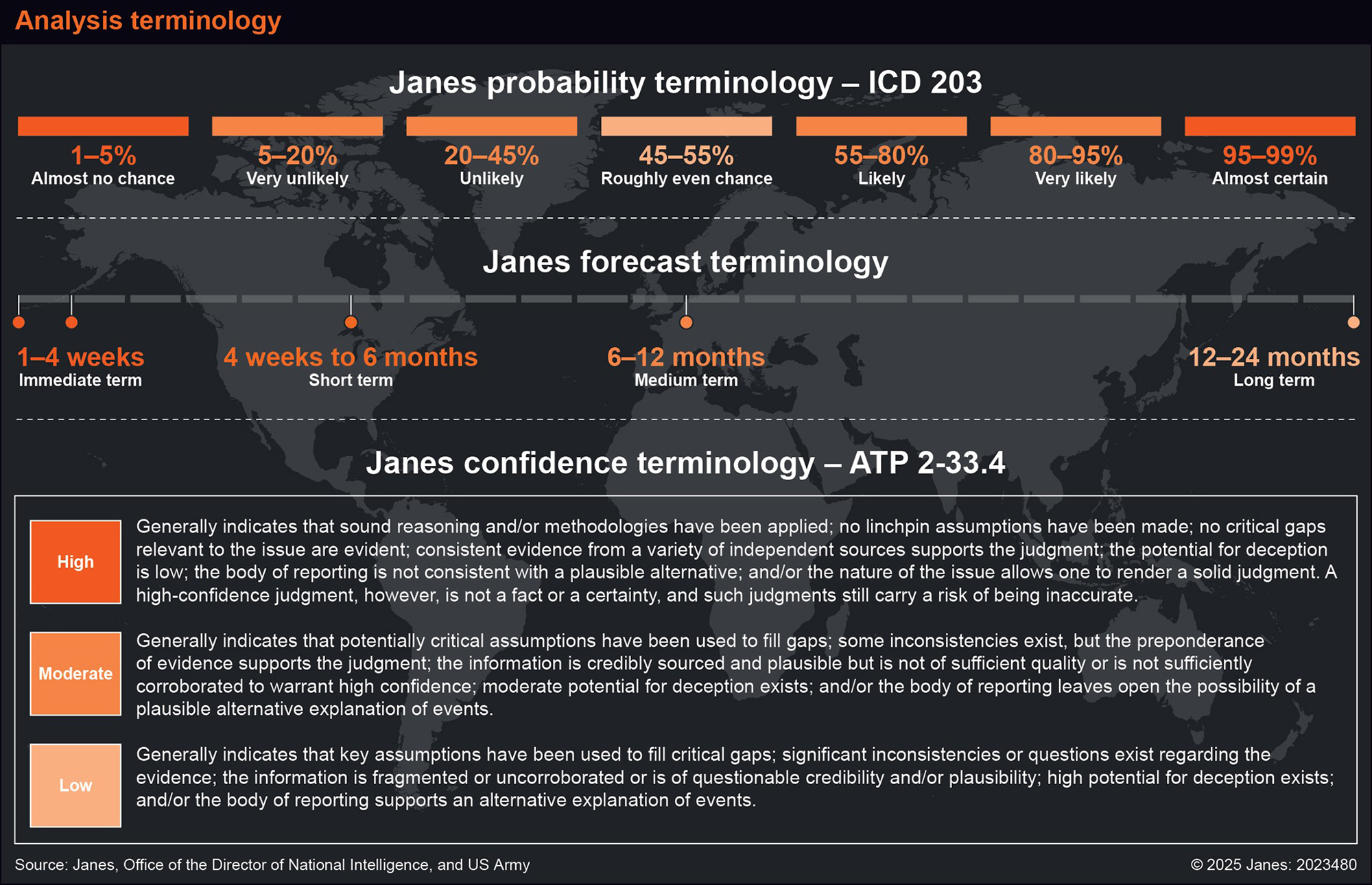 Janes analysis terminology. Image credit: Janes