Feature: China accelerates air combat modernisation
Date Posted: 13-Nov-2025
Author: Akhil Kadidal, Bangalore
Key points
- China is fast-tracking the development of new and enhanced air-combat capabilities
- Progress is aligned with wider military modernisation goals over the coming decade
In a series of disclosures starting from its 3 September military parade to mark the 80th anniversary of the end of the Second World War, China has unveiled hitherto unknown military aviation programmes, reflecting its accelerating effort to progress the air combat capability of the People's Liberation Army (PLA). Simultaneously, China also appears to have operationalised new aircraft previously in development.
The scope of China's recent military aviation developments indicates that China is hastening core PLA capability in line with stated objectives to significantly advance military modernisation by 2027, the 100th anniversary of the PLA, and to “basically complete” modernisation by 2035. These short-term goals – supported by China's five-year plans – lead into a more prominent target for the PLA to become a “world-class military” by 2049, the 100th anniversary of the founding of the People's Republic of China.
As evidence of its recent achievements, the PLA flew nine new manned aircraft types over the parade in Beijing. These included fifth-generation platforms such as the single-seat, twin-engine Shenyang J-35A operated by the PLA Air Force (PLAAF), its naval counterpart for the PLA Navy (PLAN), and the new twin-seat Chengdu J-20S support stealth fighter, which was in development for more than seven years.
Other aircraft of a more conventional nature that appeared in the parade included an armed variant of the Changhe Z-20 utility helicopter and three new operationalised Xi'an Y-20B transport aircraft, the Russian engines for which have been replaced by the WS20 domestically developed powerplant.
Four new special mission aircraft were also displayed. Among them was the Xi'an KJ-600 ‘Sea Plate' airborne early warning and control (AEW&C) aircraft, a platform likely to be deployed onboard the PLAN's third aircraft carrier, Fujian (CV-18), which is equipped with an electromagnetic aircraft launch system (EMALS).
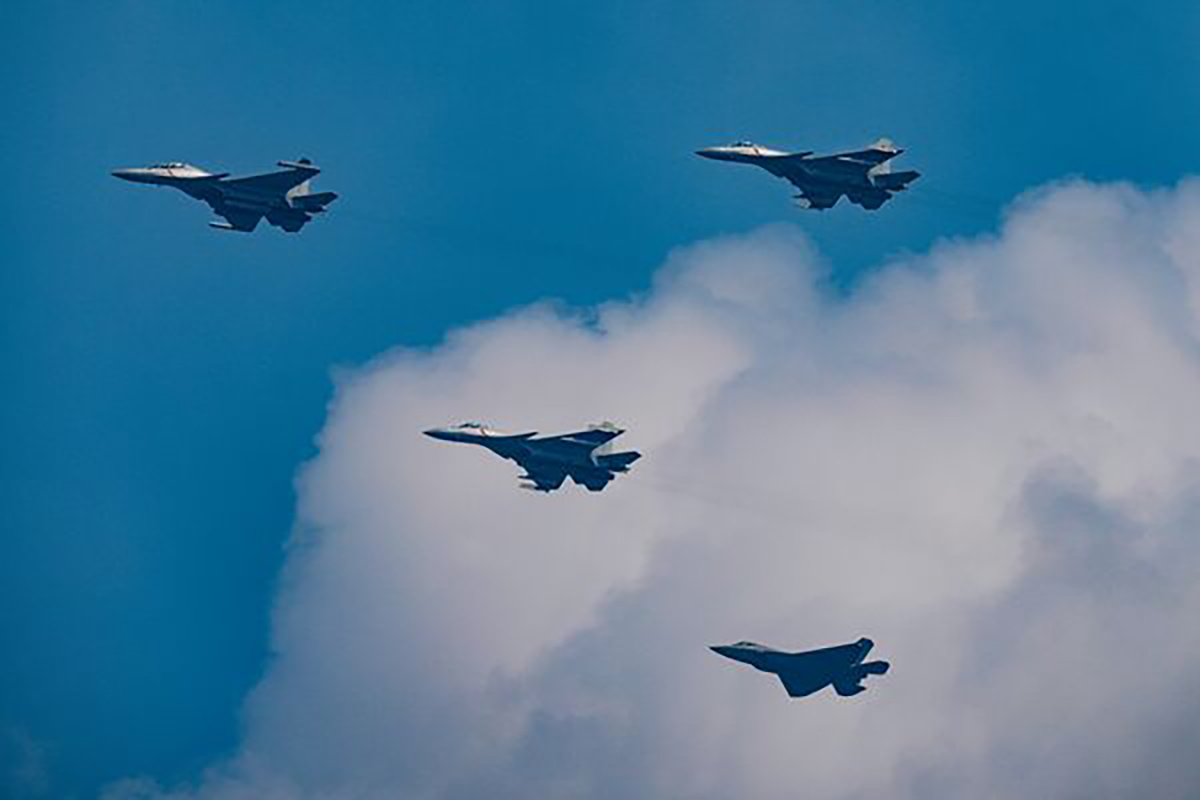 New naval fighter aircraft, including one Shenyang J-15DT EW aircraft (far left), two J-15Ts, and a single J-35 naval variant (bottom right), fly over Beijing on 3 September 2025. (Getty Images)
In addition, by showcasing seven new types of unmanned aerial vehicles (UAVs) at the parade, China also highlighted its strides in unmanned, autonomous aircraft technologies. Among these UAVs were collaborative combat aircraft (CCAs) designed to operate alongside manned combat aircraft and multirole platforms capable of intelligence, surveillance, and reconnaissance (ISR) missions as well as attack and electronic warfare (EW) operations.
China also revealed at least three new types of air-launched missiles and a new EW pod for UAVs.
A spokesperson for China's Ministry of National Defense (MND) said on 10 September, “Many of the weapons and equipment on display [at the parade] represent the latest evolution of modern warfare, including some of the country's most advanced equipment.
“These showcase the Chinese military's systemic combat capabilities, its combat capabilities in new domains and new qualities, and its strategic deterrent strength. Only by being able to fight can we stop war. We have unswervingly adhered to a defensive national defence policy.”
China's State Council Information Office (SCIO) said before the parade on 20 August that the equipment displayed at the event would be in operation with the PLA. “The weapons and equipment in this parade are all selected from domestically produced, currently active main battle systems,” SCIO said. It added that some of the platforms seen in the parade would make their “public debut, fully showcasing the leapfrog development of our military's air combat capabilities”.
As evidence of the operational use of some manned platforms, the PLA released footage on 22 September showing platforms seen at the parade– such as the KJ-600 AEW&C aircraft, the J-35 naval variant, and the Shenyang J-15T (which entered service earlier in 2025) – conducting take-off operations from Fujian.
Loyal wingmen
While the development of several unmanned platforms shown at the parade was previously known, China appears now to be confirming their adoption by specialised PLAAF and PLAN units. Furthermore, by revealing its new UAV projects, China has indicated that it is enhancing its intelligence-gathering and command-and-control (C2) capabilities within units to improve its overall ability to conduct combat operations in the future.
Writing in the state-controlledGuangming Daily on 3 September, Bai Chengsen and Xie Jiangming, academics at the PLA Ground Force's (PLAGF's) Command College, said that UAVs equipped with artificial intelligence (AI) and high-speed data connectivity would assist the PLA's efforts to employ an integrated combat system that would emphasise automation and the minimisation of risk to friendly human combatants in future battlefield scenarios.
Such technologies would also allow unmanned platforms to leverage wide-area perception and rapid response capabilities, they added.
Four combat-oriented UAVs seen at the parade were new platforms developed to operate as loyal wingmen or CCAs, according to Chinese announcers at the event. All four aircraft were allocated unit serial numbers similar to those previously seen on a UAV brigade at Hotan airbase in the autonomous region of Xinjiang.
Hotan is regarded as a test site for new aircraft, especially UAVs. Janes has previously identified a UAV operating area constructed along the southeastern end of the runway at Hotan. The identity of the UAV unit is unknown at the time of publication, but Janes analysis indicates that it is a direct reporting unit (DRU), which is tasked to report directly to the Central Military Commission (CMC) in Beijing rather than PLA theatre commands.
Among the CCA or loyal wingman UAVs at the parade were two tailless designs that Chinese announcers (as well as the state-owned China Global Television Network (CGTN)), described as high-performance ‘unmanned air dominance planes'.
Janes analysisof the two new tailless CCAs reveals they differ in design and size. The two CCAs are likely prototypes employed for operational testing, potentially towards an initial operational capability (IOC). Both are single-engine aircraft and were shown equipped with all moving wingtips. Both appeared to be equipped with internal weapons bays.
Additional details on the names or designations of the two CCAs have not been revealed. One aircraft, which Janes has differentiated from others seen at the parade by the designation CCA 3, was shown with the serial number 53636, which is associated with the UAV unit at Hotan.
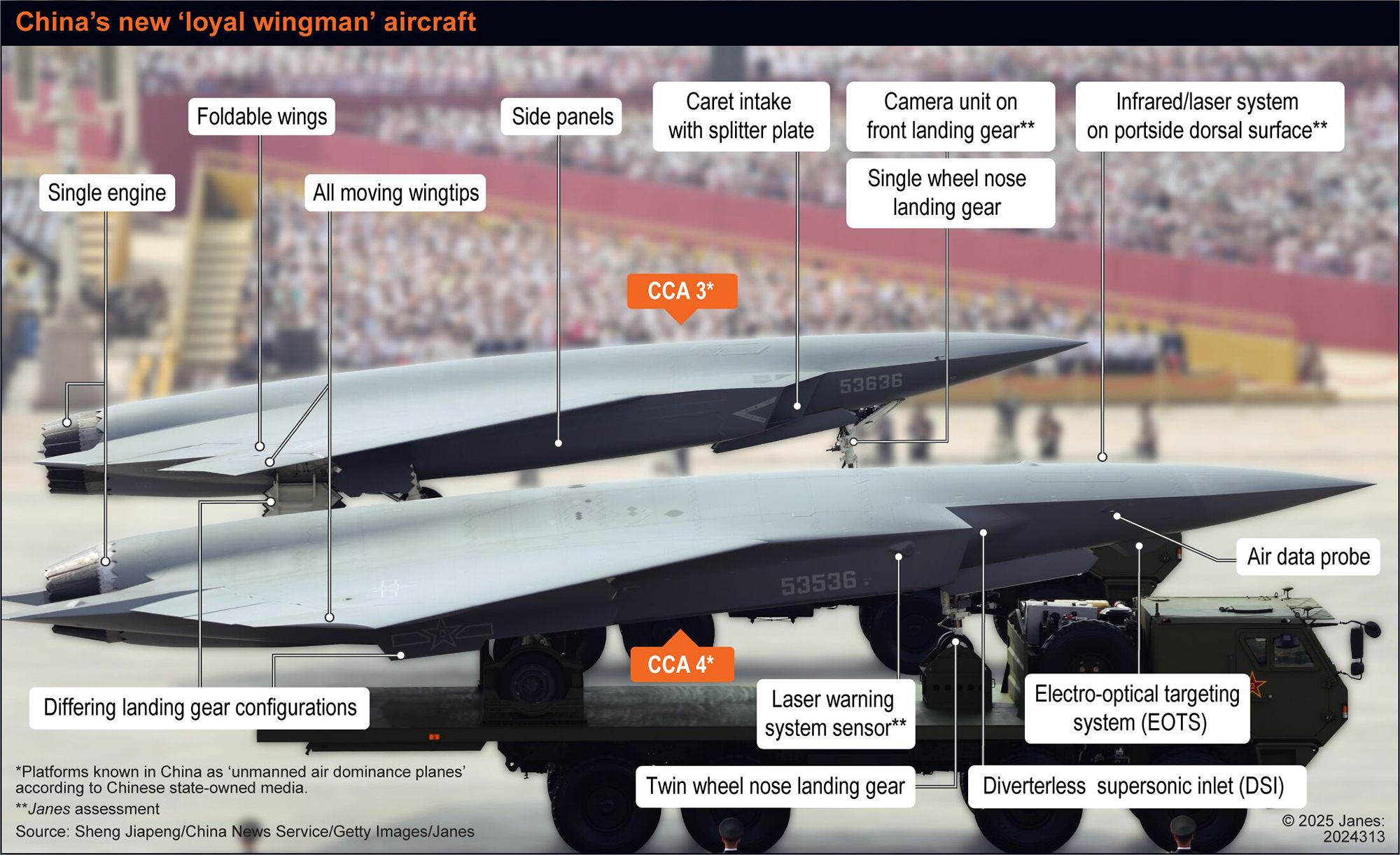 China's new CCAs seen at the 3 September military parade in Beijing. (Sheng Jiapeng/China News Service/Getty Images/Janes)
CCA 3 was equipped with lambda-shaped wings and two caret-shaped engine intakes with splitter plates. The aircraft also appeared to have foldable wings, indicating it has a role in naval aviation. However, the CCA appears to lack the twin wheels and the reinforced landing gear associated with carrierborne aircraft. The aircraft also appeared to not possess a tail hook.
CCA 3 also exhibited features associated with internal bays on its sides. However, it is not yet known if these are additional weapons bays.
The second CCA, which Janes has designated CCA 4, had a similar serial number of 53536, again indicating that it is associated with the same unidentified UAV unit at Hotan airbase.
With an estimated length of about 18 m, CCA 4 appears to be longer than CCA 3. However, in comparison with the latter, CCA 4 has an estimated smaller 11.7 m wingspan. CCA 3 has a wingspan of almost 13 m.
CCA 4 also differs from CCA 3 in having diamond-shaped wings and an electro-optical targeting system (EOTS) under the nose, forward-angled engine intakes with diverterless supersonic inlet (DSI) bumps, and laser warning sensors (LWSs) on the external sides of both engine intakes. This CCA also has a small infrared (IR)/laser port on the portside dorsal area of the nose.
The configuration of CCA 4's rear landing gear also appears to differ from that of CCA 3. CCA 4's rear landing gear bay extends along the fuselage, while that on CCA 3 appears to fold into the lower wing.
The other two combat UAVs, which also appear to have a CCA role, were also single-engine aircraft. These two aircraft are smaller than the tailless CCAs. All four CCAs appeared to feature an internal weapons bay.
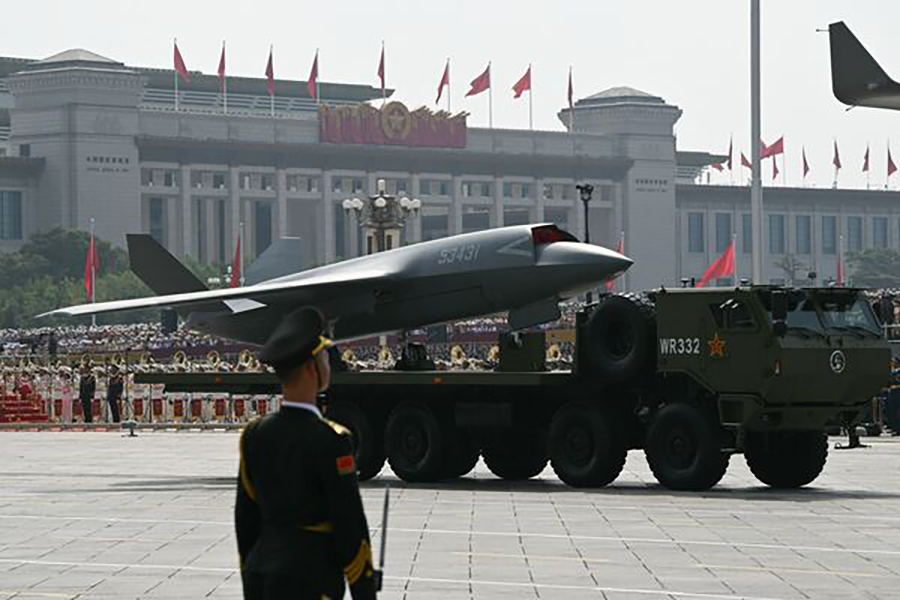 A loyal wingman UAV (which Janes has designated CCA 1) is seen during China's military parade on 3 September. (AFP via Getty Images)
One of the small CCAs, which Janes has designated CCA 1, appeared to be similar in design to the US-origin Kratos XQ-58 Valkyrie, but with a more forward positioned dorsal engine intake. The UAV was equipped with swept wings and canted tailfins.
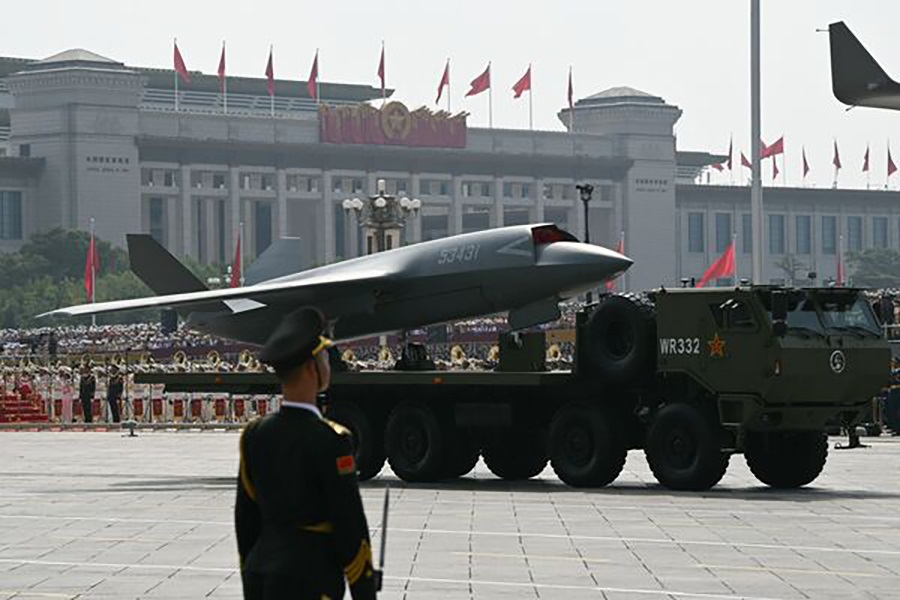
The other aircraft, designated CCA 2, was shown equipped with diamond-shaped wings, canted tailfins, and a dorsal engine intake positioned near the midriff of the aircraft. A serial number (53431) indicates that it is also currently attached to the UAV unit at Hotan.
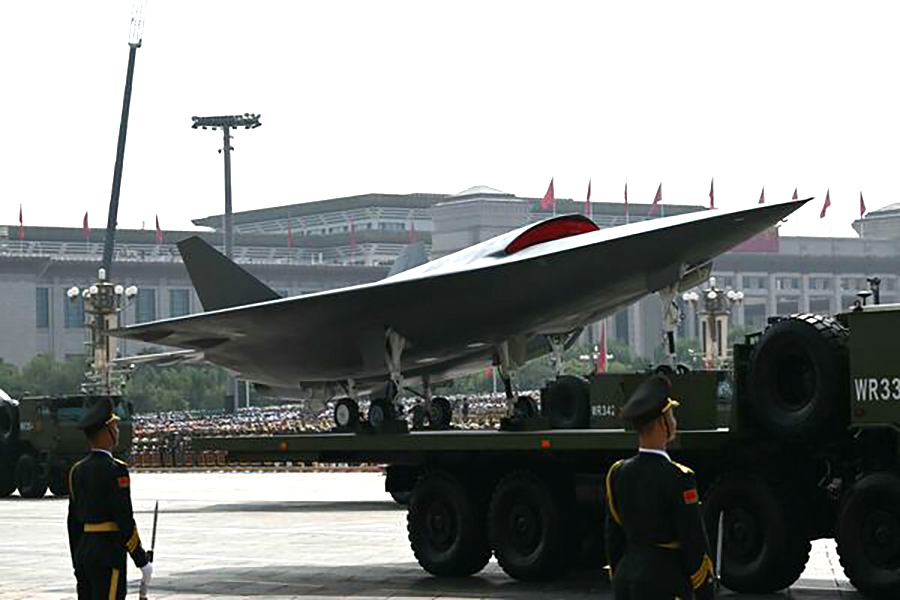 A loyal wingman UAV (which Janes has designated CCA 2) is seen during China's military parade in September. (AFP via Getty Images)
According to Bai and Xie, China's development of unmanned systems across air, land, and sea domains will “strengthen the PLA's offensive and defensive deployment methods such as information fusion and utilisation, and heterogeneous unmanned swarms”.
Naval airpower
Although China officially unveiled the Shenyang J-35 stealth fighter at Airshow China in November 2024, the appearance of three J-35A land-based fighters and at least one J-35 naval variant bearing PLA colours and serial numbers at the 3 September parade indicates that these aircraft have entered service.
The naval J-35 variant has a larger chord than the PLAAF's J-35A. The naval variant's wing trailing edge almost touches the tailplane leading edge. Its wing trailing edge is likely to have flaps that extend further, and aileron droops in landing configuration, for greater lift on carrier approaches.
The airframe and engine blades are likely to be coated with anti-corrosive compounds to allow the aircraft to effectively operate in a saltwater marine environment.
Sun Cong, chief designer of the J-35 and a member of the Chinese Academy of Engineering, told state-owned China Central Television (CCTV) in October 2025 that the naval J-35 variant also has a dual-mode take-off system that renders the variant “fully compatible with both catapult and ski-jump launch methods on aircraft carriers”.
 This graphic shows the features of six new Chinese military platforms that emerged at China's military parade in Beijing in September 2025 or afterwards. One of the UAVs in this infographic, the GJ-X, was transported to the city for the parade but was not displayed during the event. (Janes)
For more information, please see Feature: China accelerates air combat modernisation