Feature: China evolves amphibious capabilities with regional implications
Over the past three decades, the Peopleʼs Liberation Army Navy (PLAN) has undergone a transformation from a coastal defence force into a blue-water navy service that can operate worldwide.
Strait crisis
As such, from the late 1990s to the early 2000s China began developing amphibious platforms with improved range and carrying capacity, and the firepower needed to defend an invasion force against a hostile screen of warships.
Type 071
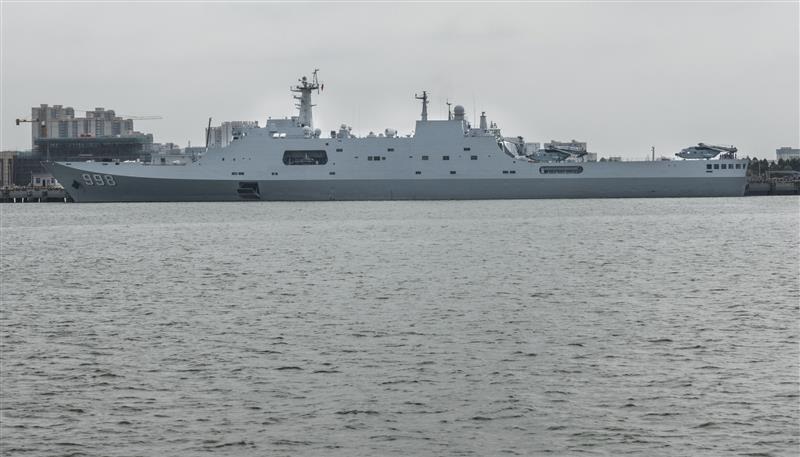
Central to this push for more capable amphibious assault ships is the Type 071 (Yuzhao)-class amphibious assault ship programme, which was established to replace the PLAN’s Type 072 (Yukan)-class landing ship tanks (LSTs).
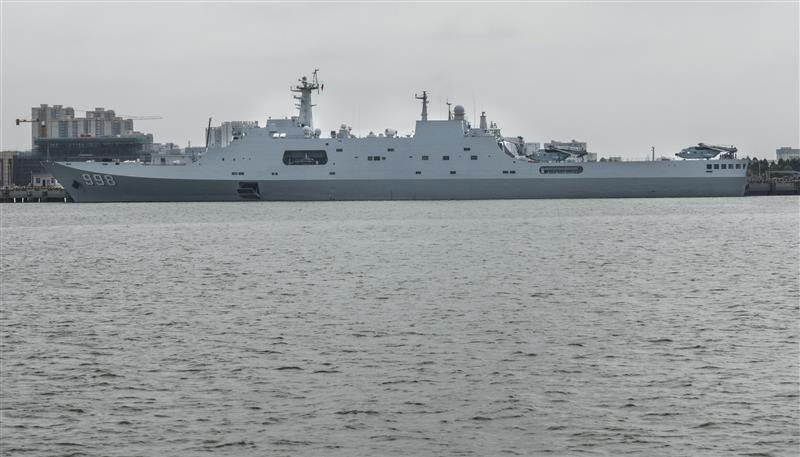
Image caption: Kunlun Shan (998) is the lead ship of China's Type 071 amphibious transport vessels.
The Type 072 LSTs were a workhorse for the PLAN in terms of amphibious transportation operations. Incidentally, China stopped building more Type 072 vessels in the mid-1990s, around the time of the Taiwan Strait crisis.
The Type 071 has an estimated length of 210 m, a displacement of 18,500 tonnes, and a well-deck capable of holding four Yuyi-class assault hovercraft.
Should there be no requirements to accommodate the hovercraft, the Type 071 is estimated to be able to accommodate up to about 60 armoured vehicles and about 800 troops. This is a massive improvement compared with the payload capacity of the Type 071, which can embark up to 10 armoured vehicles.
The Type 071 is also more heavily armed compared with the Type 072. The former is equipped with a 76 mm main gun, four 30 mm guns, and an AK-630 close-in weapon system (CIWS) to repel aircraft. In comparison the Type 072 is equipped with smaller calibre weapons and is not equipped with CIWS turrets.
The vesselʼs well-deck configuration enables the launch and recovery of landing craft and amphibious vehicles, such as the ZBD-05, in various sea conditions.
Its stern helicopter deck has two landing spots, each supporting a Harbin Z-8 helicopter, providing vertical lift capabilities that complement waterborne assault operations. This dual-capability approach allows commanders to conduct simultaneous vertical and horizontal envelopment operations.
Furthermore, the Type 071s are powered by four diesel engines with two controllable pitch screws, enabling a top speed of 25 kt and a cruising range of 10,000 n miles at 18 kt. This endurance allows the PLAN to conduct extended operations, which is a critical requirement for operations across the Taiwan Strait or in the South China Sea.
Thus far, eight Type 071 vessels have been constructed. The class has participated in numerous exercises and deployments including in operations across the Gulf of Aden, the Mediterranean Sea, and throughout the South China Sea, validating its design and operational concepts.
Satellite images indicate that China has also deployed one of its Type 071 vessels, third-of-class Changbai Shan, to the newly constructed deepwater pier at Cambodiaʼs Ream Naval Base.
China has yet to commission more Type 071 vessels after 2020, and it appears that the programme has stopped in favour of a larger, more capable amphibious vessel that can significantly expand the PLAN’s vertical assault capabilities.
Type 075
The Type 075 (Yushen)-class assault ship is essentially a helicopter carrier with a well-deck. Its design appears to have been inspired by several Western amphibious assault ships, particularly the USN’s Wasp-class and America-class landing helicopter docks (LHDs).
This design suggests that China has been studying amphibious operations carried out by the USN and understands the importance of helicopter-borne assault in modern warfare.
The Type 075 has a full-length flight deck for helicopter operations and features a floodable well-deck from which to disembark hovercraft and armoured amphibious assault vehicles. This configuration allows the vessel to discharge more units for simultaneous air and surface operations, increasing the speed and flexibility of amphibious assault operations.
The Type 075 displaces about 35,000 tonnes, and it has an overall length of about 235 m. The vessel has six helicopter landing spots on its flight deck, and it can embark about 30 helicopters in total. Like the Type 071, the Type 075’s well-deck can launch and recover landing craft and amphibious vehicles under various sea conditions.
In terms of its ability to repel aerial attacks, the Type 075 is armed with the HHQ-10 short-range surface-to-air missile system and the H/PJ-11 30 mm CIWS.
To complement these offensive options, the vessel is also equipped with the Type 726 24-barelled decoy launcher that can fire chaffs and infrared flares to counter incoming hostile precision-guided missiles.
At the time of publication, the PLAN has commissioned three Type 075 vessels into service, and the induction of a fourth vessel is imminent. China is believed to have plans for at least four more vessels in the class.
A video that began circulating on Chinese social media site Weibo in March 2024 indicates that the first-of-class Type 075 vessel, Hainan, has embarked at least two Z-20 airframes on its flight deck in addition to three Z-8C helicopters. Digital verification by Janes suggests that these videos have not been manipulated.
The Z-20 is a multirole medium-lift helicopter developed by Harbin Aviation Industry (Group) Company Ltd, which is a subsidiary of the Aviation Industry Corporation of China (AVIC). With an estimated maximum take-off weight of 10 tonnes, the aircraft can accommodate two crew members and about 10 troops in its passenger cabin, and this significantly increases the tempo at which the Type 075 can dispense advanced party troops for amphibious assault operations.
With the qualification of the Z-20, the Type 075 will also have the ability to deploy an anti-submarine warfare (ASW) variant of the helicopter known as the Z-20F. This essentially equips the Type 075 for limited ASW-screening operations.
For more information, please see Feature: China evolves amphibious capabilities with regional implications