China takes a multipronged approach to secure its investments in Myanmar
The recent military gains of the non-state armed groups (NSAGs) in Myanmar are thrusting the Southeast Asian country back into the spotlight. China, which has invested heavily in Myanmar, has found itself in a position of influence over many of the key players in Myanmar’s civil war. While other countries such as neighbours Malaysia and Singapore have resisted or divested investments due to the country’s political instability, China’s continued economic commitment and proximity has put the country in a unique position, increasing Myanmar’s reliance on Chinese investments and the latter’s influence as a result of its high risk tolerance and desire to advance regional stability.
Political instability and pressure from human rights groups are pushing countries from both the region and the West to withdraw investments, such as France’s TotalEnergies, Norwegian pension fund KLP, and the United States’ Chevron. This vacuum has consequently, and perhaps inadvertently, left China in the advantageous position of a power broker holding relationships across both sides of the conflict.
China’s main objectives in Myanmar are two-fold, attaining regional stability along the two countries’ shared 2,100 km border and preserving Chinese investments. Securing China’s investments in Myanmar furthers China’s strategic interest in accessing the Bay of Bengal via the China-Myanmar Economic Corridor (CMEC).
As China has evolved from investor to mediator, the Chinese government is taking a three-pronged approach to maintain and increase influence in Myanmar through military engagement, economic leverage, and political authority. This analysis will focus on China’s economic leverage and political authority in Myanmar.
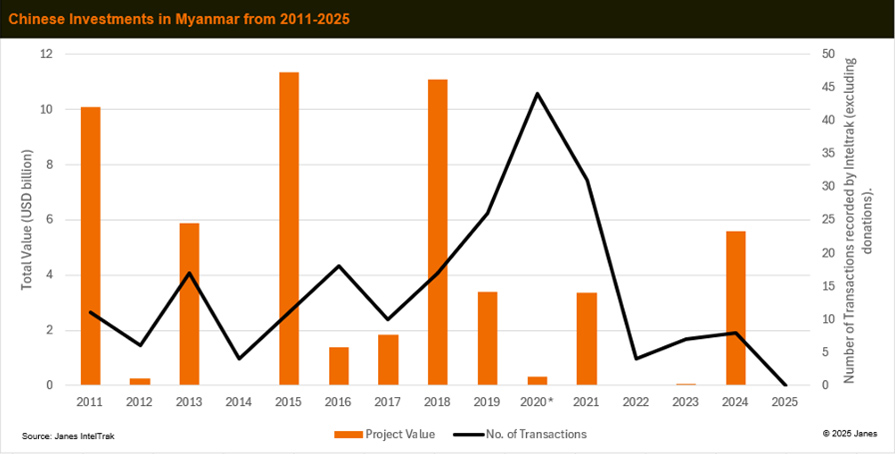 Image caption: In 2020, multiple solar power plant projects were announced (with unknown value), which were later cancelled by the Myanmar junta due to breach in tender regulations.
Image credit: Janes IntelTrak
© Janes
Ramifications for Chinese investments
It is almost certain that in the next three to six months China will continue protecting its strategic interests in Myanmar by engaging with both the junta and NSAGs. This goal aligns with the objectives of the junta and NSAGs that see Chinese investment as critical to Myanmar’s future.
Despite the ongoing civil war, China has not shuttered projects or withdrawn investment, granting it access to natural resources and investment opportunities that other countries deem too risky, and creating economic leverage. In 2024 Janes IntelTrak noted USD5.6 billion in Chinese investments that were announced in Myanmar, including the resumption of the New Yangon City project and a USD2 billion liquified natural gas (LNG) terminal in Myanmar.
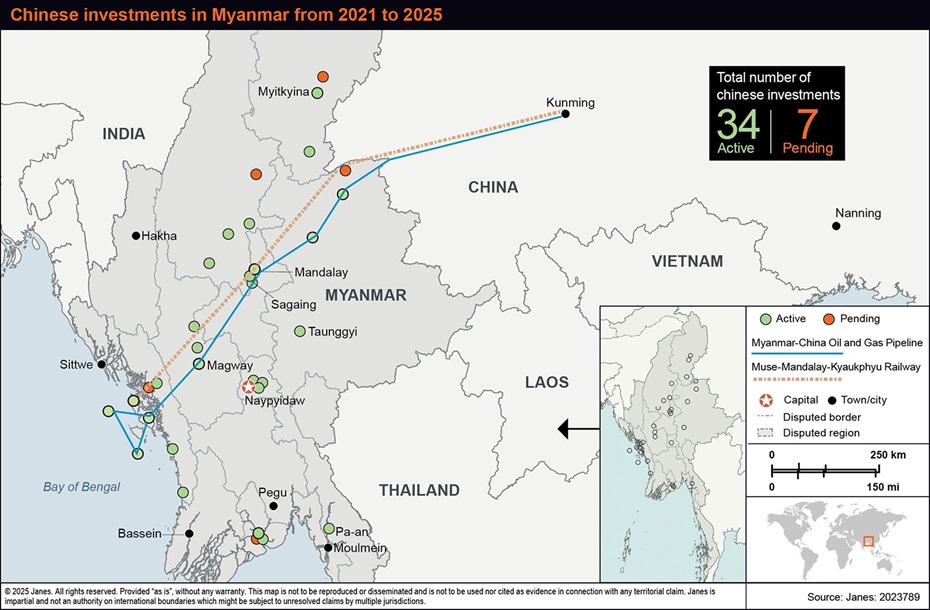
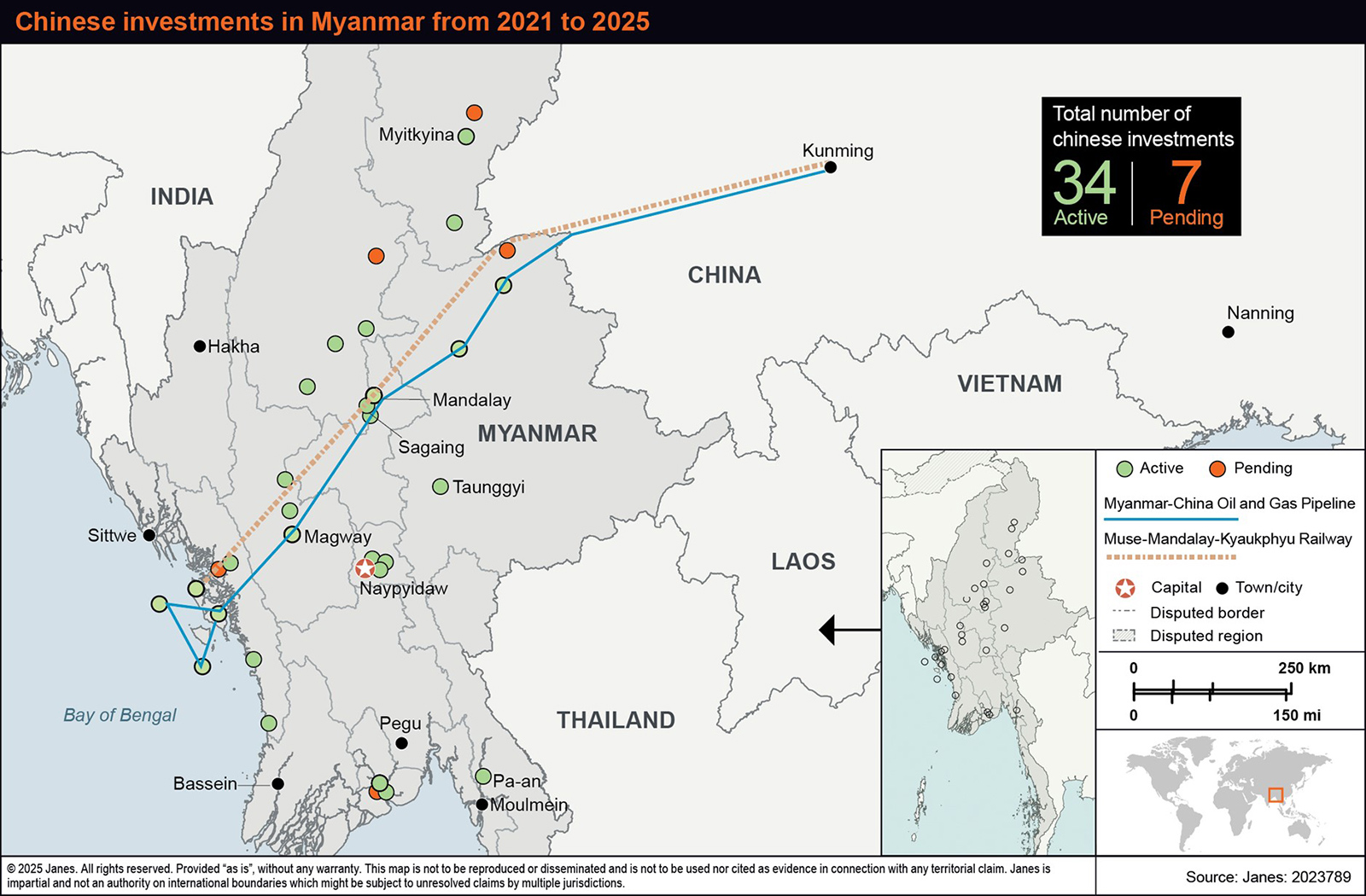 Image caption: Chinese investments in Myanmar from 2021 to 2025
Image credit: Janes
© Janes
According to Janes IntelTrak data as of May 2025, China has a total of 41 active and inactive projects in Myanmar. Since 2021 China’s investments in Myanmar are primarily concentrated in the defence, energy, mining, and construction industries, in addition to providing humanitarian aid. During the same period, China introduced 15 new projects, seven of which have not advanced beyond the original announcement, very likely due to regional instability. The few projects that have moved forward include the USD2.5 billion LNG power plant being developed by Zhefu Holding Group and three solar power projects managed by PowerChina Resources, for which the Myanmar military signed a power purchasing agreement in November 2023.
According to Janes Central Events data from January 2024 to March 2025, there were 166 attacks by NSAGs on junta security forces and vice versa impacting Chinese investments either directly or indirectly. Chinese projects were directly targeted 22 times in the above-mentioned period by the NSAGs, especially by the People’s Defence Forces (PDF), which concluded with the PDF taking control of multiple Chinese projects.
| The PDF was formed in 2021 as an armed wing of the National Unity Government with an aim of fighting the junta and overthrowing the State Administration Council (SAC). The PDF collaborates with a variety of ethnic armed organisations (EAOs) and operates across multiple parts of Myanmar. |
Janes assesses that the constant attacks threaten the approximately USD4.4 billion invested by Chinese companies. Many of the direct attacks, noted in the map below by the orange and green marks, occurred on the Monywa-Mandalay road near the mining town of Monywa, where the Wanbao Mining Company’s operations are located. The copper mining operation has been consistently interrupted by the PDF that is targeting junta soldiers responsible for providing security to the mining operations and in turn, impacting the copper trade.
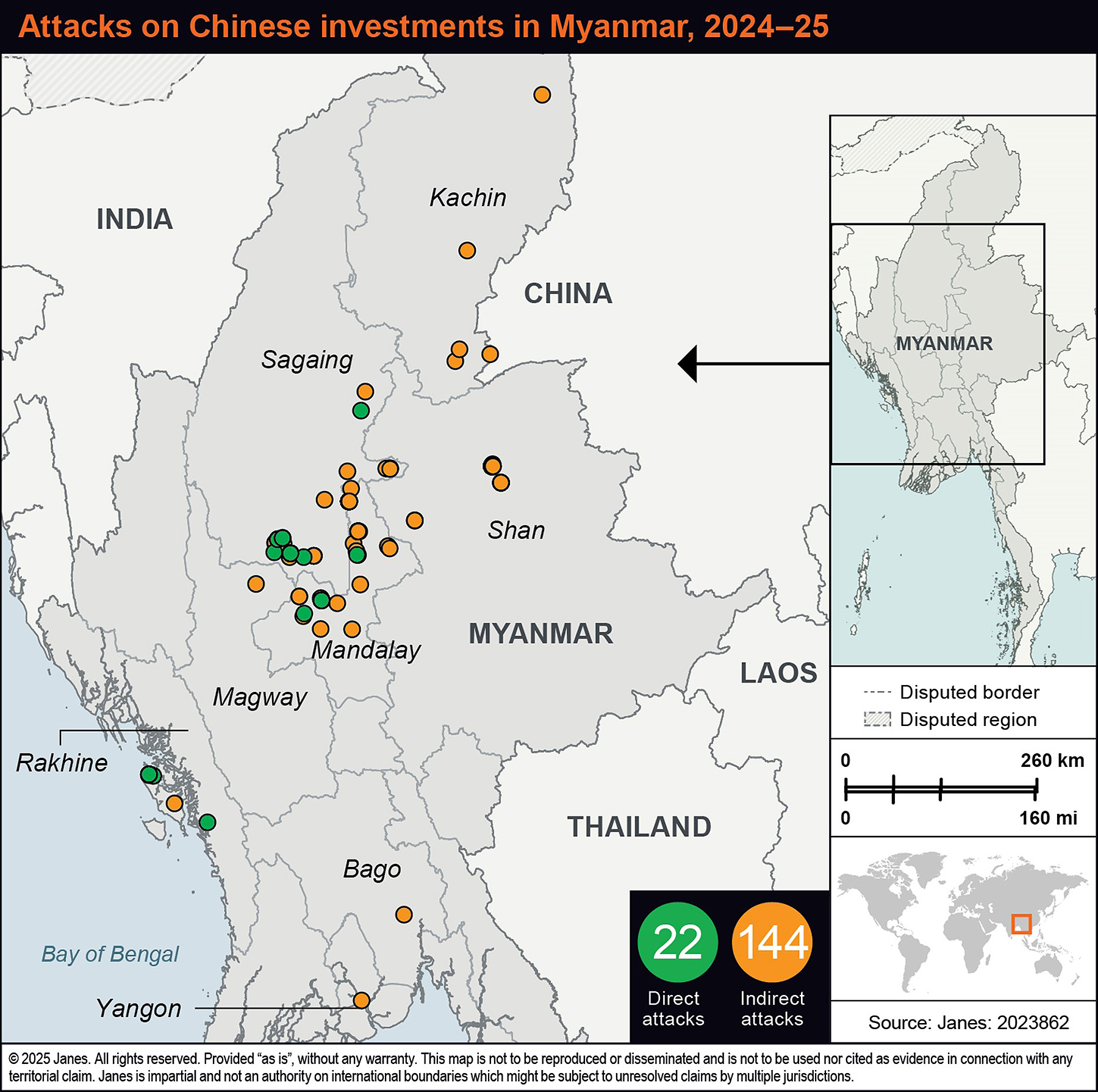 Image caption: Attacks on Chinese investments in Myanmar, 2024–25
Image credit: Janes
© Janes
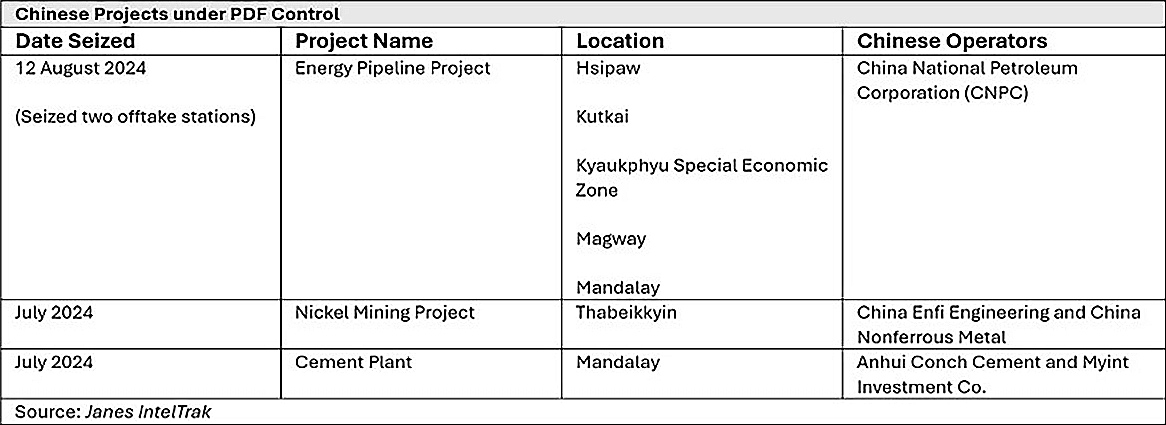
Image caption: Chinese Projects under PDF Control.
Image credit: Janes IntelTrak
© Janes
On the other side of the country, in Myanmar’s westernmost state of Rakhine, home to China’s flagship CMEC project, the Kyaukphyu Special Economic Zone (SEZ) and port have fallen under control of the junta. According to Radio Free Asia, the Arakan Army (AA) captured 14 of the 17 townships from Myanmar’s military including the western command headquarters in Ann township. The SEZ and port are under junta control at the time of publication.
| The AA, formed in 2009 in Myanmar’s western Rakhine state, is an ethnonationalist separatist group with the aim of obtaining autonomy for the citizens of Rakhine state. The AA is part of the Three Brotherhood Alliance, and mainly targets SAC military positions. |
Janes is certain that conflict along the China-Myanmar border has led to disruptions in border trade with both China and the NSAGs enforcing embargoes to gain leverage over each other. For example, in June 2024 the Myanmar National Democratic Alliance Army (MNDAA), an NSAG, captured Lashio, the largest city of Shan state and a gateway to China. However, as part of a China-brokered agreement, in April 2025 the MNDAA agreed to relinquish control of Lashio to the junta just six months after capture following threats of airstrikes from the junta and a commercial blockade by China.
| The MNDAA, formed in 1989 in Myanmar’s Kokang region, is an armed resistance group with an aim of maintaining control over the Kokang region. It is a part of both the Three Brotherhood Alliance and the Northern Alliance and mostly targets SAC military positions. |
With the military controlling only 21% of Myanmar, according to a November 2024 assessment by the BBC, threats to Chinese investments have intensified as the junta continues to lose territory. China now likely believes that the overstretched Myanmar military can no longer protect its interests in the country, indicated by Beijing choosing to step in with the establishment of its own security company and broker ceasefire talks between the NSAGs and the junta.
To read more, please see China takes a multipronged approach to secure its investments in Myanmar