China very likely to balance coercive rhetoric against Taiwan with positive messaging to manage escalation in 2026
Intelligence question
Is China going to invade Taiwan in the next six to 12 months? Is China promoting narratives to justify military action against Taiwan and prepare its population for war?
To answer these questions, the warning intelligence report focuses on the following essential elements of information:
- Is China actively calling to remove the Taiwanese government?
- Is China calling to protect ‘Chinese’ citizens in Taiwan?
- Is China promoting a narrative that dehumanises Taiwanese citizens?
CPC narratives regarding Taiwan
In the February 2026 report, Janes assessed the Chinese war rhetoric indicator as ‘moderate’, following an assessment of ‘high’ in the June 2025 assessment. Between January and December 2025, Janes observed an increase in hostile rhetoric regarding Taiwan in People’s Liberation Army (PLA) communications, while political authorities adopted a harsher tone against third parties supporting Taiwan, including Japan.
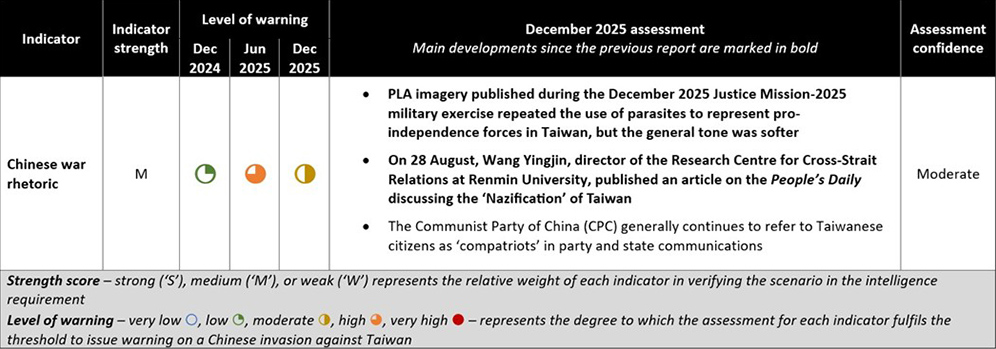 Indicator assessment, Image credit: Janes
However, a sustained promotion of persuasion-focused narratives from the Communist Party of China (CPC), focusing on peaceful integration and referring to Taiwanese citizens as ‘compatriots’ has also continued. Janes assessed that the warning level for this indicator was ‘moderate’ because party, state, and military outlets lowered the tone and avoided broad, dehumanising narratives.
Coercion-focused messaging
Janes assesses that the CPC’s coercion-focused messaging about Taiwan has the double objective of:
- Undermining Taiwanese resistance to unification
- Dissuading third actors from providing support to Taiwan – diplomatically, economically, and militarily.
Since 2022 CPC authorities have become more assertive in their promotion of negative messaging, with an increasingly hostile and militarised tone in direct and indirect statements about Taiwan. Janes assesses that these narratives fall into three categories:
- Presenting unification as inevitable
- Presenting pro-independence forces as a liability for Taiwan
- Threatening third parties with punishment if they support Taiwanese independence.
In 2025 coercion-focused narratives intensified, including the publication by the PLA of videos dehumanising Taiwanese President William Lai Ching-te and those the CPC perceives as supporting Taiwanese independent. Janes identified this as a key indicator to track in the second half of the year.
However, between July and December 2025 there were no further communications signalling a dehumanisation of Taiwanese citizens and political actors. Janes assesses that this indicates a political decision to avoid the most extreme coercion-focused narrative, and a lack of endorsement of this sort of narratives, which initially the PLA published, by the civilian leadership of the CPC.
Key narrative 1: Unification is inevitable, and any attempt to prevent unification will lead to war
Objective: Threatening the use of force to undermine support for independence and make options other than unification less desirable.
Audiences: Taiwanese population (primary); Chinese population and international audiences (secondary).
Implementation: The CPC conveys this narrative through direct and indirect methods. Direct methods include explicit statements from party and state agencies, which officially communicate China’s readiness to use force to unify Taiwan if necessary. These statements are also included in doctrine and white papers.
Indirect methods focus on conveying the increasing readiness and capability of PLA forces to launch a military operation against Taiwan. The PLA implements this narrative through clear communication campaigns regarding the commissioning of new platforms – such as the Type 003 Fujian aircraft carrier – troop training and drills in the Eastern Theater Command (ETC), and a more evident targeting of key Taiwanese infrastructure in military exercises.
Examples:
- On 2 April 2025, a commentary on the People’s Daily stated that “Taiwan independence and peace are incompatible, and Taiwan independence means war”
- On 24 July 2025, Zhu Weidong, head of the Institute of Taiwan Studies of the Chinese Academy of Social Sciences – a think tank directly under China’s State Council – stated in an article on the People’s Daily that inciting cross-strait confrontation would lead to “disaster and destruction for Taiwan”
- On 31 December 2025, President Xi Jinping stated that “the reunification of our motherland, a trend of the times, is unstoppable!” in his 2026 New Year message
Key narrative 2: Pro-independence actors are acting against Taiwanese interests
Objective: Coerce Taiwanese leadership to accept Chinese narratives by eroding the standing of Taiwanese political actors who refuse unification and justifying punitive action.
Audiences: Taiwanese leadership and population (primary); Chinese citizens and international audiences (secondary).
Implementation: The CPC pushes this narrative through reactive statements to Democratic Progressive Party (DPP) and Taiwanese government actions, using press conferences and state agencies to attempt to erode the legitimacy of Taiwan’s political leadership. Within China, official outlets give voice to strong critics of Taiwan, gradually promoting a narrative where Taiwan’s authorities are a threat to Taiwan’s wellbeing.
Janes assesses that the CPC also uses non-official channels to promote this narrative, including state-nexus threat actors. Through cyber activity such as the use and proliferation of bots in social media, China-based actors, which Janes assesses to be working with the support of and very likely under the direction of the CPC, promote narratives, often false, to undermine the legitimacy of DPP authorities.
Examples:
- On 28 August 2025, Professor Wang Yingjin, director of the Research Centre for Cross-Strait Relations at Renmin University, authored a piece on the People’s Daily stating that the DPP prioritised “party interests over those of the Taiwanese people” and that the Lai administration was leading a “green terror” campaign, “undermining Taiwan’s democratic rule of law”. Wang presented this as evidence of a “dangerous trend of gradual Nazification of pro-independence forces”.
- On 25 October 2025, at 80th Anniversary of Taiwan’s Restoration, fourth-ranked member of the Standing Committee of the Politburo of the CPC and chief party ideologue Wang Huning repeated that pro-independence activities were fundamentally opposed to the “interests and feelings of Taiwan compatriots”.
- On 18 December 2025, Ministry of Foreign Affairs spokesperson Guo Jiakun accused the DPP of turning Taiwan into a “powder keg” following the US’ announcement of arms sales for a total value of USD11 billion to Taiwan. At a press conference on the same day, Taiwan Affairs Office spokesperson Chen Binhua also used the “powder keg” expression and accused the DPP of using the Taiwanese people as “cannon fodder” for independence.
- In December 2025, the ETC of the PLA included imagery depicting pro-independence forces as parasites as part of the communications campaign of the Justice Mission 2025 military exercise
Key narrative 3: Recognising China’s sovereignty over Taiwan is a pre-condition for smooth bilateral relations
Objective: Deter third actors from providing support to Taiwan, contributing to the international isolation of Taipei and reducing Taiwan’s resources to resist unification, including a potential invasion.
Audiences: International audiences (primary); Taiwanese leadership (secondary).
Implementation: The CPC leadership implements this narrative through a dual strategy of official political and diplomatic statements, and punitive action. Official statements are reactive to the action of third parties, but also proactive, as China consistently seeks to include the CPC’s position on Taiwan as a pre-condition to bilateral agreements with other countries.
Punitive action often takes the form of restrictions on trade, investment, and freedom of movement, as the CPC very likely seeks to leverage the volume of China’s economy and population to increase pressure on the target country.
Examples:
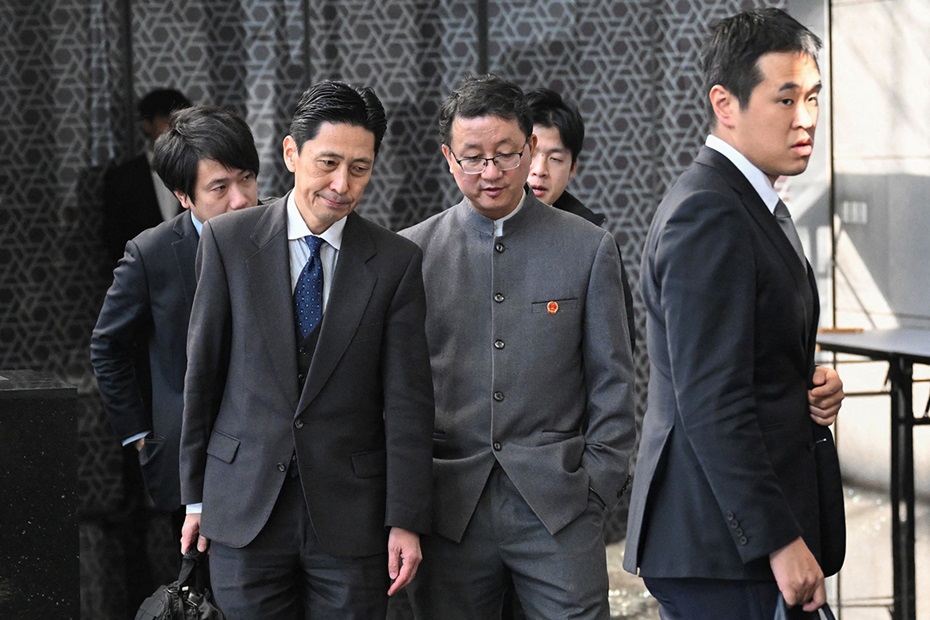
- On 7 November 2025, Japanese Prime Minister Sanae Takaichi stated that a Taiwan contingency would qualify as a survival-threatening situation for Japan, which would constitutionally allow the Japan Self-Defense Forces to intervene. China issued formal protests, summoned the Japanese ambassador, and official outlets published strong messaging against Takaichi and her government
- In November and December 2025, China added several measures to official political statements, including an official travel alert against visiting Japan, the suspension of more than 40% of flights from China to Japan, the suspension of Japanese seafood imports, and the increase of China Coast Guard and aircraft patrols around the disputed Senkaku/Diaoyu Islands.
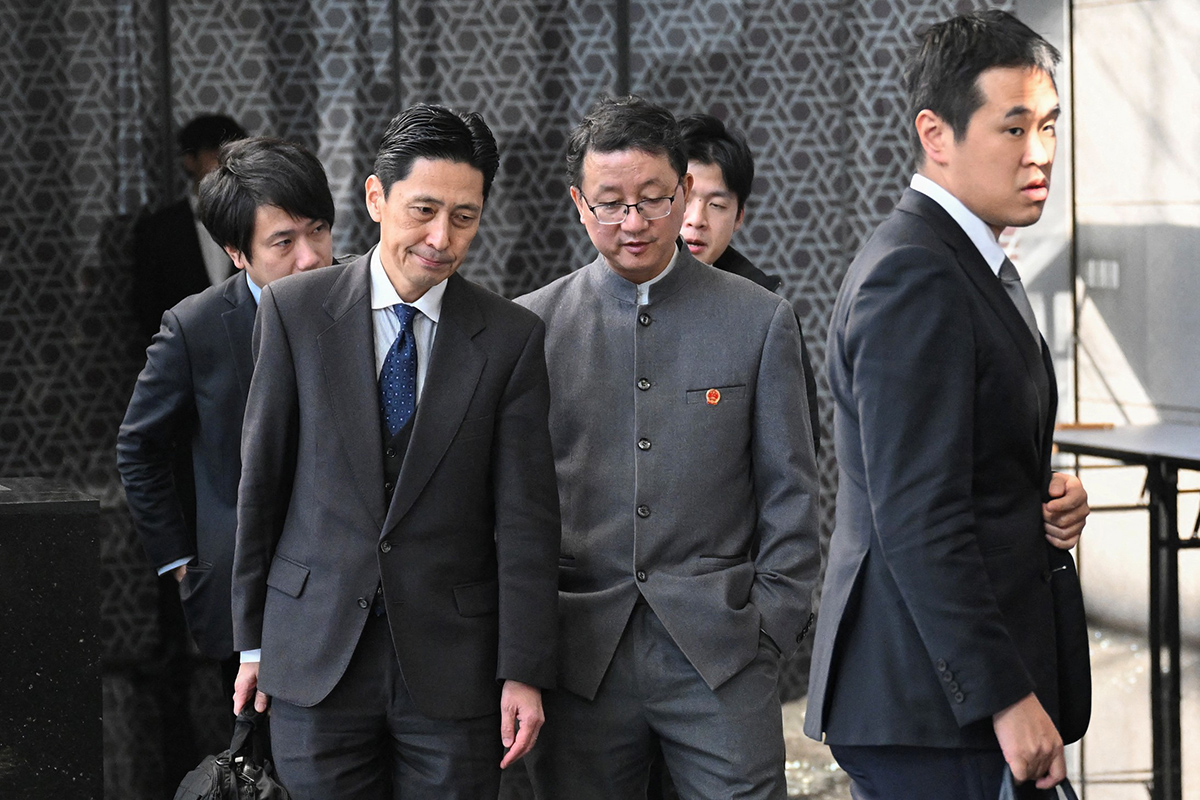 Japanese Director-General of the Foreign Ministry's Asian and Oceanian Affairs Bureau Masaaki Kanai (L) and Chinese Director-General of the Department of Asian Affairs Liu Jinsong (C) depart after a meeting at the Foreign Ministry in Beijing on 18 November 2025, amid a diplomatic row over Japanese Prime Minister Sanae Takaichi's comments on Taiwan. Image credit: Pedro Pardo/AFP via Getty Images
Persuasion-focused messaging
State and party agencies at all levels in China also rely on positive messaging to persuade the Taiwanese population that unification is in their best economic, social, and cultural interests. This is a key element in achieving peaceful unification, which necessitates a willing Taiwanese population to materialise. Positive narratives focus on national unity and shared history, respect for Taiwan’s values and way of life, and the alleged material benefits following unification.
In 2025 the CPC has intensified the implementation of persuasion-focused narratives, focusing on the alleged material and energy security benefits of peaceful unification. Core narratives, including the unity of the ‘Chinese nation’ and the alleged respect for Taiwan’s way of life, have also continued. This long-standing messaging has failed to persuade the Taiwanese population, with surveys on national sentiment showing a consistent decrease in ‘Chinese’ feeling. Janes assesses that the negative sentiment linked to China’s coercive approach and a strong perception of separated identity weigh against any potential positive effect of unification.
In addition, Janes assesses that, as of March 2026, economic arguments are unlikely to gain support in Taiwan – although the Chinese economy grew at 5% in 2025, this confirmed a deceleration trend. In contrast, Taiwan’s economy beat expectations over the same period, reaching a 15 year high of 8.63%, according to Taiwan’s Directorate-General of Budget, Accounting and Statistics (DGBAS).
Key narrative 1: Citizens on both sides of the Taiwan Strait are all members of the Chinese nation
Objective: Promote the idea of cultural, ethnic, historical, linguistic, and social unity between the populations of China and Taiwan; and counter claims of Taiwanese singularity.
Audiences: Taiwanese population and Chinese population (primary); international audiences (secondary).
Implementation: References to unity are constant and permeate and sustain the CPC’s approach to Taiwan. The most common representation of this narrative is the consistent use of the word “compatriots” (in Mandarin tongbao 同胞, lit. ‘same womb’) to refer to Taiwan’s citizens. This implies that the CPC sees the populations in the People’s Republic and Taiwan as members of the same family, and analogies to unchangeable family and blood links are often part of CPC communications about Taiwan.
Examples:
- On 25 October 2025, China established the Taiwan Recovery Day, to commemorate Wang Huning who emphasised that “compatriots on both sides of the Strait are one family”
- On 31 December 2025, during his New Year’s Eve speech, Chinese President Xi Jinping declared that “We Chinese on both sides of the Taiwan Strait share a bond of blood and kinship” and referenced to the establishment of the Taiwan Recovery Day on 25 October as an “indelible memory” of the year.
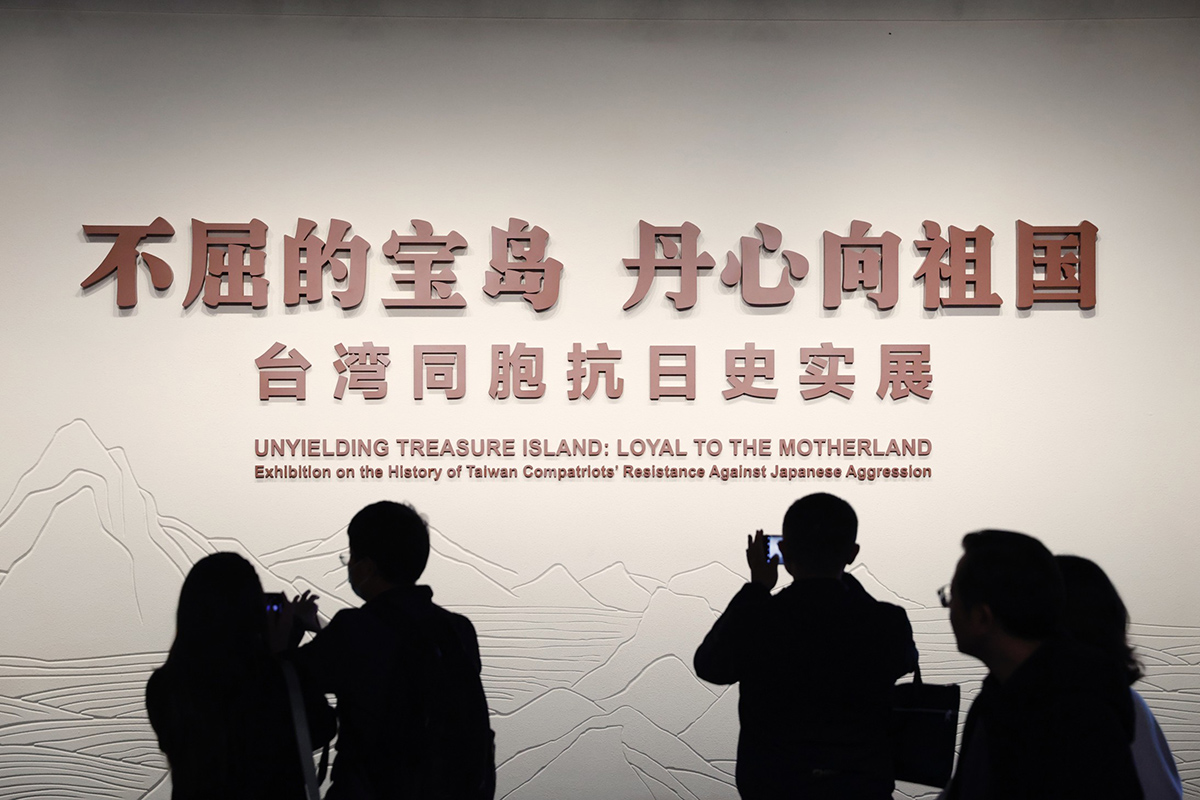 People visit the exhibition. Image credit: Han Haidan/China News Service/VCG via Getty Images
Key narrative 2: China pursues peaceful unification, respecting Taiwan’s system and way of life
Objective: Persuade the Taiwanese population that the CPC would respect Taiwan’s liberal democratic system in case of unification, addressing Taiwanese fears of an imposition of CPC systems.
Audiences: Taiwanese population (primary); international audiences (secondary).
Implementation: The CPC pushes this narrative in official statements and white papers, consistently advocating for replicating Hong Kong’s ‘One Country, Two Systems’ approach in Taiwan. Given that the CPC has no real power over Taiwan’s political and economic systems, China has very limited options to promote this narrative through channels other than advocacy.
However, Janes assesses that the CPC’s approach to Hong Kong is an indirect vehicle for this narrative. Taiwanese voices against unification often use the Hong Kong example as an argument to rebuke China’s claims that the People’s Republic will respect Taiwan’s ‘way of life’, with the 2020 Hong Kong National Security Law and the legal prosecution of Hong Kong businessman Jimmy Lai for sedition and conspiracy to collude with foreign forces very likely undermining China’s ‘One Country, Two Systems’ offering.
Examples:
- In October 2025, Xinhua News Agency published a series of commentaries describing a post-unification Taiwan, where “Taiwan’s current social system and way of life will be fully respected … and private property, religious beliefs, and lawful rights and interests will be fully protected”. However, the Xinhua commentaries made clear that politically it would be “patriots administering Taiwan”, which would have a “high degree of autonomy”
- On 25 October 2025, at the 80th Anniversary of Taiwan’s Restoration Wang Huning stated that the CPC will “adhere to the guideline of ‘peaceful reunification and One Country, Two Systems’ … [taking] into account Taiwan’s realities”