China's first public display of nuclear triad signals increasing prioritisation of strategic deterrence capabilities
Intelligence question
- What is the significance of the nuclear systems China displayed in the military parade on 3 September?
- How do these systems fit in China’s nuclear policy, strategy, and ambitions?
- Do these systems indicate that China is likely to change its nuclear policy in the next 12–24 months?
- How is China’s nuclear expansion likely to impact the regional security balance?
Significance
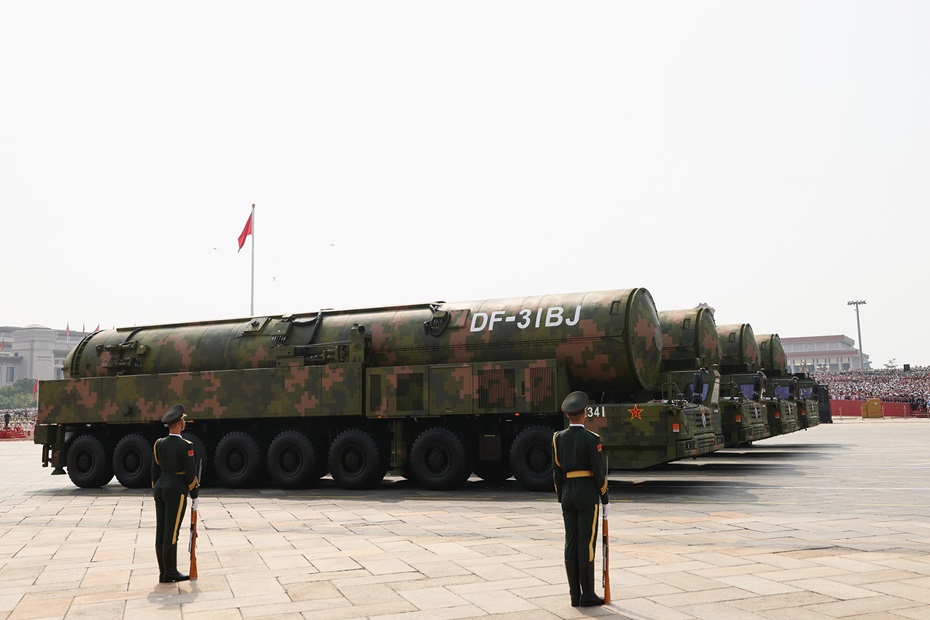
On 3 September China displayed the country’s land-based, submarine-launched, and air-launched nuclear-capable delivery systems at the military parade to commemorate the 80th anniversary of the Victory of the Chinese People’s War of Resistance Against Japanese Aggression and the World Anti-Fascist War, the name the Communist Party of China (CPC) uses to refer to the Chinese resistance against Japan and the Second World War.
The People’s Liberation Army Rocket Force (PLARF) oversaw the Strategic Strike Groups at the parade, which included the First Nuclear Missile Formation and the Second Nuclear Missile Formation. The First Nuclear Missile Formation displayed the newest delivery systems in China’s nuclear triad:
- The Jinglei-1 (JL-1) air-launched ballistic missile (ALBM)
- The Julang-3 (JL-3) submarine-launched ballistic missile (SLBM) with intercontinental range
- The Dongfeng-31BJ (DF-31BJ) and DF-61 land-based intercontinental ballistic missiles (ICBMs).
The Second Nuclear Missile Formation displayed the DF-5C liquid-fuel ICBM, which has a global range, according to a 3 September Xinhua News Agency report on the parade.
For a detailed analysis of the weapon systems included in the military parade, please see Special Report: China’s military parade highlights strides towards modernisation and the Intelligence Briefing On parade: Janes reviews Chinese military technologies.
Completing the triad
The addition of the air-launched JL-1 long-range ballistic missile to China’s existing land-based and submarine-launched missiles means that this is the first time China has displayed its nuclear triad publicly. The CPC almost certainly aims to signal to domestic and international audiences China’s mature strategic deterrence capabilities, which the country’s political leadership links to international standing and national sovereignty. The display of the nuclear triad comes amid the most rapid expansion of China’s nuclear capabilities in its history, including modernising existing delivery systems, developing new systems, and building new silo fields.
According to the Bulletin of Atomic Scientists’ Chinese Nuclear Weapons, 2025 report, as of March 2025 China possessed “approximately 600 nuclear warheads for delivery by land-based ballistic missiles, sea-based ballistic missiles, and bombers”, an increase from the 440 missiles cited in the 2024 iteration. This expansion very likely also includes a shift in the training and testing patterns of the PLARF – on 25 September 2024, the PLARF test-launched an ICBM into the Pacific Ocean for the first time since 1980, which Janes analysts identified as a DF-31AG. PLA imagery confirmed this assessment on 31 July 2025. For a more detailed assessment of the significance of this event, please see China very likely to increase the frequency of ICBM tests following 25 September launch.
This expansion is very likely to respond to the following three rationales:
- China’s nuclear policy commits to No First Use (NFU) and minimum deterrence. However, minimum deterrence is dependent on the adversaries’ capabilities. This implies that an improvement in the opponents’ defence capabilities necessitates an improvement in China’s offensive capabilities to keep deterrence credible and effective. As countries that the CPC considers as potential adversaries – India, the United States, and potentially Russia – continue to improve their missile defence capabilities, China needs to modernise its delivery systems to keep deterrence credible.
- China continues to develop its armed forces, including the strategic forces, aiming to turn the PLA into a world-class military by 2049. This includes the country’s nuclear forces, which benefit from the rapid scientific, technological, and technical changes in China’s armed forces and the political will to display military force. Under President Xi Jinping, the CPC is more confident and assertive internationally, and given China’s international standing, the party leadership is less concerned about the impact of its military strengthening.
- With the addition of the JL-1 ALBM, China becomes one of the few countries to possess a nuclear triad, which adds to its prestige and international standing. However, this symbolism also has domestic effects, allowing the CPC to portray its leadership as successful in placing China among the most advanced countries in all domains.
The nuclear systems in the Strategic Strike Groups in the 3 September parade align with these factors, as modernisations of, or additions to, existing systems. They strengthen China’s second-strike capabilities through higher survivability, domain diversification, and an improvement in accuracy, speed, and penetration capabilities. The nuclear systems displayed, include:
- The land-based DF-31BJ is a silo-based variant of the DF-31 family of ICBMs, and is very likely to be deployed in the new silo fields in Hami (120 silos, Xinjiang province), Yulin (90 silos, Inner Mongolia), and Yumen (120 silos, Gansu). This will help China increase the numbers of its nuclear arsenal with modern missiles, which are very likely multiple independently targetable re-entry vehicle (MIRV)-capable, providing higher survivability and improved penetration capabilities.
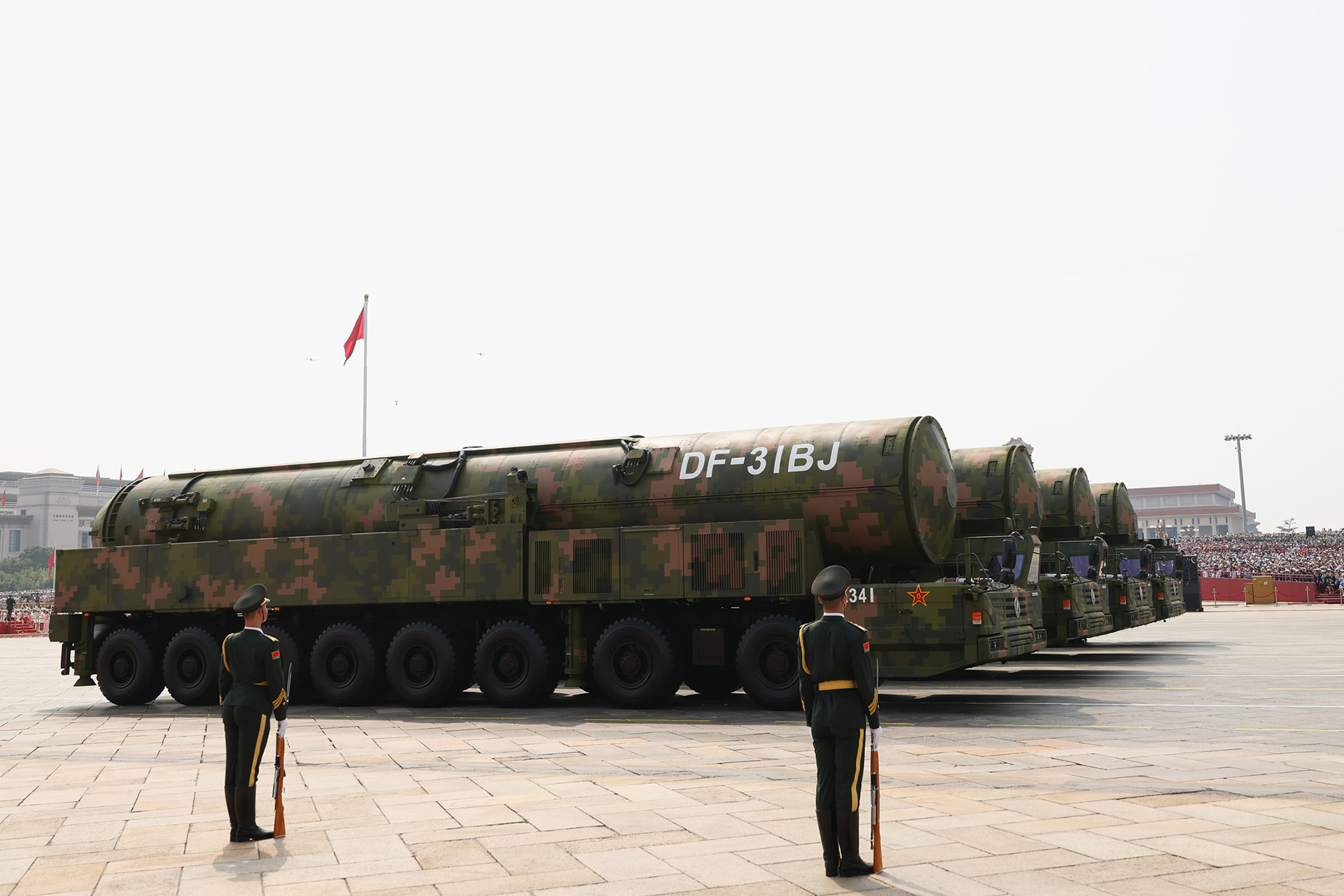 DF-31BJ missiles displayed at Tiananmen Square on 3 September 2025 in Beijing, China, during a military parade marking the 80th anniversary of China’s victory over Japan and the end of the Second World War.
Image credit: Lintao Zhang/Getty Images
- The land-based DF-61 is a new system, very similar to the MIRV-capable, road-mobile DF-41 ICBM.
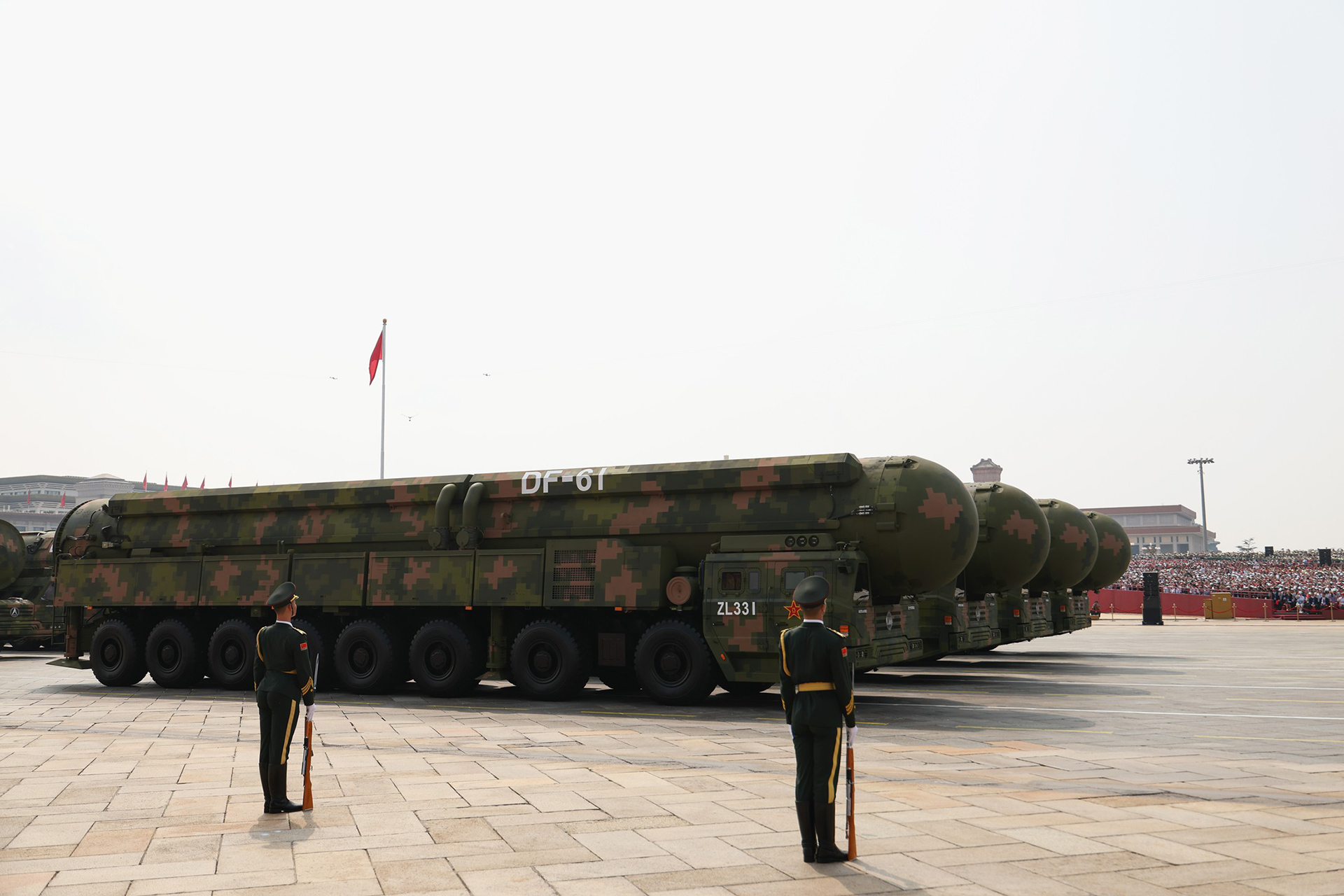 DF-61 missiles displayed at Tiananmen Square on 3 September 2025 in Beijing, China, during a military parade marking the 80th anniversary of China’s victory over Japan and the end of the Second World War.
Image credit: Lintao Zhang/Getty Images
- The submarine-launched JL-3 is China’s newest SLBM, replacing the JL-2 SLBM in the Type 094 Jin-class nuclear-powered ballistic missile submarines (SSBNs). Unlike the JL-2, the MIRV-capable JL-3 has intercontinental range, allowing China’s SSBNs to target the continental shelf of the United States without venturing into the Western Pacific. This increases the credibility and threat of China’s second-strike capabilities. The JL-3 will be deployed in China’s next-generation, quieter Type 096 SSBNs, under development as of 2025, which will substantially improve the survivability of the sea leg of its nuclear triad.
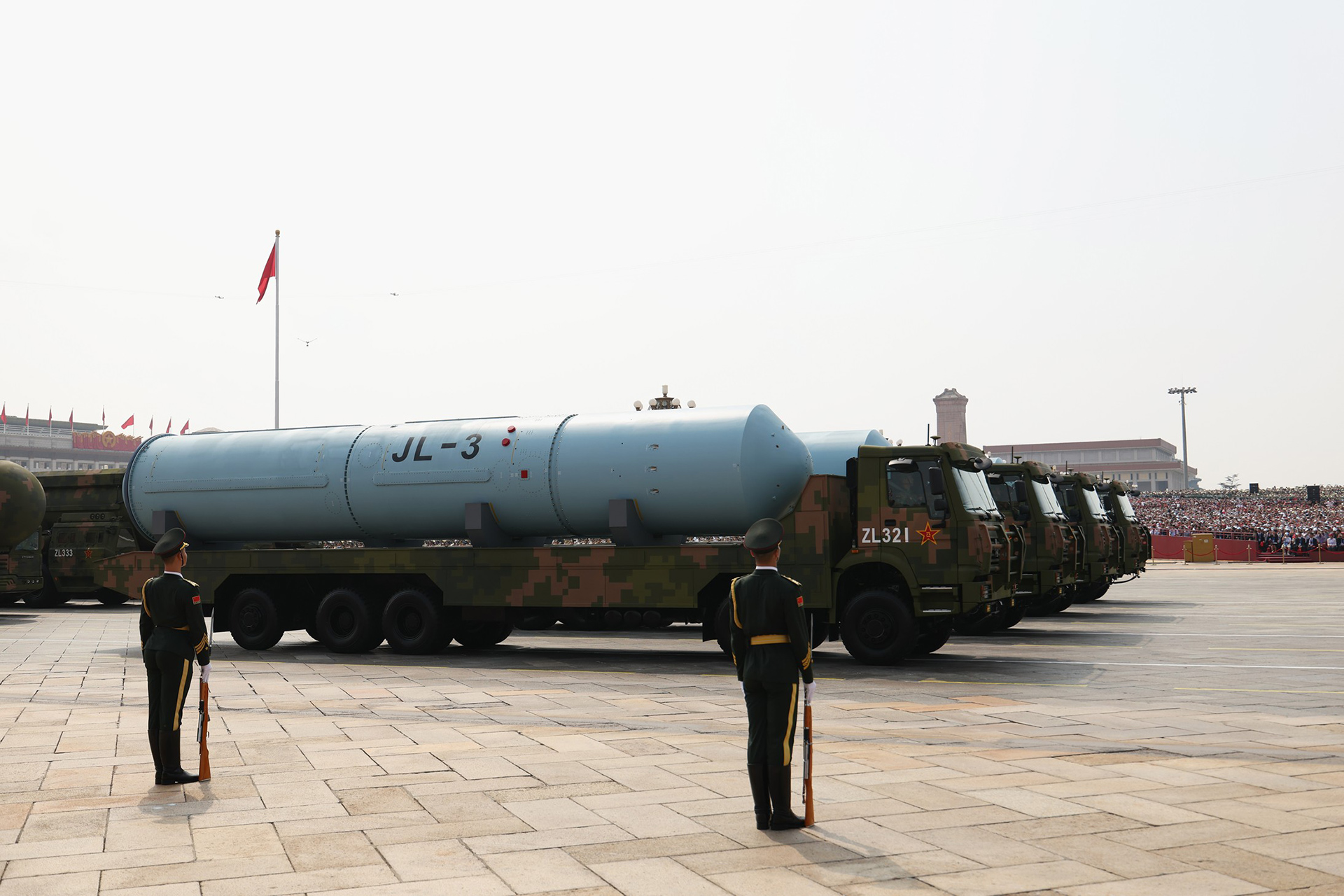 JuLang-3 (JL-3) missiles displayed at Tiananmen Square on 3 September 2025 in Beijing, China, during a military parade marking the 80th anniversary of China’s victory over Japan and the end of the Second World War.
Image credit: Lintao Zhang/Getty Images
- The JL-1 ALBM is China’s first air-launched nuclear missile, very likely to be deployed on the H-6N strategic bomber and the fifth-generation H-20 stealth strategic bomber, currently under development. The H-6N variant allows for air-to-air refuelling to increase its range. Once operational on the H-6N and, particularly, the H-20, the JL-1 will strengthen the mobility, survivability, and penetration capabilities of China’s nuclear forces, benefitting from the electronic countermeasures and other technologies present in the PLA’s latest strategic bombers.
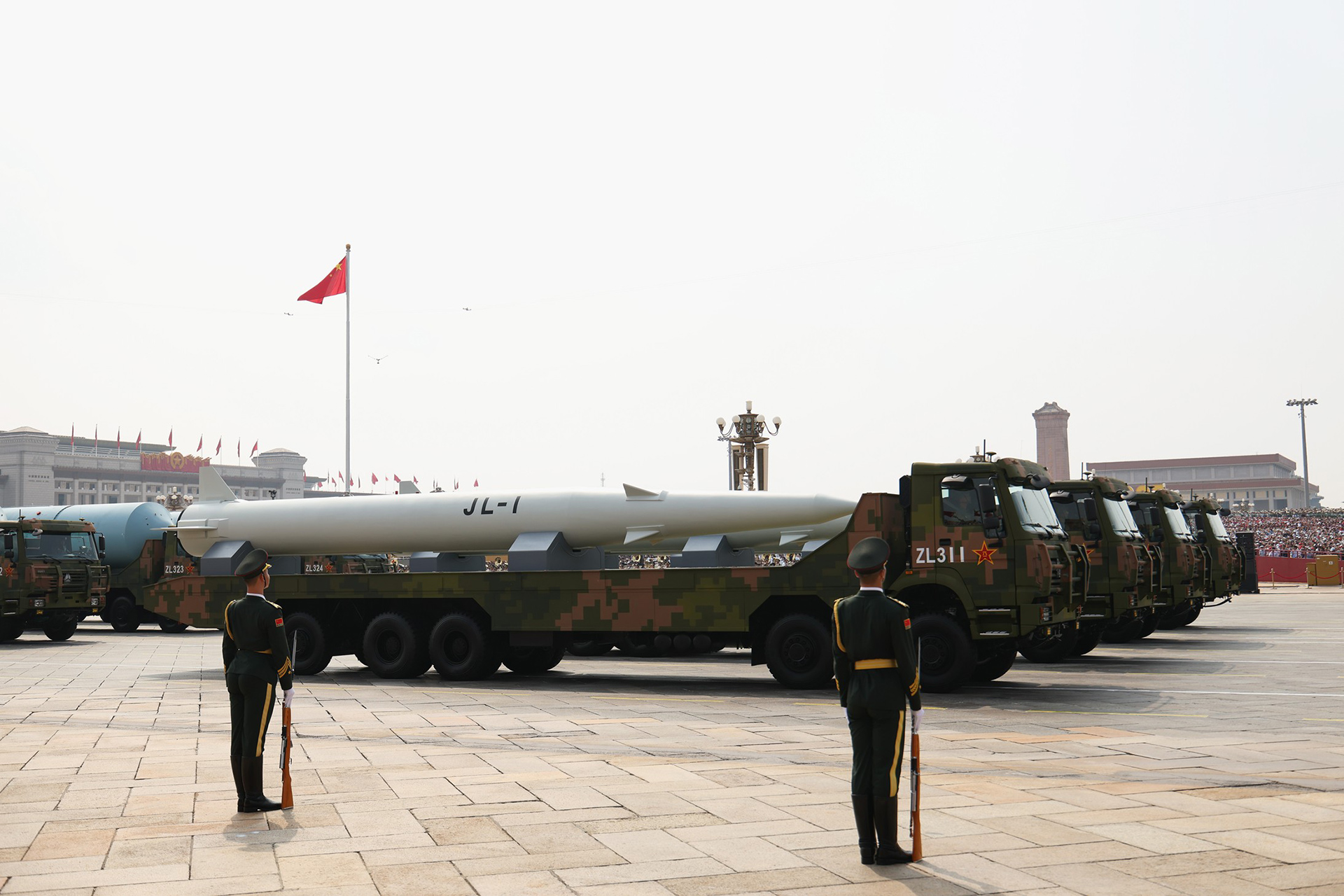 JingLei-1 (JL-1) missiles displayed at Tiananmen Square on 3 September 2025 in Beijing, China, during a military parade marking the 80th anniversary of China’s victory over Japan and the end of the Second World War.
Image credit: Lintao Zhang/Getty Images
- The land-based DF-5C has global range, according to the 3 September Xinhua report on the parade, reinforcing China’s nuclear deterrent. The same report stated that the DF-5C “stands on guard at all times”, likely indicating that this silo-based, liquid-fuel missile is among the first options for a second strike. The DF-5C’s global coverage and multimegaton warhead strengthen the threat and deterrent effect of China’s second strike.
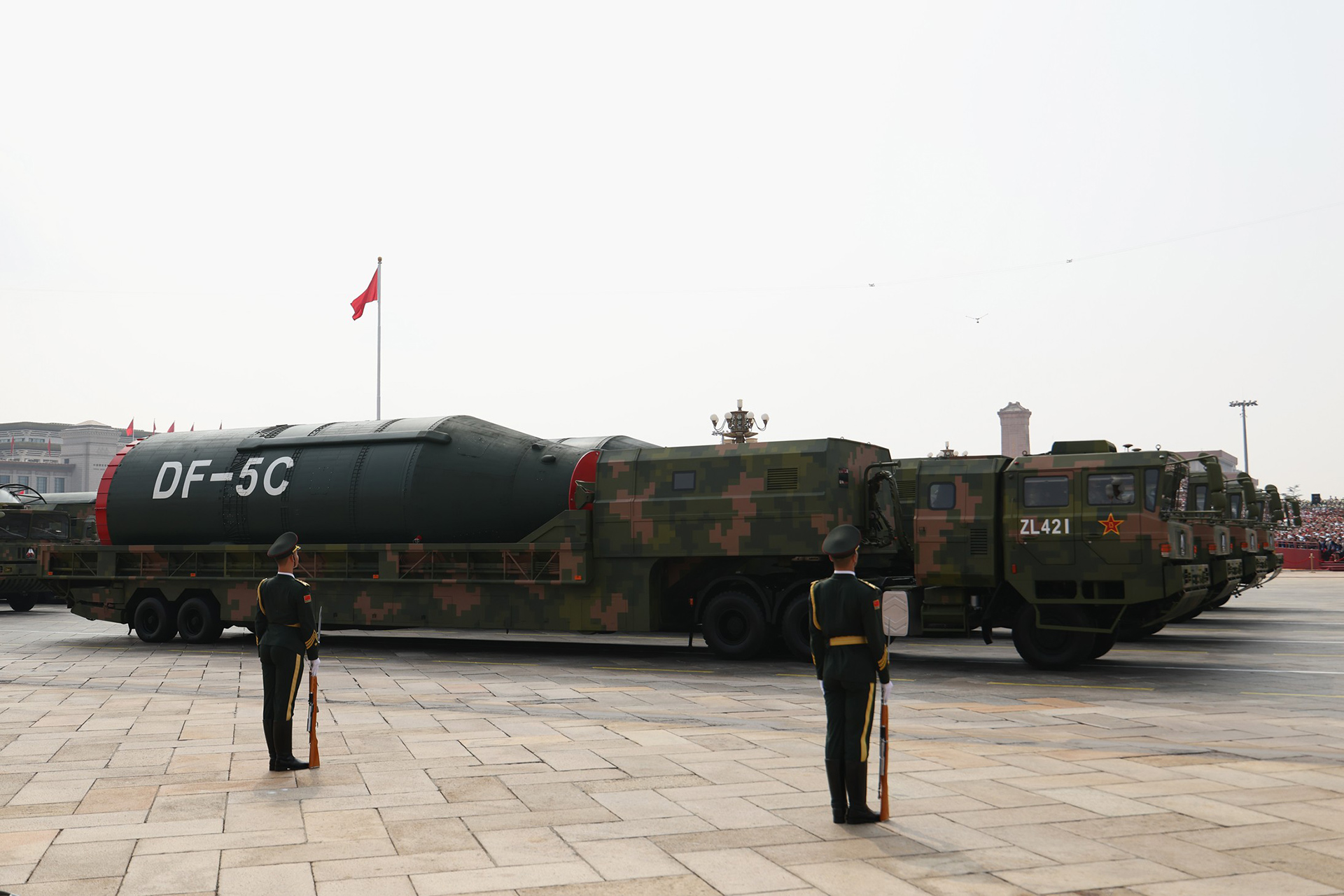 DF-5C missiles displayed at Tiananmen Square on 3 September 2025 in Beijing, China, during a military parade marking the 80th anniversary of China’s victory over Japan and the end of the Second World War.
Image credit: Lintao Zhang/Getty Images
For more information please see: China's first public display of nuclear triad signals increasing prioritisation of strategic deterrence capabilities