China’s hosting of Russia’s Putin, North Korea’s Kim, and 24 other world leaders at military parade indicates will to champion reform of global governance
Event
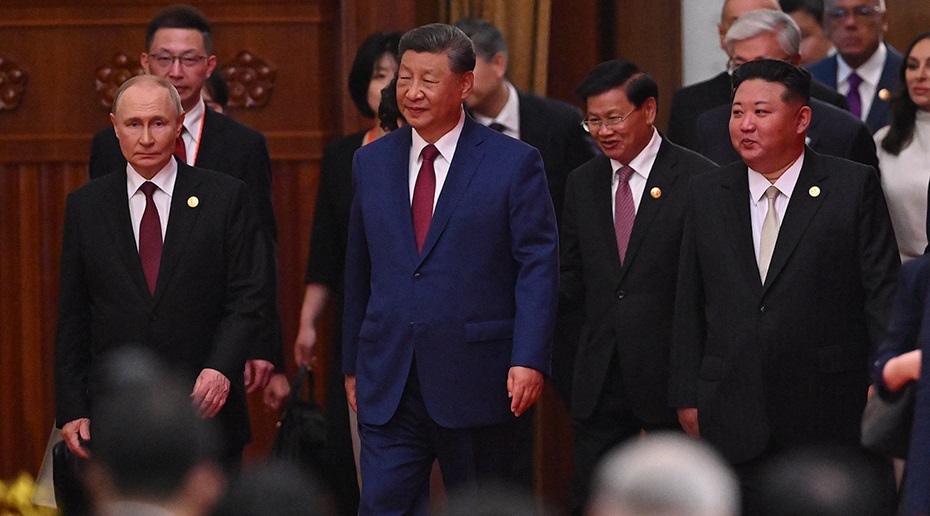
On 3 September, China held a military parade to commemorate the 80th anniversary of the Victory of the Chinese People’s War of Resistance Against Japanese Aggression and the World Anti-Fascist War, the name the Communist Party of China (CPC) uses to refer to the Chinese resistance against Japan and the Second World War. Twenty-six countries sent their head of government or state to the parade, including Russian President Vladimir Putin and North Korean leader Kim Jong-un.
Although in June Kyodo News, Japan’s largest news agency, reported that China was considering inviting US President Donald Trump to the parade, the United States did not send a representative to the event. Most European countries also declined China’s invitation, with representatives of the European diplomatic delegations in Beijing refusing to attend to protest the presence of Putin. The only exceptions were Slovakian Prime Minister Robert Fico, the only European Union (EU) head of state in attendance; Serbian President Aleksandar Vučić; and at a lower diplomatic level, Hungarian Minister of Foreign Affairs and Trade Péter Szijjártó and Bulgarian Deputy Prime Minister Atanas Zafirov. NATO member Türkiye sent two representatives – Minister of Foreign Affairs Hakan Fidan and Minister of Energy and Natural Resources Alparslan Bayraktar. South Korean Speaker of the National Assembly Woo Won-shik also attended the event.
In addition, the secretary generals of the Association of Southeast Asian Nations (ASEAN), the CIS, and the Shanghai Cooperation Organisation (SCO), and the undersecretary general of the United Nations (UN) attended the event.
Significance
This was the first time Chinese President Xi Jinping, Kim, and Putin appeared together at the same event, with Putin and Kim flanking Xi during the parade, and the first time Kim attended a multilateral event. China had announced the Global Governance Initiative (GGI) – China’s proposal to reform global governance – on 1 September, and the CPC leadership very likely intended to use the parade to present China as a champion of the developing world against a US-led world order. Singling out North Korea and Russia among attendees indicates that the CPC attaches more relevance to China’s relations with these two countries, which also see the current international order as built by and for the United States and its allies and partners.
The 3 September parade was the second time China organised such an event to commemorate the end of the war, and there were notable changes in the seniority of attendees. Compared with the 2015 parade, most European and other US-aligned countries – except Hungary, Serbia, Slovakia, and Türkiye – either did not attend or reduced the seniority of their representatives. For example, in 2015 then South Korean President Park Geun-hye attended the parade, while in 2025 it was the speaker of the National Assembly. However, developing countries, and particularly Asian countries, sent higher-profile representatives, including the heads of government or state of all ASEAN countries. The exception included Thailand – currently undergoing a political transition after the removal of Prime Minister Paetongtarn Shinawatra from office on 29 August – and the Philippines, a US ally with ongoing territorial disputes with China.
The parade followed the largest SCO summit in the history of the organisation, held in Tianjin between 31 August and 1 September, where Xi announced the Global Governance Initiative (GGI). The GGI joins the Global Development Initiative (GDI), Global Security Initiative (GSI), and Global Civilisation Initiative (GCI) as the four pillars of China’s proposal to reform the current international order paradigm. Presenting the GGI – which, according to its concept paper, seeks to address the ‘deficit in global governance’ – two days before the parade almost certainly indicates China’s will to present itself as a champion of the developing world and the leader of a new global paradigm that favours multipolarity and challenges the US-led liberal order.
Russia
The Russian leadership shares the perception that the US and its partners and allies dominate and weaponise the existing international order, and the presence of Putin illustrates the geostrategic alignment between China and Russia. This trend is reflected in Beijing’s and Moscow’s co-ordination in multilateral forums such as the BRICS and the SCO and increasing military-to-military co-operation. For example, in August Russia and China held their first joint submarine patrol in the Pacific Ocean. In May Xi attended Russia’s commemoration of the end of the Second World War, where he was a guest of honour, and with People’s Liberation Army (PLA) troops participating in the military parade in Moscow. No Russian or other foreign troops joined the 3 September event in Beijing. However, Putin’s presence is very unlikely to indicate that the CPC fully aligns with the Kremlin and refuses to work with other partners – China had invited European delegations to the parade and, according to Kyodo News, considered inviting Trump.
Xi and Putin held a bilateral meeting on 2 September, where, according to China’s state-owned China Central Television (CCTV) and the official Kremlin statement, the two leaders signed 22 bilateral co-operation agreements in fields such as aerospace, agriculture, artificial intelligence, education, energy, health, public media, and scientific research. Significantly, in a trilateral meeting with Mongolian President Ukhnaa Khurelsukh, the three leaders signed a “legally binding memorandum” for the Power of Siberia 2 gas pipeline and the Soyuz-Vostok transit pipeline, which will allow Russia to export gas to China through Mongolia. However, the meeting did not lead to an agreement on funding and a construction schedule, and it is almost certain that China seeks to take advantage of Russia’s urgency to export gas to obtain better conditions from Russian suppliers.
North Korea
This was the first time Kim attended a multilateral event – in 2015 North Korean member of the Workers’ Party of Korea Politburo Presidium Choe Ryong-hae attended the commemoration event in Beijing. This shift very likely indicates Kim’s efforts to be portrayed as an equal partner to international actors, both to domestic and international audiences. Janes assesses that the early announcement of Kim’s attendance also indicates that he very likely perceives his political standing domestically as being very secure. Kim’s presence meant that Chinese, North Korean, and Russian leaders attended a parade in Beijing for the first time since 1959, when Mao Zedong hosted North Korean leader Kim Il-sung and Soviet Union Premier Nikita Khrushchev at China’s National Day Parade.
Kim and Putin held a bilateral meeting on 3 September 2025 after the event. Kim also held talks with Xi on 4 September, but there were no further details at the time of publication. This was the first time the two leaders had met since June 2019, when Xi led a Chinese delegation in an official visit to North Korea.
Outlook
In the next 12 months, China’s foreign policy and diplomacy are almost certain to adopt a more assertive approach to challenging the US-led international system, aiming to reform existing institutions to favour multipolarity and a greater representation of developing countries. This will almost certainly include continuing to improve and develop co-operation projects with Russia, particularly in the fields of energy, artificial intelligence, and scientific research, capitalising on Russia’s need for manufactured products and international support. Co-operation with Russia will almost certainly also include increasing joint military and law enforcement drills. However, the CPC will seek to avoid portraying this relationship as an anti-Western bloc to avoid further antagonising the European Union and regional US-allied and US-aligned countries such as Japan and South Korea.
In the next 12 months, the CPC leadership will seek to take advantage of the ongoing trade-related frictions between the US and its international partners to improve Beijing’s relations with these countries. China’s foreign policy will very likely focus on seizing the political space left by the US’ retrenchment in the developing world while building on trade opportunities with US partners to mend political frictions. This will include seeking to build momentum with EU members, NATO members, and US allies that have a friendlier approach to China to advance the CPC’s foreign and security policy priorities. China will almost certainly use the narrative of the GGI – sovereign equality, international rule of law, multilateralism, people-centred approach, and practical co-operation – to guide this outreach, particularly to developing countries, and challenge US and Western narratives. However, as China seeks to build better relations with US partners in Asia and Europe, the CPC will prioritise maintaining diplomatic strategic autonomy and avoid fully siding with countries such as Russia and North Korea on issues such as the Ukraine war and the Korean Peninsula, given that these openly challenge and antagonise the US and its partners, particularly on security and defence matters. China will very likely continue to expand military collaboration with Russia, including joint patrols and other activities around Japan and into the Pacific Ocean.
Consequently, China is very likely to use the growing momentum in relations with Russia to empower multilateral forums where both countries have a leading role, such as the BRICS – including BRICS+ – the SCO, and the UN Security Council. In particular, the BRICS and the SCO will very likely benefit from improving diplomatic ties between China and India, leading to a growth in their remit, number and size of agencies, and membership in the next 12 to 24 months. In these multilateral forums, co-operation is likely to focus on practical issues such as development policies, new technologies such as artificial intelligence, and vocational training, with security co-operation almost certain to be limited to anti-terrorism training and joint drills. China will also continue to push for a de-dollarisation of trade between members of multilateral platforms where it has a leading role, but there is almost no chance that this leads to an abandonment of this currency in the next 12 to 24 months.
Risk positive indicators
- China avoids increasing the frequency and size of joint military drills with Russia
- China adopts a more proactive approach to pressuring Russia to stop the aggression in Ukraine.
Risk negative indicators
- China, North Korea, and Russia develop trilateral, security-related co-operation mechanisms
- China and Russia sign defence-related agreements.
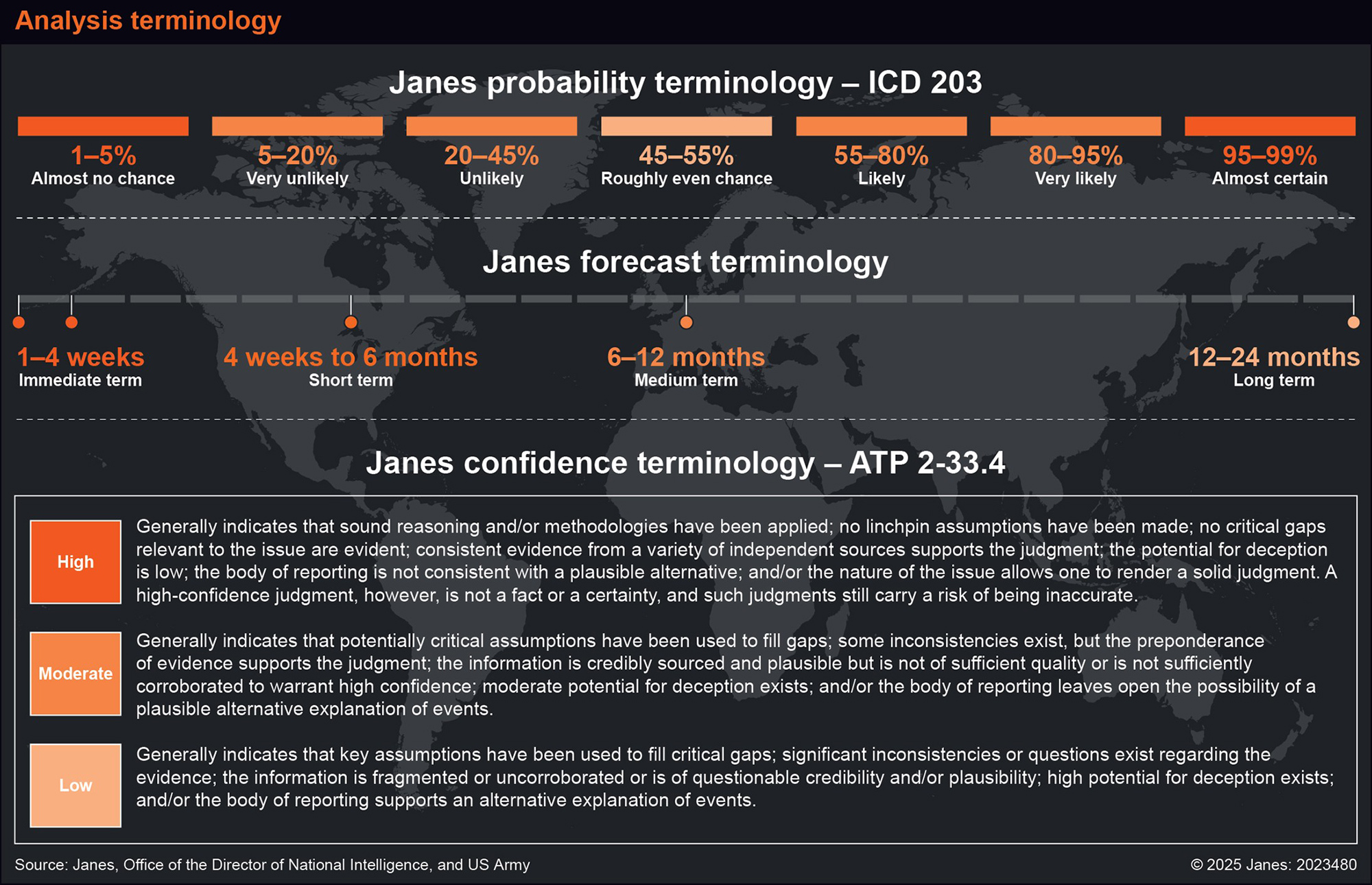 Janes analysis terminology
For more information, please see China’s hosting of Russia’s Putin, North Korea’s Kim, and 24 other world leaders at military parade indicates will to champion reform of global governance