Insight report: China's measures to reduce exposure of key resources to external disruptions likely to undermine deterrence against Taiwan invasion
Intelligence requirement
Is China going to invade Taiwan in the next six to 12 months? What is the level of exposure of China’s key resources (grains and oil) to external disruptions?
To answer these questions, the warning intelligence report focused on the following essential elements of information:
- What is the total volume of China’s grain stockpiles?
- What is the total volume of China’s oil stockpiles?
- What is China’s total oil storage capacity?
- How much grain is China importing and from whom?
- How much oil is China importing and from whom?
In the December 2024 Warning intelligence report, Janes analysts assessed China’s measures to shield grains and oil – key resources to guarantee food and energy security – from external disruptions and sanctions within the ‘Increase in stockpiles of key resources’ indicator. The report noted an expansion of storage facilities; a continued growth in grain and oil stockpiles; a gradual shift to reduce reliance on imports, and particularly on the United States and US-aligned countries; and an ongoing critical exposure to potential international sanctions. This contributed to the indicator’s assessment of moderate warning.
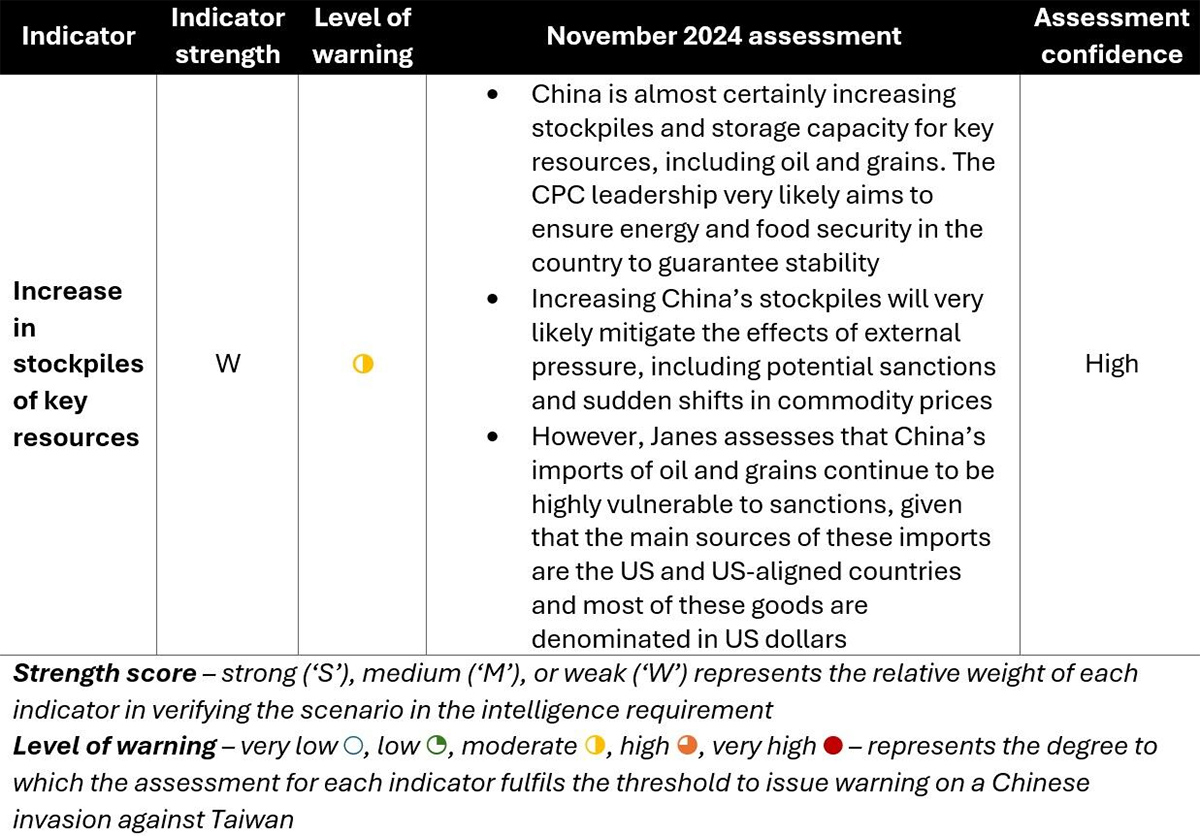 Indicator assessment
Image credit: Janes
© Janes
This deep dive will focus on the measures taken by the Communist Party of China (CPC) to strengthen the country’s energy and food security, the volume of China’s stockpiles, the infrastructure and storage capacity, and those trade relationships instrumental to meet the country’s domestic demand of key resources. The report will also provide an assessment on the most likely outlook for these trends in the next six to 12 months.
Outlook
In the next six to 12 months China will almost certainly continue to be highly vulnerable to disruptions in foreign trade to meet its domestic demand for grains and oil. Although China will very likely continue to replace imports from the US and US-aligned countries, as well as US dollar-denominated exchanges, with those from geopolitically aligned countries and those using local currencies, there is almost no chance that this trend leads to a significant shift in the next 12 months and China will almost certainly continue to rely on US dollar-denominated imports and the US and US-aligned countries to fulfil this need.
In case of forceful action against Taiwan, including a military invasion, this dependency would be a key weakness, which the US would almost certainly have the chance to exploit. Given the CPC’s focus on guaranteeing food and energy security in China as a crucial means to maintain social and political stability, this indicator contributes to the assessment that the CPC will avoid forceful actions against Taiwan in the next six to 12 months.
However, China will also almost certainly develop its domestic infrastructure to expand domestic production and strengthen the country’s capacity to stockpile these key resources, reducing the risk that reliance on foreign markets presents to its food and energy security. The 15th Five-Year Plan, which will cover the 2026–30 period, will almost certainly include these projects as priorities.
It is almost certain that trade tensions with the US and President Donald Trump’s protectionist policies will accelerate this process as the CPC leadership perceives these measures as detrimental to its own economic development. It is likely that tougher restrictions against Chinese trade also exacerbate fears in the CPC that the US will go beyond tariffs and start targeting key resources, increasing the perceived need to shift away from US dollar-denominated trade and partners geopolitically aligned with Washington, DC.
As a result, China is almost certain to further pressure third countries to adopt local currencies as the preferred way to settle trade in the next 12 months. It is very likely that this pressure will focus on oil exporters in the Gulf Cooperation Council, such as Saudi Arabia and Kuwait, but the CPC will almost certainly use bilateral and multilateral mechanisms, such as the BRICS, to maximise the effect of this push.
Key assumptions and information gaps
Key assumptions
- The CPC will prioritise social stability over national reunification
- The CPC assumes that major military action against Taiwan will trigger international sanctions
- The CPC will take measures to mitigate the exposure of key resources to such action before an invasion
- Not all trade partners would enforce sanctions to the same degree, with some countries not enforcing sanctions at all
- The US will not drastically change its position towards Taiwan in the next six to 12 months
- US-aligned countries will remain US-aligned in the next six to 12 months
Information gaps
- Relative relevance of specific grains in China’s food security
- Stockpiles of specific grains
- The CPC’s tolerance to foreign sanctions, including the threshold of ‘critical’ scarcity and inflation
- Volume of China’s oil stockpiles
- Currency denomination of every import
- China's capacity to replace a drastic reduction of imports from the US and US-aligned partners with increased imports from other countries
- China's margin to increase domestic oil production
Level of tolerance in the US and US-aligned countries to the economic backlash of potential sanctions against China
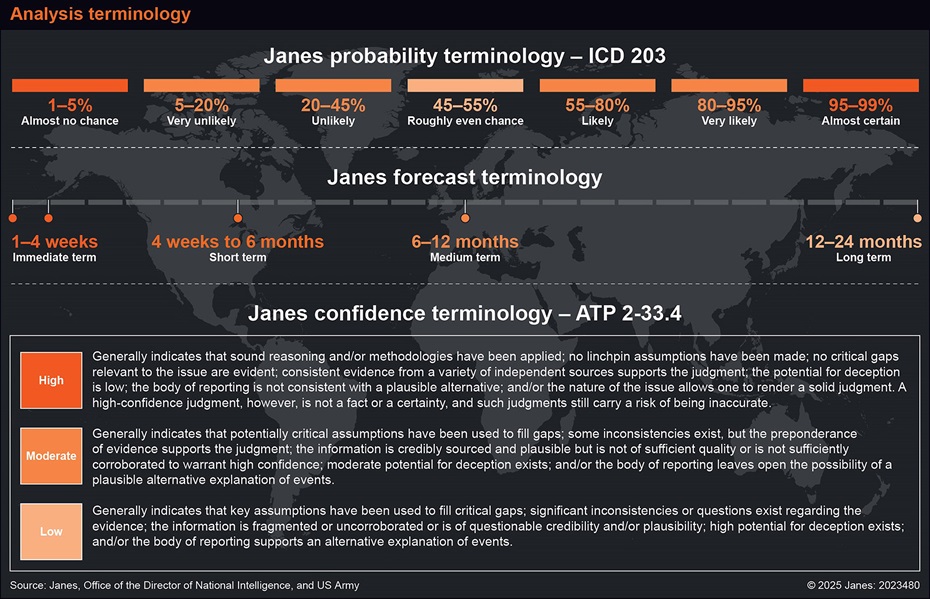
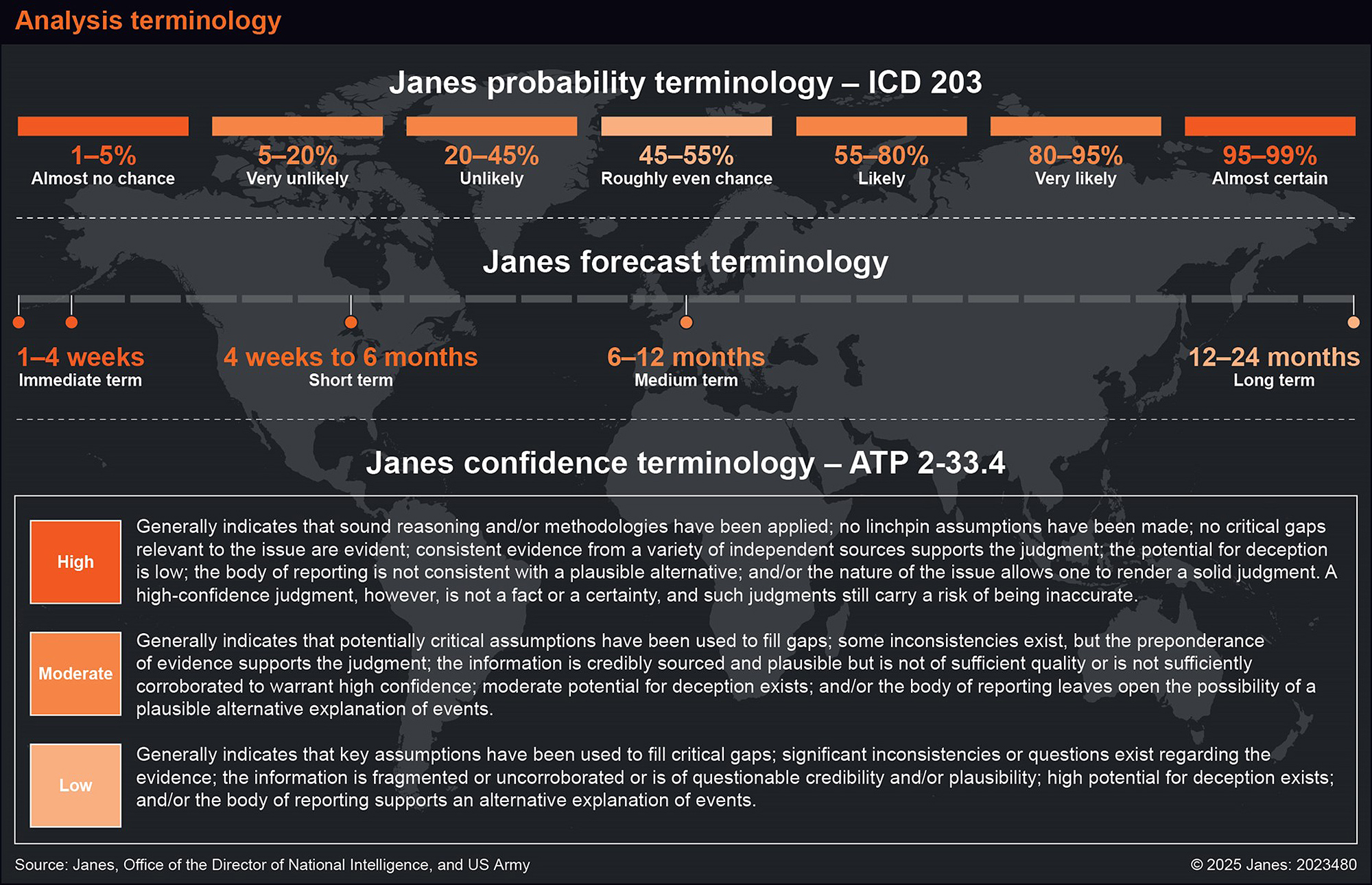 Analysis terminology
Image credit: Janes
© Janes
For more information, please see Insight report: China's measures to reduce exposure of key resources to external disruptions likely to undermine deterrence against Taiwan invasion