Strategic realignment: Economic consequences for Russia in Venezuela’s changing oil sector
Event
Following the 2–3 January 2025 Operation ‘Absolute Resolve’ in Venezuela, the US administration is planning to develop Venezuela’s oil sector and reintegrate it into the global oil market by gradually lifting sanctions, encouraging both US and international companies to invest in the country, facilitating oil exports, supplying equipment and materials for oil production, and restoring power infrastructure.
If successful, this plan would have significant ramifications for Russia’s economic engagement in Venezuela and could potentially affect the entire Russian oil sector in the medium and long term. The direct financial impact is likely to be moderate, as Russia’s involvement was primarily aimed at supporting the government rather than generating profit from the arrangement. However, should Caracas fail to acknowledge the debt repayments, this could likely have consequential repercussions for Russian state lenders.
Significance
After the United States seized Russian-linked oil tanker Bella I (later renamed Marinera), bound for Venezuela on 7 January 2026, authorities also seized two additional vessels, Sophia and Olina. These actions sent a clear message to Moscow that Washington’s strategy for redeveloping Venezuela’s oil sector excludes Russian participation, at least as a facilitator of crude oil exports and supplier of diluent (light crude oil), an essential component for oil production.
Analysis
This leaves Russia with few practical options to preserve its position as facilitator of Venezuelan oil exports. Thus far, apart from raising allegations of breaches of international maritime law, Moscow’s response has been comparatively restrained. It is likely that Russia will adopt a more pragmatic approach, seeking to leverage its geopolitical vulnerability in Venezuela by engaging with the US administration to further its interests during discussions on its most pressing concern – the war in Ukraine – with Venezuela’s interests left as collateral.
Although Moscow has provided considerable political and military support to ensure the survival of the Nicolas Maduro regime in Venezuela for over 12 years, Russia never established a robust economic relationship with the South American country as China did. The fact that Russia and Venezuela are both crude oil producers likely affected the limited nature of the economic relationship.
During Maduro’s state visit to Moscow on 7 May 2025, Russian President Vladimir Putin expressed, in diplomatic terms, his dissatisfaction with the level of trade turnover between Russia and Venezuela. This was noted despite trade turnover in 2024 having increased by 64%, reaching only USD200 million. There was a significant increase in trade compared with the previous year, but it was still not sufficient for the strategic partners. By contrast, Russian trade with Brazil for the same year amounted to USD1.05 billion.
With US efforts under way to dismantle Russian involvement as a key crude oil exporter and supplier of critical materials for the Venezuelan oil industry, Moscow may face an additional obstacle – the potential loss of other aspects of its economic presence in Venezuela, which is minimal, in comparison with China, for example, but is nonetheless of symbolic and geopolitical significance.
Regarding specific projects, state-owned Roszarubezhneft is the sole Russian entity to have formed a joint venture with Petróleos de Venezuela, SA (PDVSA) for oil exploration activities. Roszarubezhneft was established in 2020 with the specific task of managing Russian assets in Venezuela and is wholly owned by the Russian Federal Agency for State Property Management (Rosimushchestvo). As part of a strategic energy alliance between Moscow and Caracas, agreed to during Maduro’s visit to Moscow in November 2025, Venezuela’s National Assembly extended the joint venture agreement, allowing operations to continue until 2041, with plans to invest USD616 million.
Although Russia holds concession rights to the Boqueron and Perija fields in western Venezuela, the oilfields remain undeveloped, and Russia does not extract oil in Venezuela. As things stand, the future of the Roszarubezhneft concession is uncertain and may ultimately be determined by Venezuela’s geopolitical realignment and Russia’s willingness to invest further in the country. In the statement published on 13 January 2026 by Russian state-controlled media outlet TASS, Roszarubezhneft stated that the oil assets were acquired in accordance with local and international law, and that the company intends to keep and develop these assets.
Another Russian direct investment in Venezuela is Rosoboronexport’s ammunition manufacturing plant in Maracay, Caracas. The facility, which is the first of its kind in the Americas, started operations in July 2025. Initially, it will run four production lines with an annual production capacity of up to 70 million 7.62 mm cartridges for Kalashnikov rifles, producing steel-core, tracer, and blank ammunition. Although there were intentions to expand to full-cycle production of ammunition and weapons, the plant currently does not fulfil the original 2006 agreement to manufacture AK-103 rifles and ammunition. According to a Janes IntelTrak assessment from July 2025, the opening of the plant was largely symbolic and deviated from the original plan announced by Putin and the late Venezuelan President Hugo Chávez in 2006, as the project was marred by corruption scandals and inefficiency.
With disrupted oil export and diluent supply links, and with a high likelihood of losing the oil exploration concession and management of the ammunition plant, Russia may face a significant impact on its domestic oil sector, as Venezuela’s oil industry under the US administration could reshape the global energy landscape, given the depth of the country’s reserves and new investment.
The US Energy Information Administration estimates that Venezuela possesses 303 billion barrels of proven crude oil reserves, representing approximately 17% of global reserves. Owing to longstanding US sanctions imposed on Venezuela since 2006, the country produced only 0.8% of total global crude oil in 2023. Most of this output was destined for China. In 2023, Caracas exported 400,000 barrels per day (bpd), accounting for around 68% of Venezuela’s total crude exports.
Outlook
If the US redirects exports previously destined for China to other markets, this could create a short-term opportunity for Russia to increase its crude oil exports to China, strengthening energy ties between Moscow and Beijing. In 2023, Russian crude oil exports to China stood at 2.1 million bpd. It is highly likely that China would turn to Russia for oil, given the lower price of Russian crude and Beijing’s geopolitical interest in supporting Russia’s economic stability. Should China replace Venezuelan oil with Russian oil, the Kremlin’s budget would benefit in the short to medium term, over a period of up to two years, and ultimately sustain the war efforts in Ukraine.
However, should oil prices decline to a minimum of USD50 per barrel as a result of increased supply from Venezuela entering the global market, Russia would encounter greater difficulty in maintaining its exports, which are already under pressure from a range of US and European sanctions, including the 2022 Russian crude oil price cap. Analysis published in Корреспондент.net indicates that if oil prices fall to USD50 per barrel as envisaged in the US administration’s plan, Russian Urals crude oil prices could drop to as little as USD30 per barrel.
In this scenario, the Russian state budget would be affected and may also prompt deeper reforms in the overall operations of the Russian oil sector. In a Telegram post, Russian oligarch Oleg Deripaska asserted that those changes could lead to shifts in Russia’s “sacred state capitalism” and pressure on the Russian state-run oil sector to cut costs, divest non-core assets, and open participation by private business in the sector. In this scenario, price pressure may even reverse the current process of the nationalisation of the Russian oil sector, opening the sector not just for foreign technologies and services, but even of foreign ownership and operation.
Risk positive indicator
- The US administration successfully revives the Venezuelan oil sector and maintains Russia’s economic presence in Venezuela.
- As a result of increased production from Venezuela, global oil prices are expected to remain low, placing pressure on the profitability of the Russian oil sector.
Risk negative indicator
- Political and security challenges in Venezuela may delay the full development of the oil sector in the medium term.
- Russia may be able to export more crude oil to China because of the discontinuation of Venezuelan exports to China.
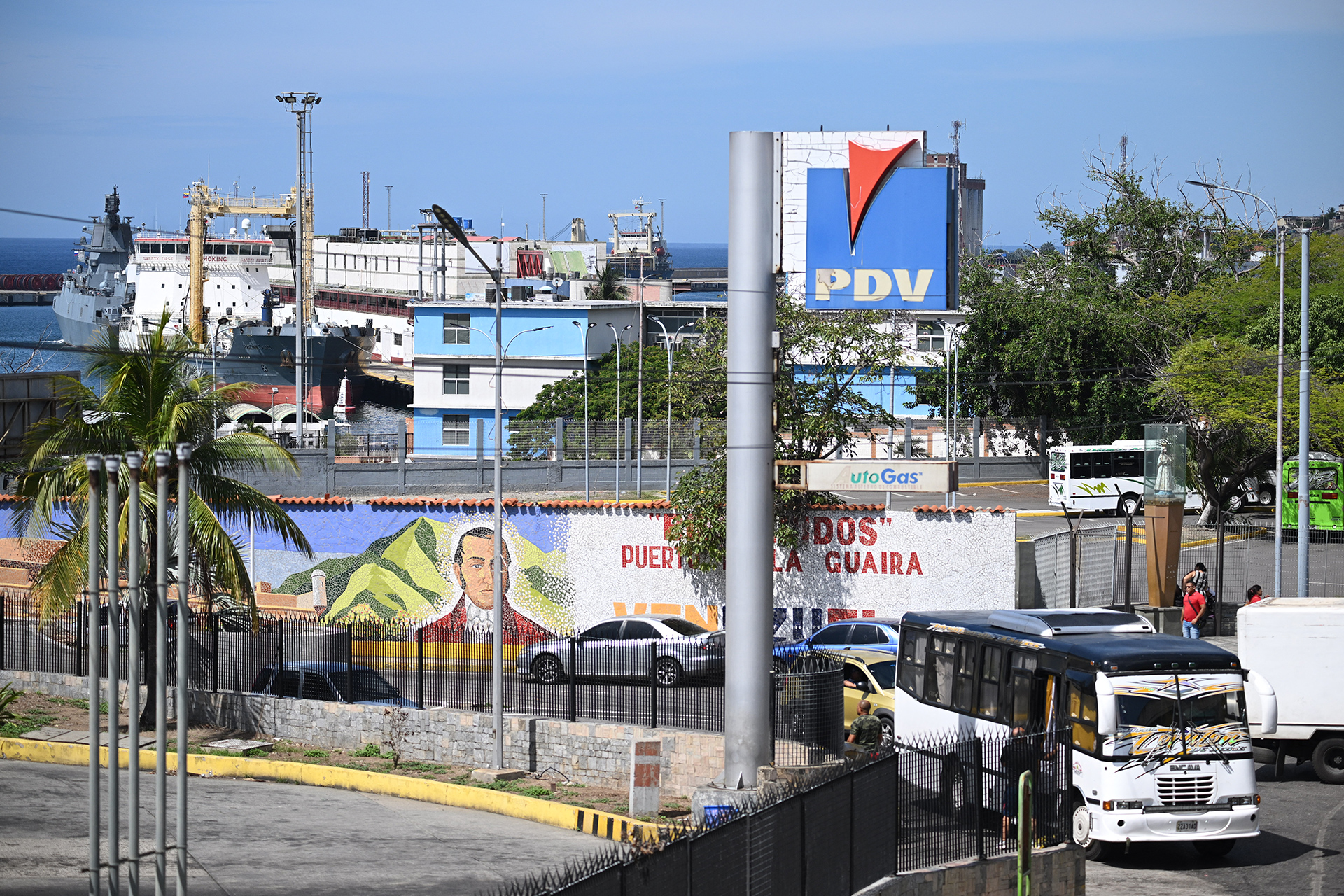 Frigate Admiral Gorshkov (L-back) and oil tanker Academic Pashin, part of the Russian naval detachment visiting Venezuela, arrive at La Guaira's harbour on 2 July 2024, Image credit: AFP via Getty Images