Effective defence intelligence requires effective data fusion and AI enablement
Phil Smith, Chief Technology Officer
As risks mount in the global environment, the ability to deliver actionable insight to decision makers is critical. This requires tradecraft, technology, and AI skillsets deployed at both an atomic and macro level, with accuracy and connectivity critical to achieving insight. With a 125-year legacy of delivering assured foundational intelligence, Janes believes the need is not just to co-locate intelligence on a single ‘pane of glass’, but rather to deliver ‘data fusion’ at the intelligence object level to create a highly assured, interconnected foundational intelligence asset that can underpin a broad range of use cases.
Transforming high-noise information into assured, entity-based intelligence
By nature, intelligence inputs contain high levels of noise, consisting of a vast array of multimedia information sources, often interwoven with disinformation and misinformation. While there are many technologies that can parse and assess this information to pull out important content, few have been able to effectively resolve this content into an assured intelligence asset that clearly identifies entities, capabilities, and strategic context within a well-defined data framework that enables an analyst to achieve insight with confidence.
To achieve this goal, we believe you need to be able to:
- Apply tradecraft to assess and identify what is valuable and reliable
- Identify entities and capabilities against a well-defined point of reference
- Place into context within a schema, i.e. understand relationships between entities
- Place the intelligence asset in a form that can be interrogated to create insight
- Enable consumption at point of need, i.e. deploy assets into consumption systems.
The key is not to create yet another system for an analyst to use, rather to create an intelligence asset that can be ‘moved to the analyst’. Deployed into existing systems the analyst uses, so that this assured, interconnected foundational intelligence becomes accessible at point of need.
A key benefit of this is that the act of adding a highly interconnected foundational dataset into an intelligence system can effectively act as ‘connecting data fabric’ that can synergistically interconnect data already within that system, thus augmenting and enriching existing intelligence assets.
Integrated intelligence platforms require hybrid technology capabilities
Knowledge graphs, human/AI teaming within tradecraft processes, and novel technologies are all required to create an effective capability to process intelligence, each representing a specific part of the process. At Janes, we have, over the last five years, built a Single Intelligence Environment that now creates a highly assured, massively interconnected intelligence asset that can be uploaded into geospatial, intelligence, and mission systems.
The key components that achieve this goal are:
Source ingestion and processing – Extensive use of ML and AI capabilities to classify, deduplicate, and perform entity detection is now a common and well-proven pattern. While some organisations pass this ‘low-noise’ signal to customer analysts, our intent is to create an assured intelligence asset. Hence, we treat this as an input to our internal tradecraft workflows.
Tradecraft workbench – A single-pane-of-glass environment for analysts to perform tradecraft workflows. The key here is the seamless integration of entity schemas, AI-enabled tools, geospatial tools, validation rules, and editorial capabilities to enable our 300+ analysts to create assured content and analyst insight within an entity-centric intelligence schema.
Entity-centric system of record – Each created entity is stored as an individual object within an object database, complete with capabilities, relationships, and related analyst insight. This system of record manages the full life cycle associated with an assured intelligence product including attribution to source, versioning and validation controls, and creating an entity-centric ‘base’ for the intelligence asset.
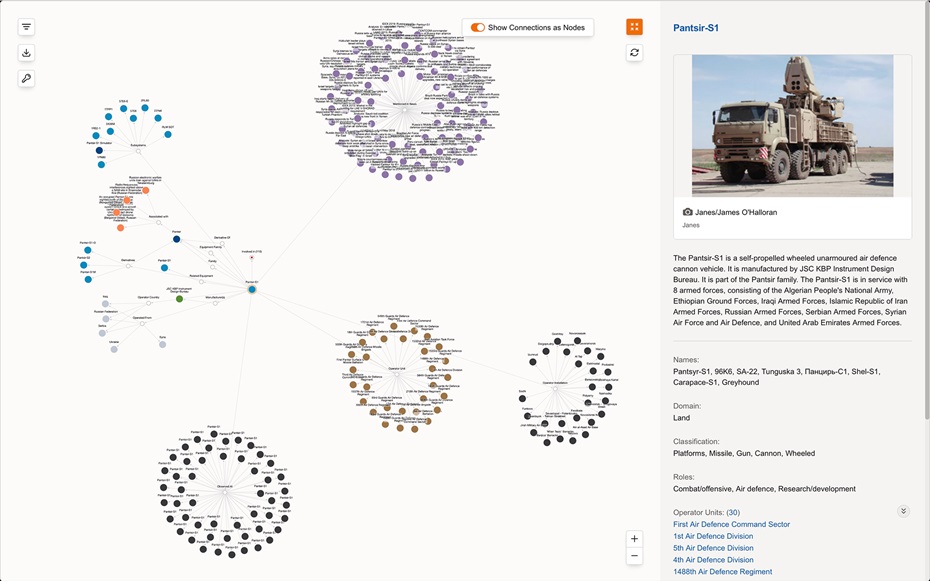
Knowledge graph – Knowledge graphs clearly excel in creating order and understanding from complex, unstructured data, combining static and dynamic data within an ontological model. In combination with AI tools, we can bring additional relationships, data, and context that enrich situational understanding and accelerate development of operational plans.
Experience services – Having created such a rich, interconnected asset, it is important to make it accessible and exploitable. The key to this is anticipating discovery, analytical and consumption needs, and building services that meet these. This can be through a single-pane-of-glass portal, via an API, or via data transfer into an operational or intelligence environment.
Janes intelligence portal – The online portal delivers an optimised analyst platform for the use of this asset, providing dynamic navigation, search, and geospatial and visualisation capabilities that enable extremely rapid discovery and analysis across foundational, current, and country intelligence information.
About more than technology
Wrapped around the technology platform are robust tradecraft and data governance frameworks that are required to maintain the level of discipline and definition to create such an assured and interconnected product.
There remains an ongoing need to train and refine AI and ML capabilities to continue to expand our entity scope, optimise efficiency, and build new classification models.
These are long-term capabilities that must be deployable within hybrid teams to enable success at scale. These hybrid teams then create the opportunity for continuous refinement of our tradecraft processes and models to further refine and improve the resulting asset.
Onwards to the future
None of this is to say that this is the only way to solve this challenge. Others have tried other techniques, using alternative technologies to drive change and insight. However, at Janes, we believe that to create an assured, sustainable asset, a multilayered approach such as this is required. In particular, we hold the view that the human in the loop will be required for the foreseeable future to achieve true high-quality intelligence insight.
The use of LLMs remains a dynamic area of innovation – we don’t think LLMs replace the analyst, but human/AI teaming creates the opportunity to accelerate, empower, and scale up analyst capabilities. Natural language query tools, supported by Retrieval-Augmented Generation (RAG), will create new ways to interact with intelligence assets to discover insights at pace.
Critical to this success will be the supply of highly structured, high-quality data to drive fine-tuning of LLMs, to support RAG queries, and to deliver explainable responses in an intelligence context at scale. We believe an entity-centric intelligence platform that can maintain an assured data asset is fundamental to the creation of high-quality AI-enabled intelligence.
Likewise, the advancing capabilities of knowledge graphs and the evolution of techniques and standards that support increased transportability and scale of an asset will play a critical role in the future, as will improving techniques for integrating what is essentially a graph payload into other types of systems, greatly enriching the client’s existing data.
It is clear that the continued evolution of graph and AI technologies, combined with tradecraft capability and strong data management capabilities, is essential to delivering mission advantage at pace. Janes is well placed to deliver on this promise.