Feature: Shifting geopolitics impacts Asia-Pacific defence spending
More than three years after Russia’s full-scale invasion of Ukraine plunged Europe’s security environment into a period of turbulence, the beginning of Donald Trump’s second term as president of the United States has demonstrated the major transformation under way in the Asia-Pacific’s security affairs.
While the world’s attention remains on the effects the profound shift in US foreign policy is having on its NATO partners, allies elsewhere in the world remain exposed to the potential for similar realignments of long-standing American relationships.
Although the Trump administration’s hawkish stance on China stands in contrast with its apparent desire for accommodation with Russia, this is unlikely to provide sufficient reassurance to US treaty allies in Asia concerned by the fraying of the country’s commitment to maintain defence partnerships that have formed key pillars of the post-Second World War global order.
In contrast to the recent succession of major policy announcements regarding European defence funding plans though, US-aligned countries in the Asia-Pacific have appeared less eager to endorse Trump administration suggestions that greater investment in defence is required, with some notable instances of relatively robust pushback.
Whether this primarily reflects genuine satisfaction with current defence funding levels, a lower propensity to engage in diplomatic flattery, or confidence that a US less engaged with European concerns will be more likely to honour its stated Asian policy objectives is hard to say, but the region’s response to Trump’s disruption of the US’ previously highly valued network of allies has been notably cooler than Europe’s.
To assess whether this reaction represents dangerous complacency or shows the positive results of prior foresight, the defence budgets of the US’ closest Asian allies provide crucial evidence. Here the influence of each country’s unique combination of local strategic environment, domestic political concerns, and varying degrees of economic dynamism introduce a wide array of complicating factors. As data from Janes Defence Budgets demonstrate, however, the level of concern shown for developments in Asian security by countries in the region can be discerned in their spending trends. Whether in expectation of partnership or in fear of abandonment these can help answer the question, is Asia taking changes in the US’ global security posture seriously enough?
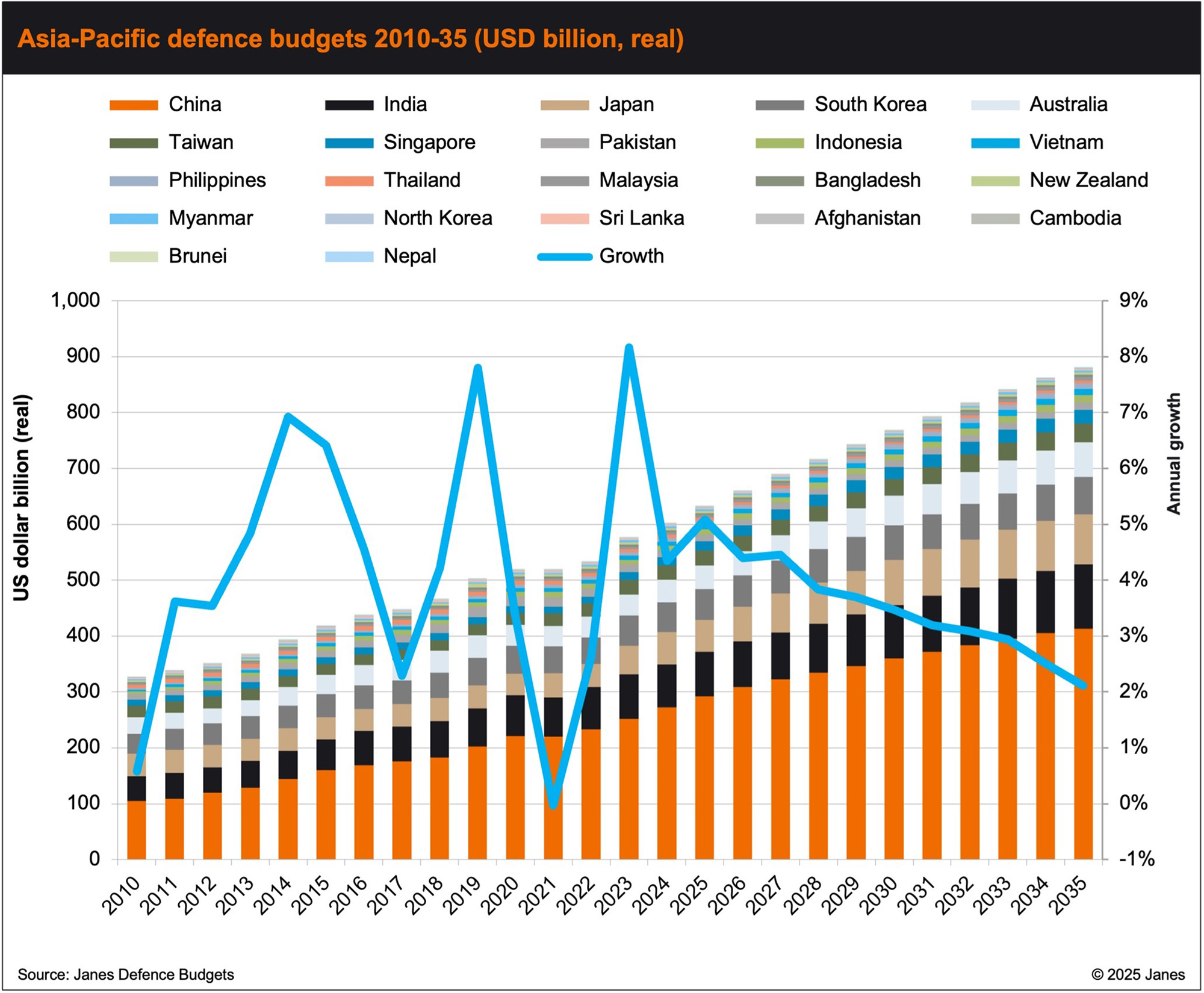 Image caption: Total Asia-Pacific defence spending 2010-35.
Image credit: Janes Defence Budgets
© Janes
US partnerships
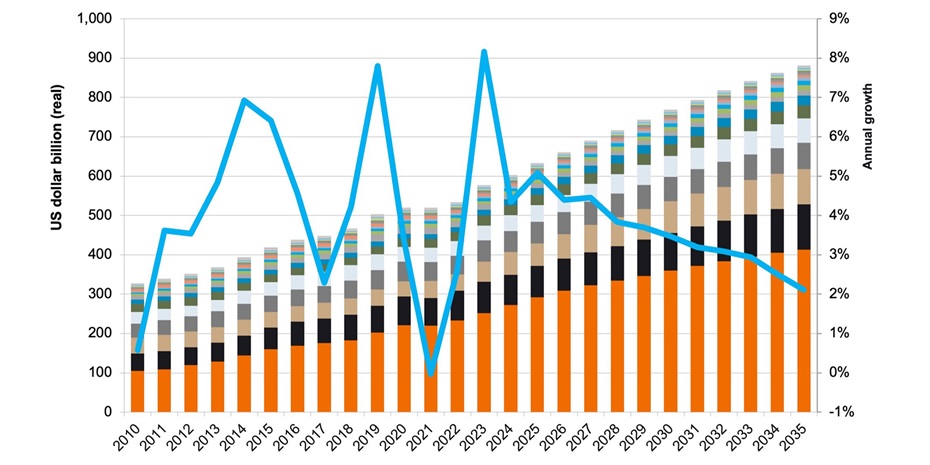
Overall defence spending in the Asia-Pacific region rose by 5.1% in real terms in 2025, to a total of USD632.2 billion. Of this, USD181.1 billion, or 28.6%, will be spent by countries whose defence posture is defined by a close security partnership with the US: Japan, South Korea, Taiwan, and Australia. Include Singapore, the Philippines, and Thailand and this total rises to USD211.0 billion, or 33.3%. In comparison, China is expected to spend USD291.8 billion, or 46.1% of the region’s total.
Collectively this first group of core US allies in Asia increased their defence budget by a relatively moderate 2.2% in real terms in 2025 – slightly below the average annual rate of 2.9% they recorded over the previous decade. Such sedate expansion could be seen to suggest that US allies in Asia are notably more relaxed about the stresses currently being placed on the world security order than their European counterparts – whose spending collectively grew by more than 9.4% in 2025.
However, while America’s Asian partners may well have failed to anticipate the speed and degree to which the new US administration would seek to alter relationships with Europe, attributing slowing Asian spending in 2025 to insufficient concern over regional insecurity or satisfaction with strategic dependence on the US would be a gross mischaracterisation.
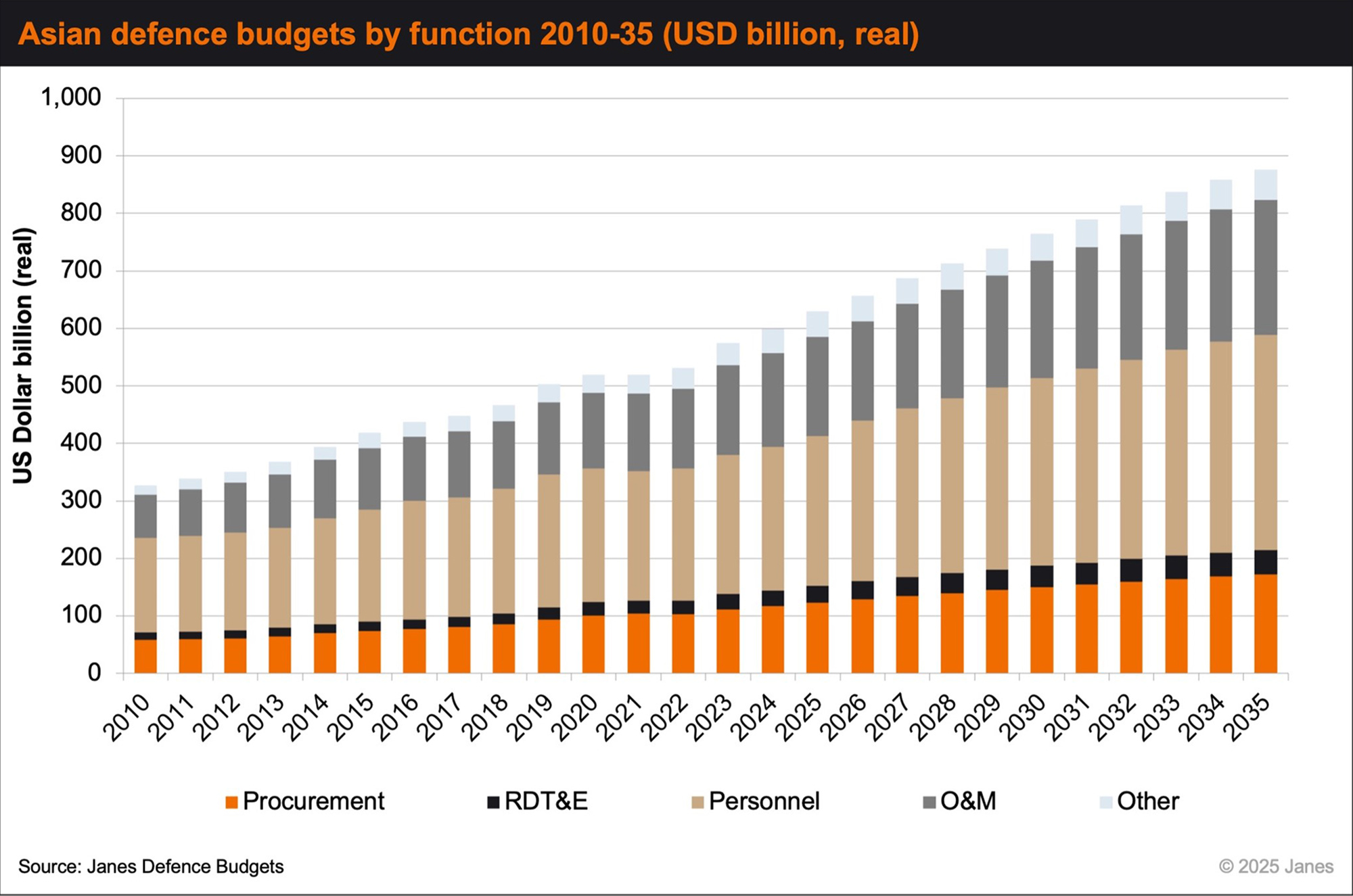 Image caption: Investment in defence procurement in the Asia-Pacific between 2025 and 2035 is forecast by Janes Defence Budgets to increase by about 40%.
Image credit: Janes Defence Budgets
© Janes
Instead, the expansion of the collective defence expenditure of Japan, South Korea, Taiwan, and Australia slowed for the second consecutive year in part because of the height of the record growth peak it reached in 2023. That year these countries’ growth spiked from an average rate of 1.7% across the decade to 2022 to 13.2% in real terms, as both Japan’s and South Korea’s allocations increased by double-digit percentages.
These were the first budgets drafted by these countries since Russia’s invasion of Ukraine in February 2022, and it is likely that the effects of the war on global norms against wars of territorial conquest and the health of the wider international system were major drivers of budget expansion. Although his victory was of course at that stage far from assured, the announcement of Trump’s candidacy for the presidential race in late 2022 may have focused minds on future relationships with a Trump White House.
It is notable that this recent peak of growth in Asian defence spending (and especially of US allies’ budgets) in response to the outbreak of war in Europe occurred even before the most substantial responses of the largest Western European spenders, which would take until 2024 (Western European budgets grew at rates below 4% in both 2022 and 2023). So far from failing to react to a deteriorating security environment among allies, US-aligned Asian states may already have ‘priced in’ these changes.
If the diplomatic fallout of Trump administration foreign policy at the start of 2025 represents a further degradation of the security environment for US allies in Asia, then it does not appear to have been wholly unexpected, judging by their defence funding plans.
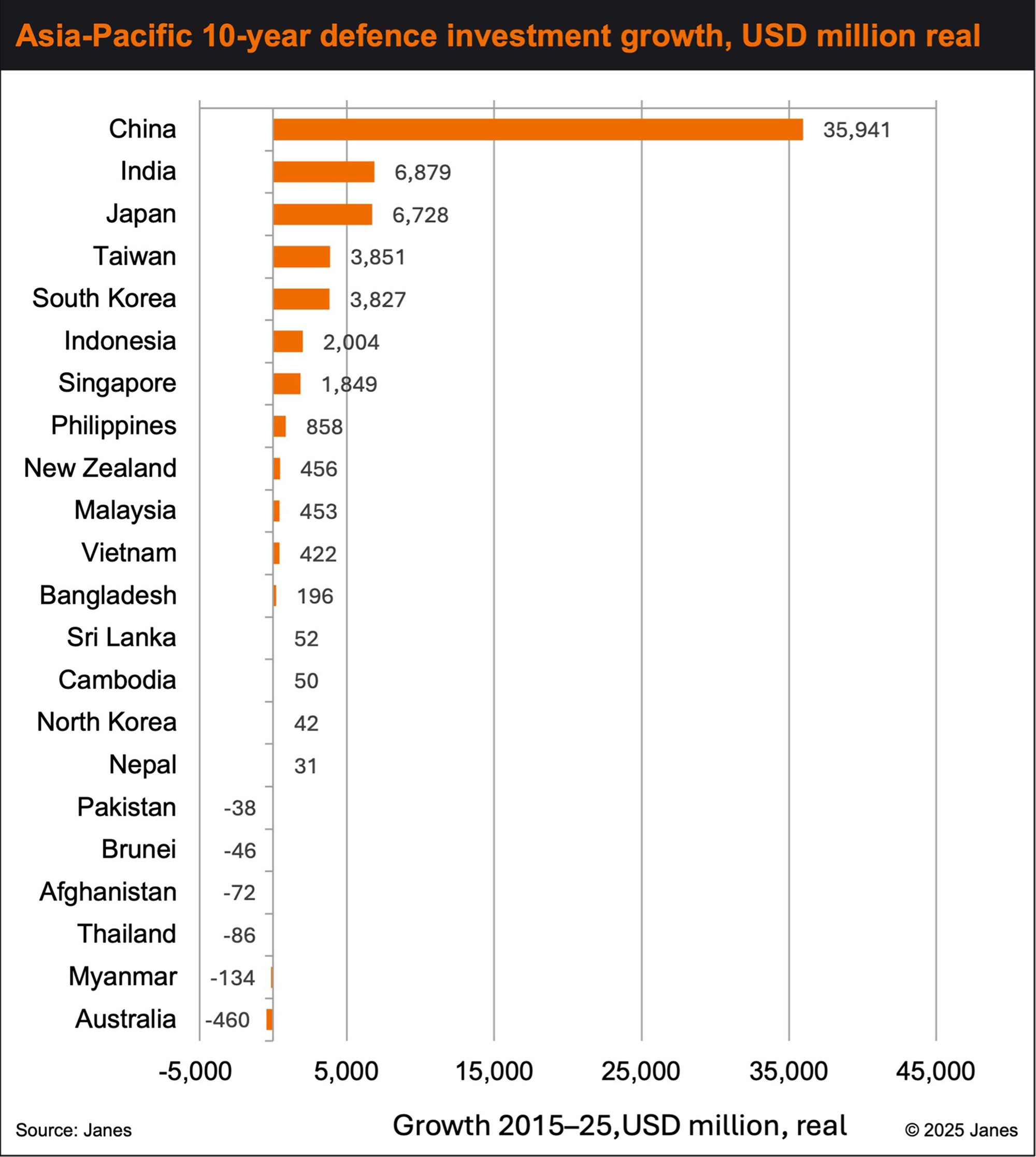 Image caption: Defence investment growth in the Asia-Pacific 2010-35.
Image credit: Janes Defence Budgets
© Janes
According to Janes forecasts – informed by each country’s stated policy goals, and by official projections where available – the most important four US security partners in the Asia-Pacific region are expected to expand their military expenditure at an accelerating pace in 2026 and 2027, with forecast growth of 6.2% in the latter year exceeded only by the previous record rate in 2023.
Disentangling the effects of Russia’s war on Ukraine, which raised fears worldwide of a renormalisation of wars of aggression, from those of a weakening of the US-backed international system in general is a difficult exercise, given the similarity of the direction in which they both can be expected to drive US allies. However, if current expectations for defence spending in Japan, South Korea, Taiwan, and Australia are a good indication, then both are eliciting a significant response.