Insight report: Hayat Tahrir al-Sham’s capture of northeast Syria marks territorial defeat of Qiwaat Suriyya al-Dimoqratiyya
Event
HTS operation in Aleppo city
On 7 January, the armed forces of the Hayat Tahrir al-Sham’s (HTS’) de facto government launched a ground offensive that captured two Kurdish-majority neighbourhoods of Ashrafieh and Sheikh Maqsoud in Aleppo city from the Kurdish forces of the Qiwaat Suriyya al-Dimoqratiyya (QSD), also known as the Syrian Democratic Forces (SDF).
The HTS-led operation followed a noticeable escalation of mutual shelling between 1 and 6 January between the Kurdish forces in the two neighbourhoods and the surrounding HTS-led forces. Both HTS and QSD leaders blamed each other for the escalation of conflict, accusing each other of targeting civilians and driving the displacement of civilians in Aleppo city and countryside.
Since the collapse of the Bashar al-Assad government in December 2024, the Kurdish-majority neighbourhoods of Ashrafieh and Sheikh Maqsoud have been under the control of the QSD’s internal security forces, the Asayish. Despite being surrounded by the HTS-led forces and cut off from the QSD-held areas in Aleppo governorate, the Kurdish militants in the two neighbourhoods have been engaged in intermittent skirmishes and mutual shelling with the HTS-led forces throughout 2025.
By 12 January 2026, the HTS-led forces were able to capture Ashrafieh and Sheikh Maqsoud, forcing the remaining Asayish forces to withdraw towards the QSD-held areas in eastern Aleppo governorate.
The Kurdish forces further withdrew towards Raqqa as the group’s general commander Mazloum Abdi continued to negotiate a ceasefire with the HTS leadership with the mediation of the US envoy for Syria Thomas Barrack and Masoud Barzani, the leader of the Kurdistan Democratic Party (KDP) of the Kurdistan Region of Iraq.
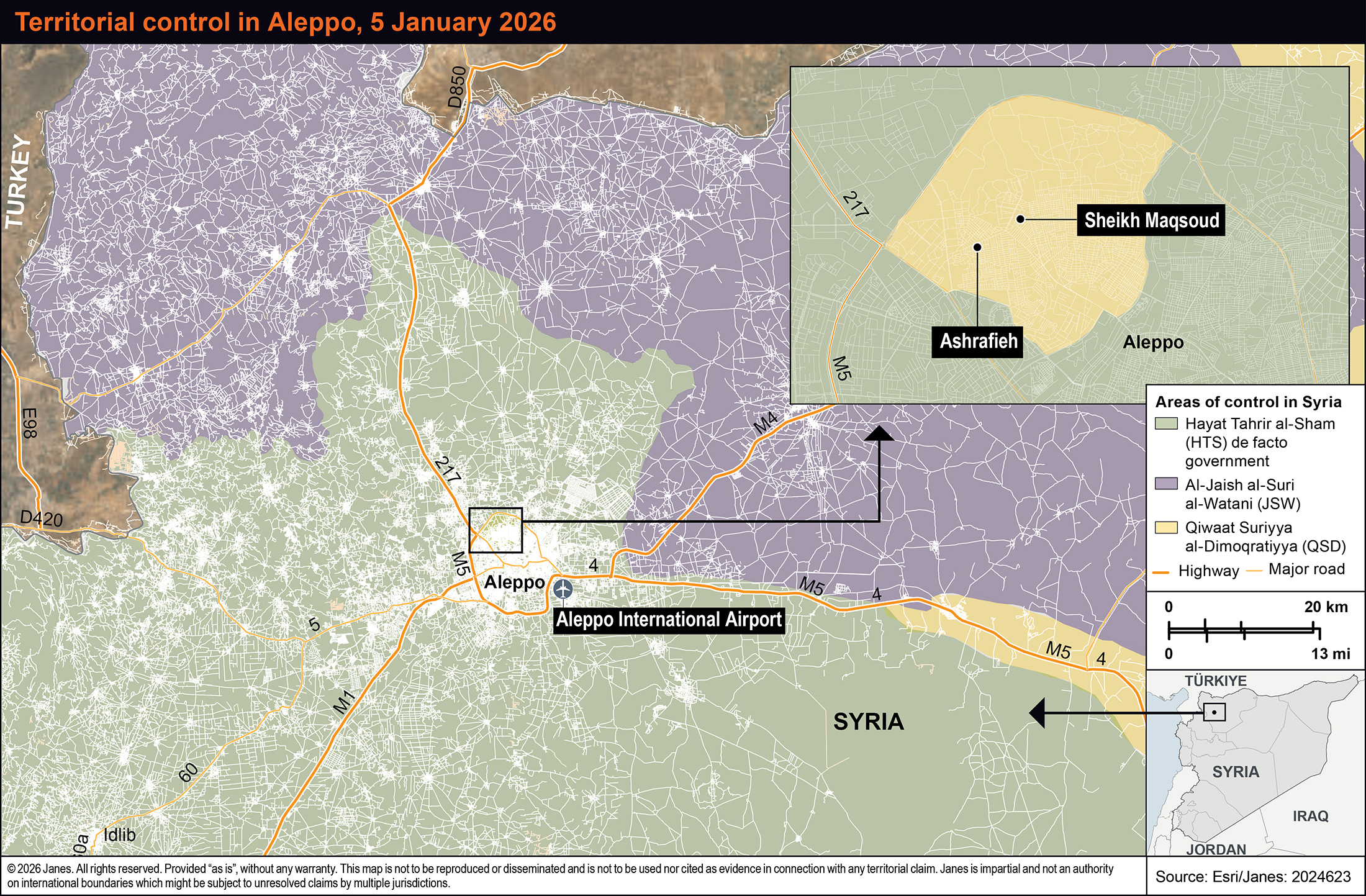 Territorial control in Aleppo, Syria, 5 January 2026.
Image credit: Janes
HTS offensive against QSD
Following the capture of the Kurdish neighbourhoods in Aleppo city, the HTS-led forces continued ground operations and captured the remaining QSD-held areas in eastern Aleppo governorate. Between 14 and 17 January, the HTS-led forces captured Deir Hafer and Maskana in eastern Aleppo countryside and advanced towards Tabqa in Raqqa governorate.
The operation in Aleppo and Raqqa governorates was led by the HTS’ military formations and supported by the Turkish-led groups of al-Jaish al-Suri al-Watani (JSW), which operate as part of the HTS-led ministry of defence.
In addition to the Kurdish forces, which is the QSD’s leading and largest component, the group incorporated a loose coalition of Arab tribal forces and smaller ethnic minority groups who joined forces as part of the US-led coalition against the Islamic State in Syria between 2015 and 2020.
As the HTS-led forces advanced into Raqqa on 17 January 2026, the Arab tribal forces in northeast Syria distanced themselves from the QSD formations and sided with the HTS-led forces. The Arab tribal forces included militant groups from Shummar, al-Aqidat, al-Baqqara, al-Jabbour, al-Bousaraya, and al-Shaitat indigenous tribes of Raqqa and Deir al-Zour, which captured the Arab-majority areas of the two governorates.
Since proclaiming itself the de facto government in Damascus, the HTS leadership has fostered closer ties with the Arab tribal forces in Syria and has frequently mobilised them in military operations against different sectarian and ethnic minority groups including the Kurds, Druze, and Alawites. Having long-standing grievances towards the Kurdish forces, the Arab tribes likely realised that aligning themselves with the HTS de facto government would better ensure the tribes’ long-term territorial and economic influence in northeast Syria.
As a result of the HTS-led offensive, the Kurdish forces conducted a rapid and wholesale withdrawal from Raqqa and Deir al-Zour towards the Kurdish-majority areas of Kobane in northeast Aleppo governorate and Hasaka governorate in northeast Syria. While Kobane borders Türkiye and is surrounded by the HTS-led forces on the Syrian side, the Kurdish-controlled areas in Hasaka governorate include access to Iraq’s Kurdistan Regional Government (KRG) territory directly via the Semalka border crossing and indirectly through Türkiye via the Qamishli border crossing. However, al-Yarubiya, the main border crossing in Hasaka, came under the control of the HTS-led forces.
On 18 January, the QSD’s Kurdish leaders and the HTS de facto government agreed on a ceasefire deal with the mediation of the US envoy and KDP leader. Despite announcing a ceasefire, intermittent skirmishes and mutual shelling continued between the HTS-led forces and the Kurdish forces in Kobane and Hasaka as of 1 February.
During their withdrawal, the Kurdish forces handed over the security of the prisons and internally displaced persons (IDP) camps holding Islamic State members and their families, including al-Aqtan prison in Raqqa and al-Shaddadi prison and al-Hawl IDP camp in Hasaka governorates.
On 19 January, QSD spokesperson Farhad al-Shami told the Kurdish media outlet Rudaw that around 1,500 Islamic State members had escaped from al-Shaddadi prison as a result of the HTS-led forces’ attack on the area. However, these claims were denied by the HTS-led ministry of interior, which blamed the QSD for abandoning the security of al-Shaddadi prison, allowing an unspecified number of Islamic State members to escape. Images and videos circulating on social media on 20 January showed al-Shaddadi prison being abandoned by the Kurdish forces and empty of Islamic State detainees.
On 21 January, US Central Command (US CENTCOM) claimed in a press release that US forces launched a new mission to transfer Islamic State detainees from northeast Syria to Iraq. The first transfer mission included transporting 150 Islamic State militants held at a detention facility in Hasaka in northeast Syria.
According to the US CENTCOM press release, up to 7,000 Islamic State detainees could be transferred from Syria to Iraqi-controlled facilities. The US and partner forces have detained more than 300 Islamic State operatives in Syria and killed over 20 during 2025. CENTCOM Commander Admiral Brad Cooper claimed that facilitating the orderly and secure transfer of Islamic State detainees aims to prevent a breakout that would pose a direct threat to the US and regional security.
As of 1 February 2026, the HTS-led security forces maintain control over the prisons and IDP camps holding Islamic State members and their families in Raqqa, Deir al-Zour, and Hasaka governorates in northeast Syria.
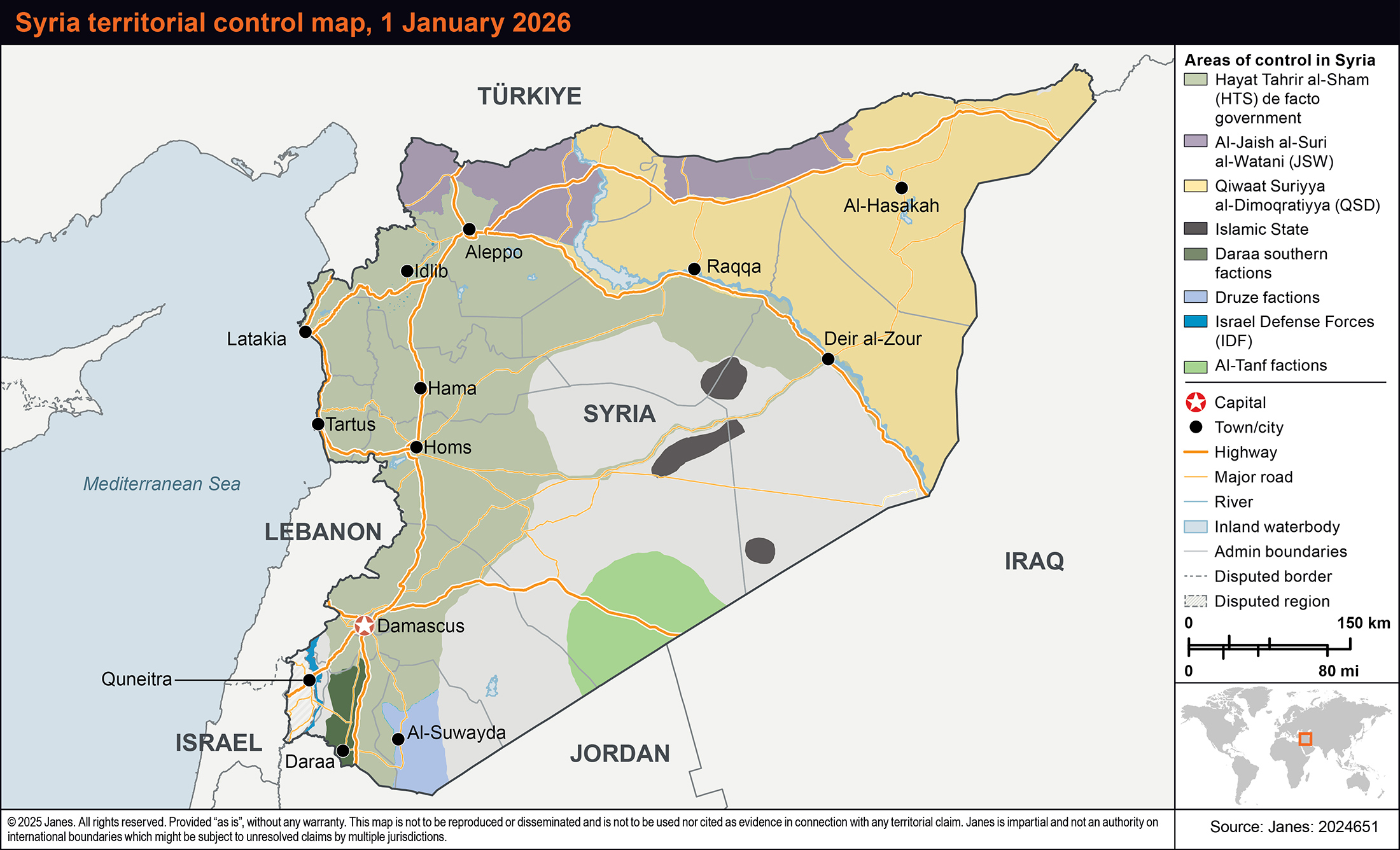 Syria territorial control map, 1 January 2026.
Image credit: Janes
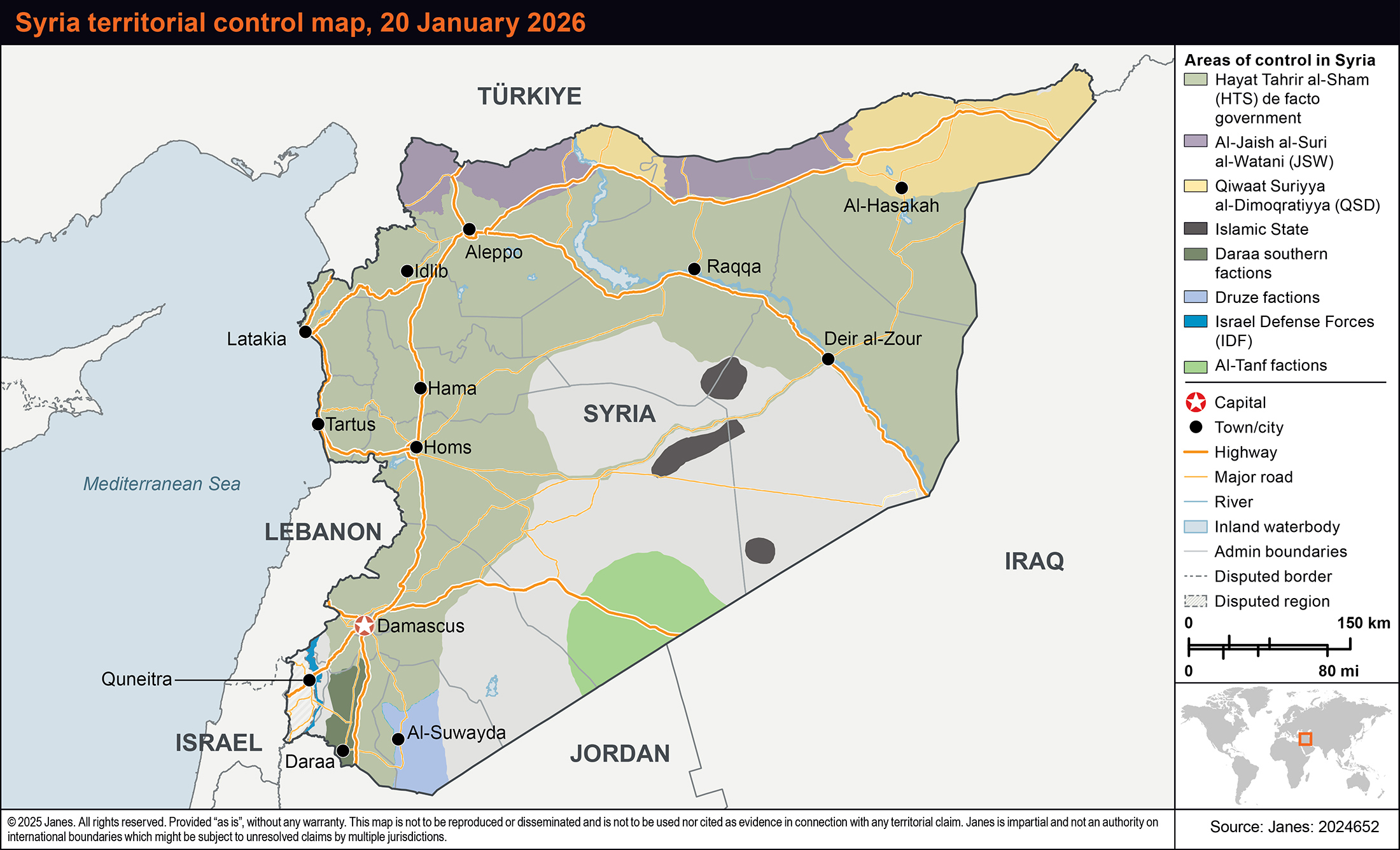 Syria territorial control map, 20 January 2026.
Image credit: Janes
Significance
The HTS-led offensive and capture of northeast Syria from the QSD marked the first notable escalation of conflict and change in territorial control in the country since the collapse of the Assad government. It also represented a significant shift in the balance of power between the HTS and QSD, two of Syria’s most influential militant groups, in favour of the HTS de facto government.
The HTS-led offensive also resulted in the QSD’s loss of control over most of its territory in northeast Syria. This was primarily enabled by the Arab tribal forces siding with the HTS-led forces and against the QSD. The tribal forces captured the Arab-majority areas in Aleppo, Raqqa, and Deir al-Zour governorates while the Kurdish forces retreated to the Kurdish-majority areas in Kobane and Hasaka where they will likely maintain governance and territorial control in the medium term.
The capture of Raqqa and Deir al-Zour allows the HTS de facto government to control the production and distribution of strategic natural resources and facilities in northeast Syria. This includes crude oil and natural gas fields and facilities in Deir al-Zour and Hasaka, including al-Omar and al-Tanak oilfields, Conoco natural gas field, and others.
Controlling northeast Syria also allows the HTS de facto government control over the production and distribution of wheat and other key agriculture products as well as water resources and facilities along the Euphrates River, including the Tishreen and Euphrates dams, the main sources of hydroelectric power in Syria.
The HTS-led offensive indicates the group’s continued reliance on coercion to consolidate its control over the territory previously held by the Assad government while extending its control over the remaining parts of the country. It highlights the HTS de facto government’s intent to pressure the Kurds and other ethnic and sectarian minority groups into making political concessions through inflicting military and territorial defeat. This approach is likely supported by the external sponsors of the HTS government, including the United States, Türkiye, and Gulf Arab countries, all of which very likely favour a centralised Syrian government structure that is able to consolidate territorial control over the entirety of the country.
Between 2015 and 2024, the US has maintained close operational ties to the QSD as part of the US-led coalition against the Islamic State in Syria. In November 2025, the HTS de facto government proclaimed its readiness to join the US-led coalition. This includes carrying out security operations against suspected Islamic State militants and assuming control over the prisons and IDP camps holding Islamic State members in northeast Syria. This has likely reduced the US reliance on QSD as its main partner force in Syria.
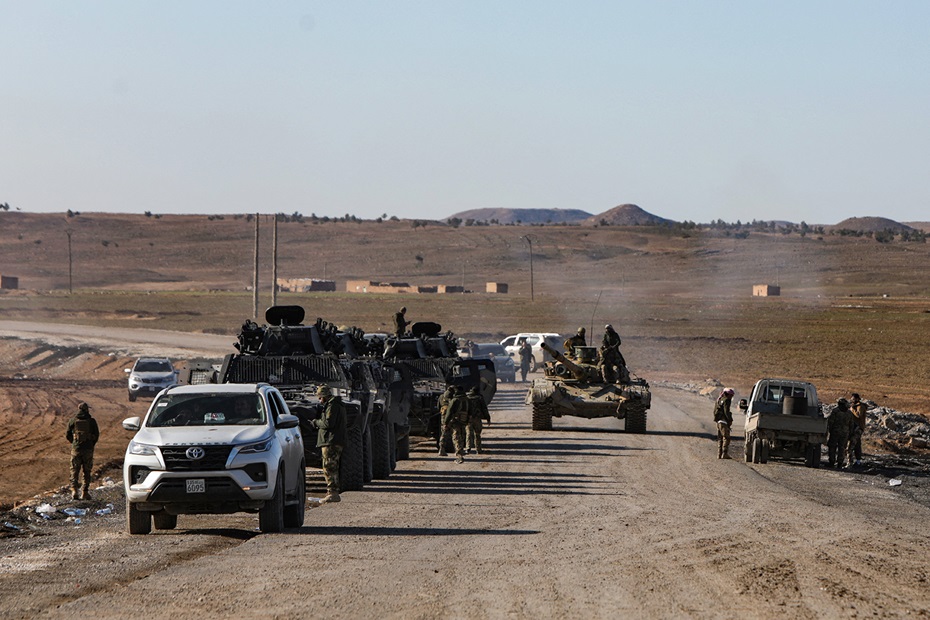
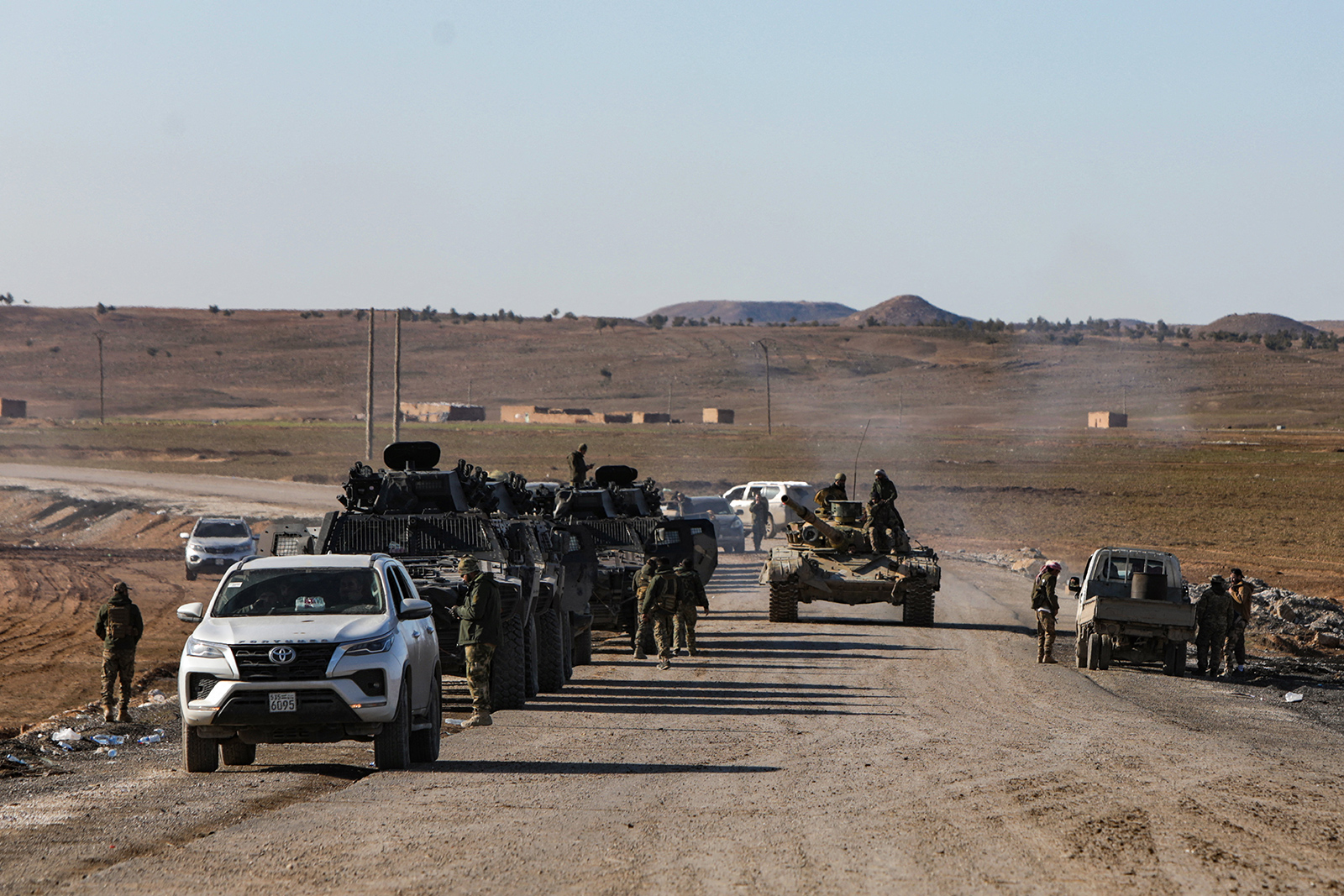 Armoured vehicles of the HTS de facto government make their way to the city of Hasaka in northeast Syria on 20 January 2026.
Image credit: Bakr Alkasem/AFP via Getty Images
HTS-QSD negotiations
The escalation of conflict in Aleppo city and the subsequent capture of northeast Syria by the HTS de facto government came only a few days following the resumption of the HTS-QSD negotiations in Damascus during early January.
Since proclaiming itself the de facto government in Syria, the HTS leadership has been engaged in frequent negotiations with the QSD’s Kurdish leaders with the mediation of Barrack. The QSD has maintained de facto governance and control over northeast Syria, including the territory east and north of the Euphrates River, and incorporating parts of Aleppo, Raqqa, Hasaka, and Deir al-Zour governorates.
For their part, the Kurdish leaders have been attempting to maintain the QSD’s semi-autonomous governance and territorial control in northeast Syria while negotiating a political agreement with the HTS de facto government that would guarantee political rights and representation of the Kurdish-majority areas in a decentralised, inclusive, and pluralist Syrian government.
On 10 March 2025, the de facto Syrian president and HTS leader, Ahmad al-Sharaa, signed an agreement with Abdi. The agreement included a framework for military de-escalation and potential political and territorial integration of the QSD and its controlled areas in northeast Syria into the HTS de facto governance, as well as the incorporation of the QSD forces into the HTS-led ministries of defence and interior.
A subsequent meeting between Sharaa and Abdi in early April included a prisoner-exchange deal between the HTS and QSD forces in Aleppo city. During this period, an unspecified number of Kurdish militants withdrew from Ashrafieh and Sheikh Maqsoud towards the QSD-controlled areas in eastern Aleppo countryside. The two neighbourhoods however remained under the control of the Kurdish forces as negotiations between the HTS and QSD leaderships stalled for the remainder of 2025.
The HTS leadership has required the QSD to fully dissolve and integrate its controlled areas into the HTS de facto government while incorporating its militants into the HTS-led ministry of defence. However, the QSD leadership has required any conclusive agreement with the HTS de facto government to include guarantees of genuine political participation for the Kurds and other Syrian minorities in a pluralist and inclusive government. The QSD also required the agreement to include guarantees of a form of decentralised and semi-autonomous governance for the QSD-controlled areas in northeast Syria; these terms were rejected by the HTS de facto government.
On 16 January 2026, Sharaa issued presidential decree no 13 of 2026, which affirmed that Syrian Kurdish citizens were to be an integral and authentic part of the Syrian people, and that their cultural and linguistic identity is an inseparable component of Syria’s unified and diverse national identity.
On 18 January, Sharaa and Abdi agreed on a new ceasefire deal with the mediation of the US envoy and the KDP leader. The deal stipulates that the HTS de facto government would control and incorporate Raqqa and Deir al-Zour governorates into its centralised governance structure. Meanwhile, the Kurdish-majority areas of Kobane and Hasaka would remain under Kurdish control while nominally integrating into the HTS-led government.
As part of the agreement, Abdi and the Kurdish leadership would nominate a governor and official representatives for the Kurdish areas in the executive and legislature bodies within the HTS de facto government. The remaining Kurdish forces would also nominally integrate within the HTS-led ministries of interior and defence where Abdi would nominate a deputy defence minister in Damascus.
On 30 January, the QSD announced on its official account on X that the terms of the agreement with the HTS de facto government include the withdrawal of military forces from the points of contacts and the entry of the HTS-led internal security forces into the Kurdish-controlled areas in Qamishli and Hasaka.
The agreement includes a phased integration process for the military and civilian bodies between the two sides. The Kurdish forces in northeast Syria would gradually integrate into the HTS-led ministry of defence as a cluster, forming a military division composed of three brigades while the Kurdish forces in Kobane would form a brigade affiliated with the HTS-led forces in Aleppo governorate. The agreement also stipulates that the Kurdish-led civilian institutions of the autonomous administration would gradually integrate into the HTS de facto governance structure as the Asayish will likely continue to maintain the internal security of the Kurdish-majority areas alongside the internal security forces of the HTS-led ministry of interior.