Iran-backed Iraqi militia attacks against Iraqi infrastructure will likely increase tensions in the lead-up to November elections
Intelligence requirement/question
- What strategic, political, or operational objectives are motivating Iran-backed Iraqi militia groups to conduct a series of unattributed attacks on infrastructure in northern and central Iraq, despite their implicit posture of restraint during the 13 June 2025 Iran-Israel conflict?
- Which state or non-state actors are most likely responsible for conducting these attacks?
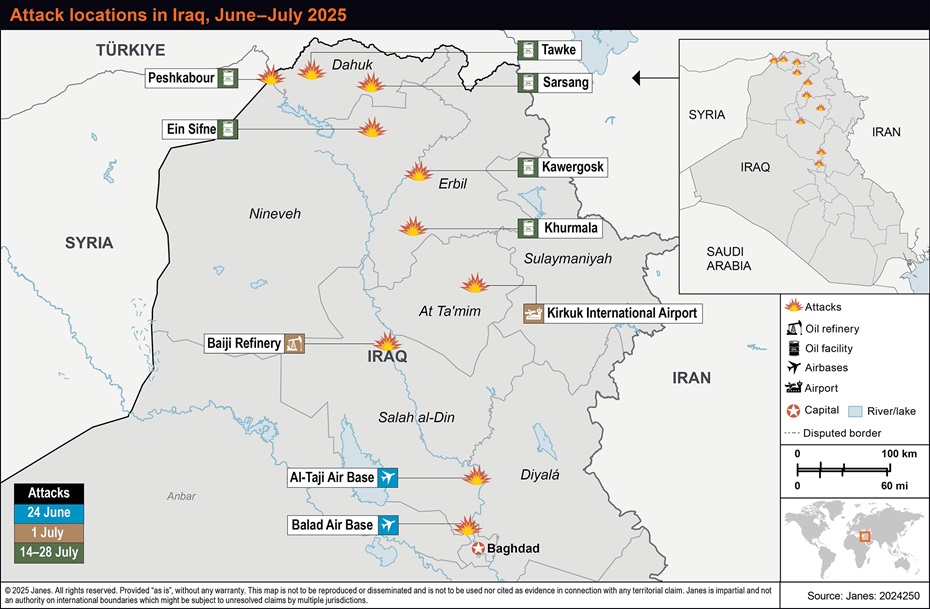
Across June and July 2025, there were multiple attacks conducted across Iraq. Please see the following table below for an overview of these attacks.
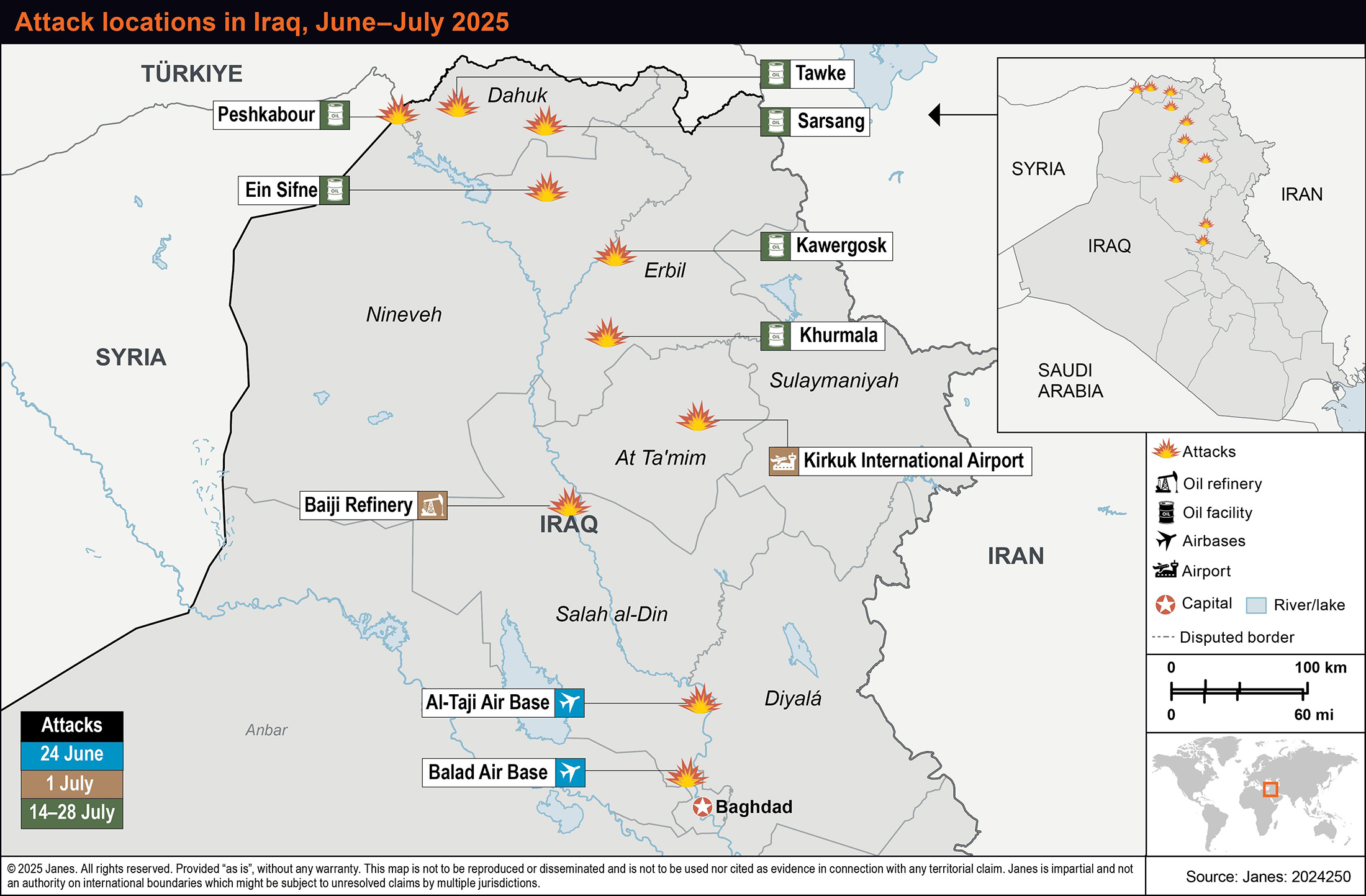 Attack locations in Iraq, June–July 2025, Image credit: Janes
Significance
Attribution of 24 June attacks
There are credible sources to assess that the UAV attacks on military installations at Al-Taji, Balad, and Imam Ali airbases, which damaged a TPS-77 at Camp Al-Taji and an AN/TPQ-36 radar at Imam Ali airbase, were likely conducted by Israeli forces in connection with the 13–23 June 2025 Israel-Iran war.
A likely strategic objective was to degrade Iraqi radar and military hardware that could potentially detect Israeli Air Force (IAF) aircraft returning from operations inside Iran via Iraqi airspace.
On 7 July, an informed adviser in the Iraqi government told Janes that the US-led coalition informed the Iraqi government that the UAVs used in these attacks originated from outside Iraqi territory.
On 29 July, an Iraqi diplomatic source (who was also a former member of the Iraqi National Intelligence Service) cited to Janes an internal assessment by Iraqi authorities attributing the attacks on Taji and Balad airbases to the Iranian Kurdish group, the PJAK, allegedly acting on behalf of Israel.
While Janes is unable to verify the veracity of the aforementioned statement, it reflects a growing perception within the Iraqi security services that Iranian Kurdish militants are becoming a vector of external threat to Iraq’s domestic security.
Further supporting the likelihood of Israeli involvement, a 10 July 2025 policy analysis report by the Washington Institute for Near East Policy (WINEP) suggests that the attacks may have aimed to obscure the extraction of Israeli personnel from Iranian territory using non-stealth aircraft at the conclusion of the operation. According to the July 2025 WINEP report, this implies that Israel may have sought to neutralise Iraqi air-defence systems or prevent real-time airspace monitoring from being shared with Iran.
Janes assesses that the involvement of Iran-backed Iraqi militias on the airbases are unlikely due to the following factors:
- Target selection inconsistency: Iran-backed Iraqi militias have historically directed retaliatory attacks against US interests, such as the Ain al-Assad military base (Anbar), Erbil International Airport, and the Baghdad Diplomatic Support Center (BDSC). In contrast, Taji, Balad, and Imam Ali airbases are not typical targets, suggesting a different actor with alternative strategic aims.
- Operational restraint: Balad airbase has been infrequently targeted by Iran-backed Iraqi militias. Indeed, the last recorded attempted attack on Balad Airbase was reported by Iraqi security forces on 15 January 2022, when base defences engaged three unidentified hostile UAVs. This is reflected in a fragile agreement in 2021 between the Iran-backed armed groups and the FGB, given that Balad hosts F-16s critical to counter-terrorism operations, as well as foreign contractors. The US Embassy in Baghdad has also been singled out for militia rocket and UAV attacks. No attacks have occurred on Balad during Prime Minister Mohammad Shia al-Sudani’s tenure, which began in October 2022, further reducing the likelihood of militia involvement at the time of the attacks.
Attacks on Baiji refinery and Kirkuk airport
On 1 July 2025, attacks were carried out against the Baiji oil refinery in Salahaddin province and against a military base at Kirkuk airport. According to a 1 July 2025 report by The National, “The military part of Kirkuk’s airport includes bases for the Iraqi Army, the federal police, and the paramilitary forces known as the Popular Mobilization Forces (PMF).”
A local intermediary in the Baiji refinery cited to Janes (in an interview on 25 July 2025) his assessment that the Iran-backed group KH had threatened to strike the refinery at dawn after being excluded from a commercial project. The threat was almost certainly widely known beforehand, to the extent that the refinery was evacuated, starting on 30 June 2025.
The attack was a result of a commercial dispute between KH and Undersecretary of the Ministry of Oil for Liquidation Affairs Adnan Mohammed Hammoud. The intermediary further noted to Janes that Asa’ib Ahl al-Haq (AAH), a rival Iran-backed militia, also maintains a strategic interest in the Baiji refinery.
Control of the Ministry of Oil, under the Cabinet formed by Sudani in 2022, has been reported in an April 2025 report by the Combating Terrorism Center (CTC) in West Point to be a point of contention between AAH and the Dawa party, where Adhan al-Jumaili, a senior ministerial undersecretary, is loyal to AAH. This institutional fragmentation suggests that the refinery is entangled in broader intra-Shia militia competition over economic assets and patronage networks.
While the use of UAVs in the Baiji refinery attack is significant, the site has experienced forms of sabotage in the past, where the proximate Siniya complex was struck by Islamic State group rockets, according to Al Jazeera and other news agencies in November 2020.
The Baiji refinery was also captured by the Islamic State in June 2014 and retaken by Iraqi forces in 2017. Given that Sudani only reopened Baiji’s northern refinery complex in February 2024, the deliberate and openly telegraphed nature of this strike signifies an escalation in both tactics and messaging by Iran-aligned Iraqi militia actors like KH to rival militias and to the FGB.
For more information, please see Iran-backed Iraqi militia attacks against Iraqi infrastructure will likely increase tensions in the lead-up to November elections