Event
On 13–14 September, Al-Qaeda affiliate Jamaat Nusrat al-Islam wal-Muslimin (JNIM) conducted a series of attacks in western Mali targeting convoys of fuel tankers originating from Senegal. The group first attacked fuel tankers under military escort between Diédiéni and Kolokani, about 100 km from Mali’s capital, Bamako, on 13 September. The group followed with an attack on a convoy of approximately 40 fuel tankers, also under military escort, between Kaniéra and Lakamané on the Kayes-Nioro du Sahel route on 14 September. According to a 15 September report by Radio France Internationale (RFI), at least 20 fuel tankers had been set on fire, while there were no reports of casualties.
On 15 September, the Malian Armed Forces (Forces Armées Maliennes: FAMa) released a statement on its official X account that “Malian soldiers responded forcefully” in response to the attack. A 19 September statement by the FAMa added that operations in Kayes, Mopti, and Nara regions on 18–19 September had “dismantled transit camps and logistics networks” involved in what it qualified as “criminal arson attacks” on Route Nationale 1 (RN1). The FAMa also stated that these operations “aim to prevent the movement of armed groups to Kayes region”. The governments of Senegal and Côte d'Ivoire had not issued any official statements on the attacks at the time of publication. According to an article published by the privately owned Malian newspaper L'Indépendant on 18 September, the FAMa had successfully escorted a convoy of fuel tankers and other private vehicles from Séribougou, Koulikoro region, that were “unable to return to the capital [Bamako]” due to the threat posed by JNIM.
On 3 September, JNIM imposed a blockade in Kayes and Nioro du Sahel cities of Kayes region of western Mali, which borders Mauritania and Senegal. The group also conducted attacks on tankers carrying fuel and abducted six Senegalese drivers that same day. It is likely that the kidnapping of the drivers was intended to extort a ransom from the government, as JNIM relies on kidnapping for ransom for its revenue.
In a video statement released on JNIM’s official media outlet Al-Zallaqa, through the social media platform Chirpwire on 3 September, JNIM spokesperson Abou Houzeifa al-Bambari announced the group was prohibiting fuel imports from Mali’s neighbouring countries, namely Côte d'Ivoire, Guinea, Mauritania, and Senegal. The video also threatened Diarra Transport, a Mali-based, privately owned passenger and goods transport company, to suspend its activities in Kayes region. JNIM has accused the company of aiding the FAMa by letting it use civilian buses for FAMa troop movements to bypass JNIM attacks on FAMa.
On 5–6 September, JNIM attacked commercial fuel convoys coming from Côte d'Ivoire near Bougouni in Mali’s southern Sikasso region. FAMa responded to the blockade and associated attack by conducting airstrikes targeting JNIM camps in Nioro du Sahel on 6 September and rescued six Senegalese drivers who had been abducted in the 3 September attack. On 9 September, Mali’s state-run Office of Radio and Television of Mali (Office de Radiodiffusion-Télévision du Mali: ORTM) reported that the FAMa had conducted an airstrike targeting a JNIM militant camp in the Mousafa sector of Kayes region.
Significance
Janes assesses that the 13–14 September attacks indicate JNIM’s intent to evolve its operations targeting the Malian economy from imposing roadblocks to targeting fuel tankers in order to disrupt fuel and electricity supply, undermining the credibility of the efforts of Mali’s military government to secure the region and likely extract wealth through fuel theft and extortion. JNIM’s strategy to conduct attacks on Mali’s economic infrastructure, including attacks on foreign-owned factories and gold mines since May 2025, is likely aimed at weakening the Malian military government’s legitimacy, further threatening the stability of strategic regions, such as Kayes in western Mali, where Mali’s main trade route with Senegal and the majority of Mali’s gold mines are located.
According to an article published by BBC Monitoring on 16 September citing L'Indépendant, one of the unnamed fuel transporting companies was “seeking to negotiate directly” with JNIM for a safe transportation route. Janes was unable to independently verify this information. However, if confirmed, this likely indicates that JNIM also intends to extort protection taxes from the transporting companies as a further revenue stream to sustain itself. JNIM has historically used its positions near border areas to generate revenue from illicit activities. Its operations since May 2025 and presence near the Mauritanian and Senegalese borders are likely strategic to sustain itself by controlling arms, narcotics, and gold smuggling routes and networks that connect western Mali to neighbouring coastal West African countries. Unverified videos circulated on social media platforms on 23 September allegedly showed JNIM militants looting fuel tankers following the attacks on convoys. If confirmed, this likely indicates that JNIM also intends to directly extract wealth from fuel theft.
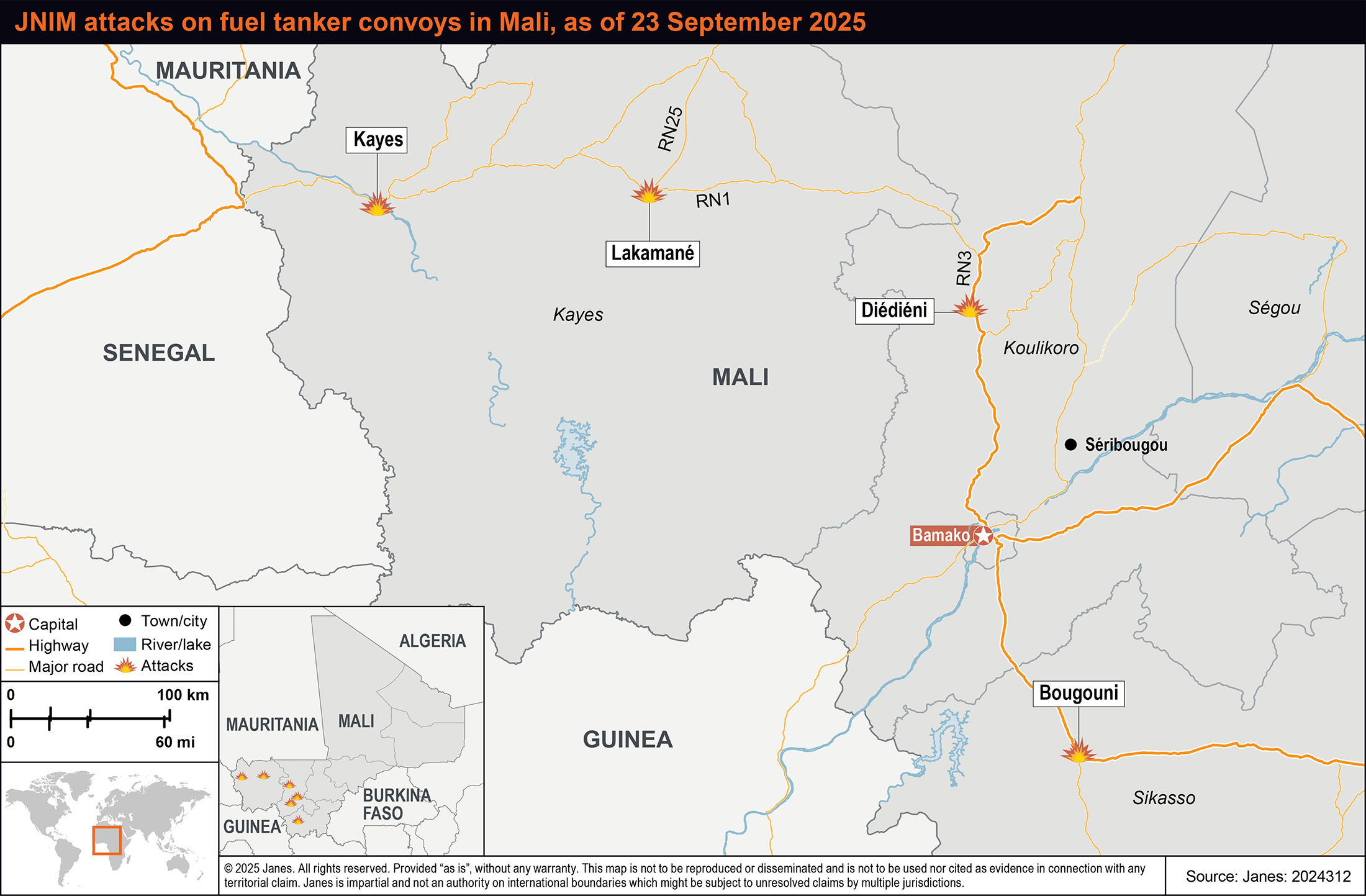 JNIM attacks on fuel tanker convoys in Mali, as of 23 September 2025. Image credit: Janes
Major Malian road highways, including RN1, Route Nationale 3 (RN3), and Route Nationale 25 (RN25), pass through Kayes and Nioro du Sahel and connect Senegal and Mauritania to Mali’s capital Bamako for fuel and food imports. The 14 September attack occurred between Kaniéra and Lakamané, located on RN1, which also links Bamako to Senegal’s ports, and RN25 gives Bamako access to Mauritania. Given the strategic importance of these cities for Mali’s economy, JNIM’s attempt to impose a blockade and continuous attacks on these routes passing through these cities likely impacts Mali’s fuel imports from Senegal and Côte d'Ivoire, as Mali is entirely dependent on imported petroleum products. According to the National Statistics Institute of Mali, Senegal and Côte d’Ivoire were the top two import countries for Mali in the first quarter of 2025, accounting for a respective 24.78% and 24.76% of the total value of Mali’s imports for that same period.
Local media, such as privately owned L’Indicateur du Renouveau and Studio Tamani, reported on 19 and 22 September respectively that fuel shortages and fuel price increases had been observed in Kayes and Mopti regions, which they attributed to the security crisis in the country. According to these reports, between 17 and 22 September, fuel price increases ranged from 13% in parts of Kayes region to 175% in the informal market in Mopti region. Fuel shortages would also affect Mali’s electricity generation. In 2024, Mali required 500 million litres of fuel to cover 100% of its electricity generation demands, according to a March 2024 statement by Abdoulaye Djibril Diallo, then director general of state-owned electricity supplier Énergie du Mali.
Moreover, on 19 August, JNIM besieged Farabougou, a town located on RN31 in Mali’s Ségou region near the southern Mauritanian border. Janes assesses that the siege of Farabougou, where FAMa’s Farabougou Base is also located, is likely of strategic importance for JNIM to further expand its activities in central Mali. The town is located near the Wagadou/Ougadou forest, an area that has been used as a hideout initially by Al-Qaeda in the Islamic Maghreb (AQIM) and then by JNIM since the group’s formation in 2017. JNIM previously captured Farabougou on 6 October 2020 and held the town until Malian forces led by General Assimi Goïta, incumbent president of Mali, secured the town on 22 October. However, the delay by the Malian military government to secure the town from JNIM militants further challenges the military government’s capability to limit JNIM’s expansion in the rest of Mali’s regions.
for more information, please visit: JNIM attacks on fuel tanker convoys in western Mali underline broader risks to government and social stability