Kremlin insider: Russia's reactions to ‘European Readiness 2030' indicate Kremlin will almost certainly continue and expand on its own rearmament plans
Date Posted: 16-May-2025
Author: Alex Petric, London
As Europe announces a comprehensive EUR800 billion (USD896 billion) rearmament, Alex Petric analyses how Russia's political, military, and industrial elites are reacting to the move and reviewing statements by Kremlin officials, Russia's defence budgets, and bilateral co-operation programmes
Key points
- Intelligence requirement/question: On 4 March 2025 European Commission President Ursula von der Leyen announced the European Readiness 2030, an EUR800 billion (USD896 billion) plan to strengthen Europe's defence capabilities. This report reviews Russia's responses to the plan over the March-May 2025 period. It analyses responses and indicators from Russian government officials and from Kremlin-aligned expert commentators. The report also analyses Janes Defence Budgets data on Russian military spending and Russia's defence and military-technical collaboration with China, Iran, and North Korea
- Significance : During March-May 2025, the key decision makers – the president, prime minister, ministers of defence or industry, or other high officials – made no significant direct public statements regarding Europe's rearmament, apart from the presidential spokesperson, Dmitry Peskov. Nevertheless, senior officials, including Russian President Vladimir Putin, did use several public engagements across the period to indirectly indicate the forward planning for the Russian military-industrial complex (MIC). This was accompanied by robust public debate among the experts on state TV networks, almost certainly intended to influence the public opinion to present Europe as a growing military threat
- Assessment and outlook: Janes assesses that the Russian political, military, and industrial decision makers will almost certainly, over the long term (12–24 months), continue with Russia's rearmament and reindustrialisation in parallel with Europe's plans. This assessment is based on how Russia perceived the ‘NATO threat' already prior to 2022, irrespective of the results of the Ukrainian conflict. Janes assesses that while Russian officials did not react directly to Europe's announcements, the Kremlin and broader military-industrial elite are almost certainly highly informed of Europe's plans. This is a high-confidence assessment, corroborated by analysis of media coverage of the topic in Russian outlets, publicity around Putin's defence-related engagements in March-May 2025, and Janes forecast figures for the Russian defence budget
Intelligence requirement/question
On 4 March 2025 European Commission President Ursula von der Leyen announced the European Readiness 2030, an EUR800 billion (USD896 billion) plan to strengthen Europe's defence capabilities. This report reviews Russia's responses to the plan over the March-May 2025 period. It analyses responses and indicators from Russian government officials and Kremlin-aligned expert commentators. The report also analyses Janes Defence Budgets data on Russian military spending and Russia's defence and military-technical collaboration with China, Iran, and North Korea.
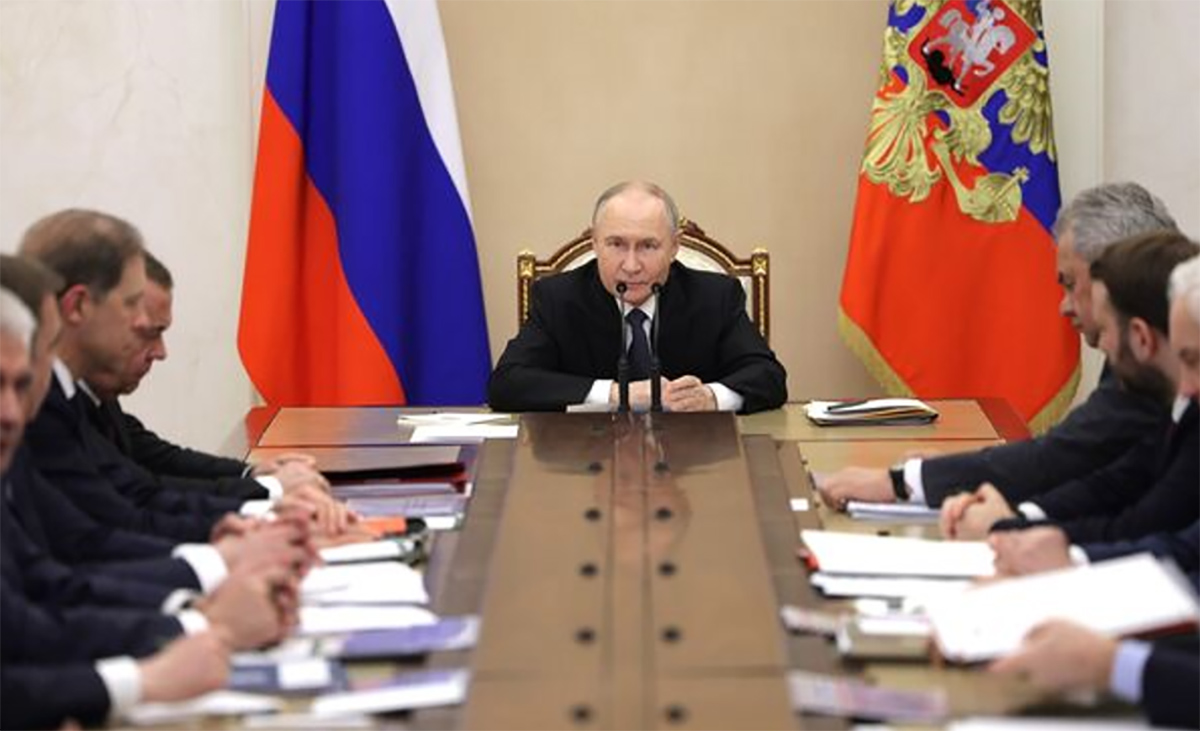 Russian President Vladimir Putin (in the centre) chairing a Military-Industrial Commission meeting in the Kremlin, Moscow, on 23 April 2025. (Kremlin (photographer not listed))
Significance
During March-May 2025, the key decision makers – the president, prime minister, ministers of defence or industry, or other high officials – made no significant direct public statements regarding Europe's rearmament, apart from the presidential spokesperson, Dmitry Peskov. Nevertheless, senior officials, including Russian President Vladimir Putin, did use several public engagements across the period to indirectly indicate the forward planning for the Russian military-industrial complex (MIC). This was accompanied by robust public debate among the experts on state TV networks, almost certainly intended to influence the public opinion to present Europe as a growing military threat.
Responses of the government officials
On 6 March Peskov – when asked to comment on Russia's position regarding Europe's rearmament plans – answered by quoting Putin's statement from earlier years, saying that “in the past, when Putin was asked about [the] rearmament race, the president said that Russia will never again be pulled into a race; rather, it will take such asymmetric steps that best ensure its security without risk of overspending”.
On 18 March Putin delivered a keynote speech outlining the Kremlin's views on Russia's long-term trajectory – to the congress of 1,300 members of the Russian Union of Industrialists and Entrepreneurs (Rossiyskiy soyuz promishlyennikov i pryedprinimatyelyey: RSPP) – the country's leading business lobby of the largest industrial conglomerates. Putin stated that his speech “addresses Russia's sovereignty”, its “long-term business prospects”, and “is important for entire industries”. Putin praised the adaptability of large businesses, saying that “sanctions became a catalyst for positive structural economic changes, including in the technological sectors”. Drawing special attention to Western sanctions, Putin stated that “28,595 sanctions have been imposed against Russian individuals and legal entities”. He warned the audience that “sanctions are the new reality” and concluded that both the country and the industrialists in the audience “need to ensure intensive growth of the real economy through modernised manufacturing and increased productivity”.

President Vladimir Putin speaking to the Russian Union of Industrialists and Entrepreneurs on Russia's response to Western sanctions, hours before US President Donald Trump's call on 18 March 2025 in Moscow, Russia. (Kremlin official website)
On 23 April the Kremlin convened a meeting of the Military-Industrial Commission, a key decision-making body comprising 69 high-level government and military officials, as well as industrial executives, overseeing the co-operation between the Ministry of Defence and the MIC. Although the core of the meeting was closed to the public, the Kremlin published Putin's opening speech, almost certainly to showcase its ‘successes' both to adversaries and allies. Putin noted that in 2024 “almost all enterprises completed their state defence orders in full and on time”. He stated that in 2024 “production of certain items more than doubled, for example, munitions, communications systems, and electronic warfare”. He added that “troops received over 4,000 armoured vehicles, 180 combat aircraft and helicopters, as well as over 1.5 million of various UAVs [unmanned aerial vehicles]”. Putin praised the military industry's “high technological advances” and “the feedback loop with the front lines”.
When discussing the future, Putin stated that the MIC's tasks for 2025 are “ambitious” and that “the defence industry expansion and modernisation involve over 400 enterprises”. He emphasised “the increased production of unmanned systems, especially boats, marine systems, and lasers for engagement of targets, such as UAVs and, in future, [aircraft] or missiles”. He concluded with the expectation that the MIC must create “an orbital satellites constellation intended for [a] variety of purposes, from reconnaissance and closed-[loop] communication to peacetime training support”.
On 17 April Prime Minister Mikhail Mishustin, in a televised meeting, reaffirmed the government's support for the development of the domestic machine tooling industry, stating that “increased production of machine tools strengthens the manufacturing sectors and is important for Russia's industrial and technological sovereignty”.
The Kremlin also amplified the views of Aleksandr Lukashenko, President of Belarus, Russia's closest ally and a country whose industry is closely integrated into the Russian MIC. During his Moscow visit on 13 March, Lukashenko stated that “the EU [European Union] will struggle to agree on EUR800 billion as a number, and then they will struggle to find these funds”. In an interview for All-Russia State Television and Radio Broadcasting (Всероссийская государственная телевизионная и радиовещательная компания: VGTRK) on 15 March, Lukashenko stated that “Europe's rearmament is an alternative to NATO, created in response to a possibility that the US could leave NATO”. On 16 March the Minister of Foreign Affairs of Belarus, Maksim Ryzhenkov, in an interview with Belarus state TV, focused on the possible economic impact of Europe's rearmament on its citizens, claiming it “would weaken the value of the euro [and] increase prices and inflation”.
Russian military spending
According to Janes Defence Budgets data and forecasts, the Russian defence budget spending has increased substantially as a consequence of its invasion of Ukraine in 2022, from USD48.5 billion in 2022 to USD122.7 billion in 2024. By December 2023 there were 617,000 military personnel serving on behalf of Russia in relation to the Ukrainian conflict: a figure equivalent to 1% of the country's labour force. Increased materiel funding required for the conflict had increased the defence procurement budget from USD13 billion in 2022 to USD36.4 billion in 2024, leading to a ramp-up in activity of the defence industrial complex. Janes forecasts for 2025–29 estimate that Russia's defence procurement will peak at USD42.5 billion in 2025, before plateauing between USD37.8 billion in 2026 and USD33 billion in 2029, staying at approximately three times the levels of funding from before the Ukrainian conflict began.
For more information, please see Kremlin insider: Russia's reactions to ‘European Readiness 2030' indicate Kremlin will almost certainly continue and expand on its own rearmament plans