Myanmar conflict report, January-March 2025
Intelligence requirement/question
This report assesses developments in the Myanmar conflict between 1 January and 31 March and how the conflict is affecting national and regional security. It includes the following intelligence questions:
- What are the strategic objectives and operational activities of militant groups in Myanmar?
- How are the State Administration Council (SAC) and security forces responding to the insurgency?
Conflict overview
Janes assessment: Janes assesses with a high level of confidence that fighting between non-state armed groups (NSAGs) and SAC forces will very likely continue in the next three to six months in Ayeyarwady, Bago, and Tanintharyi. In the likely absence of a ceasefire in the next three months, Arakan Army (AA) militants will likely continue making inroads in these provinces and target SAC military installations. The conflict in other regions is also likely to be driven by People’s Defence Forces (PDF) militants. The medium likelihood of further flooding due to intense rains and typhoons, such as Typhoon Yagi in 2025, may hinder the NSAGs’ capability of conducting co-ordinated offensives.
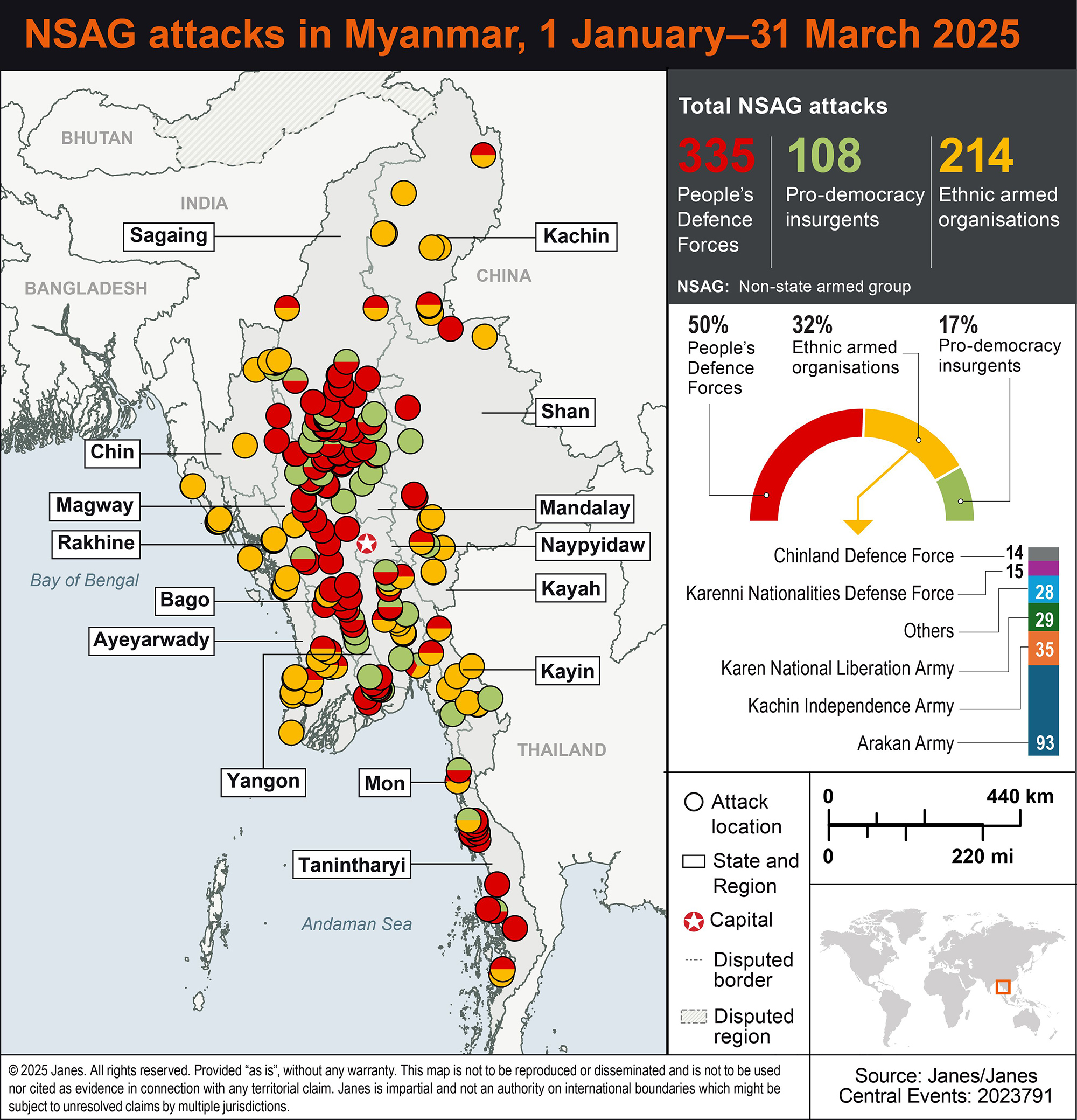 Image caption: NSAG attacks in Myanmar, 1 January–31 March 2025
Image credit: Janes Central Events
© Janes Central Events
Janes recorded 595 attacks by NSAGs across the country between 1 January and 31 March. Pro-democracy insurgents were involved in approximately 17% of the attacks, the PDFs in approximately 50% of attacks, and the ethnic armed organisations (EAOs) in roughly 32% of attacks. Pro-democracy insurgents include armed militants and groups whose affiliations Janes could not verify. Such members are neither part of the EAOs nor the National Unity Government (NUG)-affiliated PDFs but have taken up arms against the SAC. There were also instances of attacks where the groups collaborated with each other.
There was a 10% decrease in the number of attacks in January–March (595) compared with October–December 2024 (668), indicating a continuation of the conflict without any significant decrease in the number of attacks. A likely driver behind the decline in the number of attacks was the unilateral ceasefires from Myanmar National Democratic Alliance Army (MNDAA) and Ta’ang National Liberation Army (TNLA) militants – members of the Three Brotherhood Alliance – which led to fewer attacks in Shan and Kachin states. The alliance members, along with AA militants, were the drivers behind the anti-SAC ‘Operation 1027’ and led the offensives impactfully for over a year. It is also likely that the attacks reduced in the face of increasing airstrikes. It is highly likely that pressure from China on the TNLA to agree to a ceasefire – even though this was unsuccessful – and SAC military pressure led to a decline in logistical support for TNLA-backed PDFs, resulting in fewer attacks. According to the data collected by a network of 16 independent media and news organisations under the Myanmar Peace Monitor and retrieved by Janes on 23 April 2025, the number of airstrikes started increasing in January (67) after a brief lull in December 2024 (55). They further increased in February 2025 (103) and March (86). The highest number of airstrikes in December 2024, and January and March 2025 were conducted in Rakhine state in response to AA advances through and beyond the state.
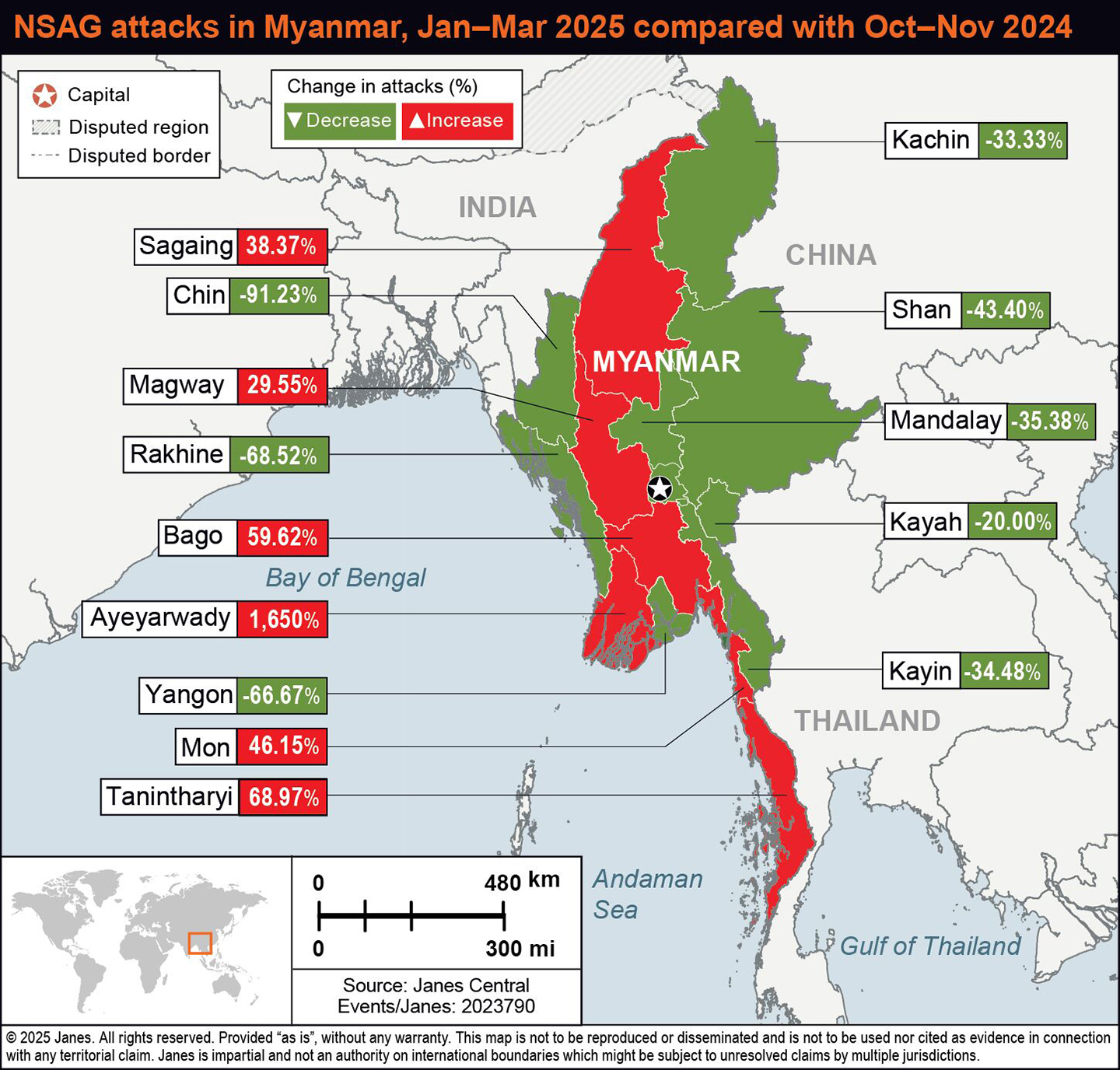 Image caption: NSAG attacks in Myanmar, Jan–Mar 2025 compared with Oct–Nov 2024
Image credit: Janes Central Events/Janes
© Janes Central Events/Janes
Domestic developments
SAC and elections
Janes assessment: The elections are very likely to proceed in December. Janes has a moderate level of confidence in this assessment, as it is the last agenda of the SAC’s Five-Point Roadmap and the junta’s route to political legitimacy. A surge in violence is almost certain to occur from early November 2025 to February 2026, as anti-SAC forces denounce the elections.
According to a report by the SAC state media on 8 March 2025, Senior General Min Aung Hlaing on 7 March announced that the general elections are slated for December 2025 or January 2026, at the latest. This is the first time since the 2021 coup that a tentative timeline for a general election was announced. Sr Gen Hlaing later reaffirmed the timeline on the 79th Armed Forces Day on 27 March; the first past the post (FPTP) voting electoral system will be implemented for election to the Pyithu Hluttaw (the lower house) and a proportional representation (PR) system for the Amyotha Hluttaw (the upper house) and regional Hluttaw. The SAC almost certainly considers the election as a road map to domestic and international legitimacy after the 2021 coup by the Tatmadaw. The PR voting electoral system allows the SAC to leverage the pro-SAC parties, especially the Union Solidarity and Development Party, to act as a successor to the SAC rule without drastic changes to the status quo of governance. The elections are only likely to be further delayed or cancelled if anti-SAC forces launch a nationwide offensive, especially targeting the Bamar heartland, or as the result of an internal SAC power struggle. Janes assesses the probability of both events being very unlikely as of April 2025.
International developments
China
Janes assessment: Janes assesses with a high level of confidence that China is very likely to continue to seek to influence the trajectory of the conflict in Myanmar to protect its own interests over the next three to six months. Despite facilitating a successful ceasefire agreement between the junta and the MNDAA in January, China is unlikely to influence other EAOs such as the TNLA, AA, and KIA to pursue similar agreements with the junta in the next three to six months.
China continued to support the SAC while putting pressure on the EAOs to stop fighting in Myanmar. China’s strategy for pressuring the EAOs in Myanmar primarily involves the use of border closures and trade restrictions to adversely impact the local economy in EAO-controlled areas. This strategy resulted in varying degrees of success for China and the SAC between January and March.
Russia
Janes assessment: Janes assesses with a high level of confidence that Russia’s bilateral ties with Myanmar are likely to remain stable over the next three to six months. Sr Gen Hlaing’s first official visit to Russia in March led to several agreements to enhance socio-economic co-operation, which likely eased some economic burdens and bolstered the regime’s legitimacy. Defence ties with Russia are likely to help improve and expand drone-jamming and intelligence, surveillance, and reconnaissance (ISR) capabilities over the next three to six months but not guarantee an advantage for the SAC.
For more information, please see Myanmar conflict report, January – March 2025