Special Report: North Korea’s new submarine to reshape underwater warfare in Northeast Asia

North Korea’s claimed construction of its first nuclear-powered submarine represents a pivotal milestone in the country’s naval modernisation drive.
The submarine, described by the state-run Korean Central News Agency (KCNA) as an “8,700 tonne-class nuclear-powered strategic guided-missile submarine”, was revealed in greater detail in late December 2025 following a visit by North Korean leader Kim Jong-un to an undisclosed shipyard.
This disclosure followed earlier hints in March 2025, when KCNA released partial images of the hull under construction.
The emergence of the boat is aligned with Pyongyang’s intention – outlined at the Eighth Congress of the Workers’ Party of Korea in 2021 – to field nuclear-powered submarines.
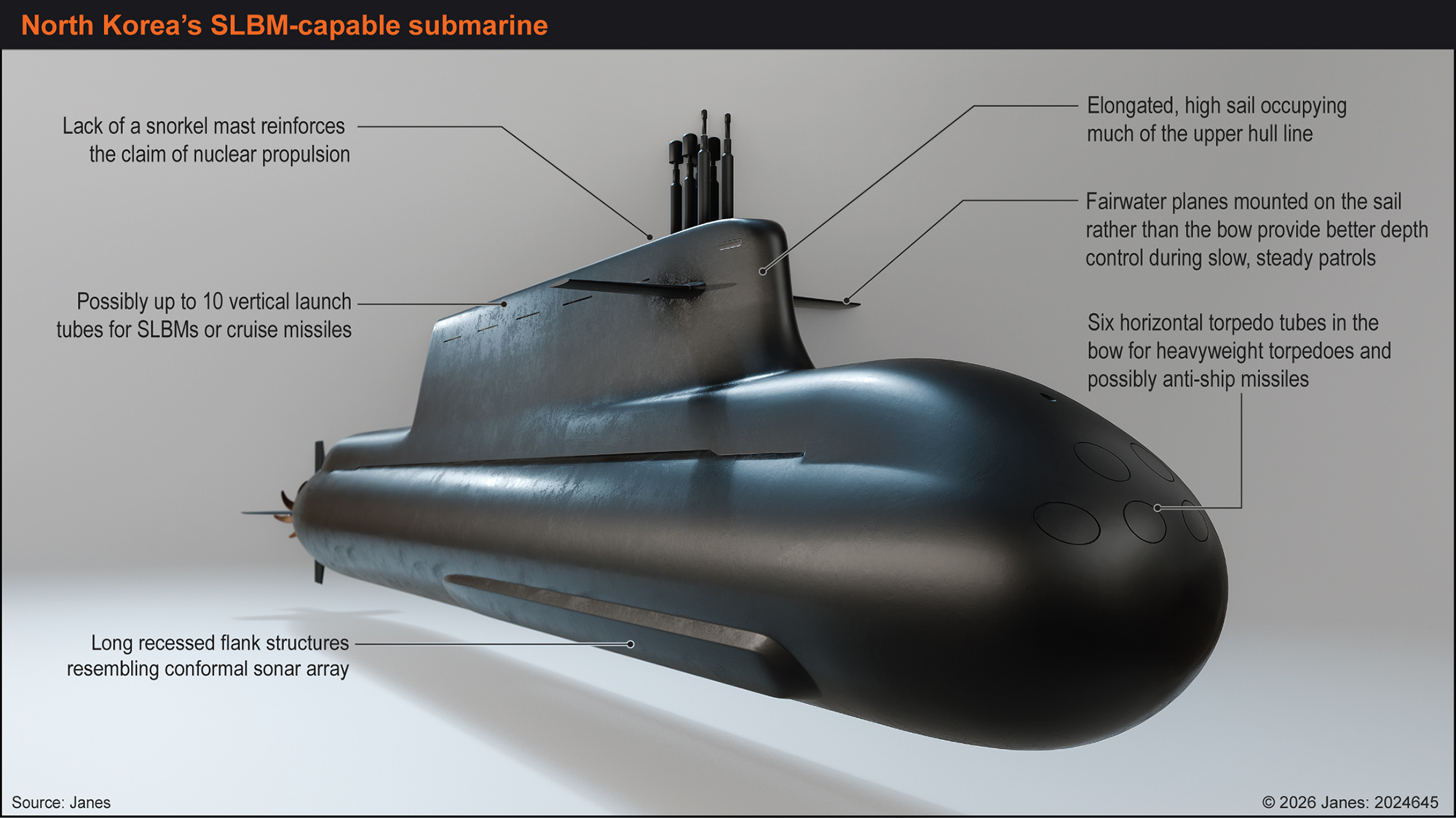 A 3D visualisation of North Korea’s SLBM-capable submarine, based on <i>Janes </i>analysis of images released by KCNA between March and December 2025.
Image credit: Janes
Atypical design
Analysis of the submarine’s design, based on images released by KCNA, indicates that its configuration is unconventional compared with other ballistic missile submarines in service with established operators today.
An elongated sail dominates the submarine’s upper hull line and appears to house between eight and 10 vertical launch hatches, suggesting a substantial missile payload.
This sail-mounted configuration is unusual, as modern ballistic missile submarines globally integrate launch tubes within the pressure hull to maintain structural integrity and hydrodynamic efficiency.
A reason why North Korea might have opted for this sail-mounted missile configuration is to simplify the integration of vertical launch systems without extensively redesigning the pressure hull.
This approach allows Pyongyang to field a submarine with SLBM capability more quickly while working within its technological constraints, and it likely mirrors the design philosophy adopted by Russian engineers for the Delta-class nuclear-powered ballistic missile submarines (SSBNs) that entered service with the Russian Navy in the 1970s.
Such an approach strengthens suppositions that North Korea may have received Russian assistance in the building of this submarine.
Notably, the absence of a snorkel mast reinforces claims of nuclear propulsion, as the vessel would not require atmospheric air for diesel engines.
North Korea has also opted to mount the submarine’s fairwater planes on the sail rather than the bow. This suggests a requirement from the Korean People’s Navy for improved depth control during slow patrols.
Such a capability improves the submarine’s stability and manoeuvrability when maintaining stealth in shallow waters or while loitering near potential launch areas.
The submarine also appears to have long flank structures that likely house conformal sonar arrays to complement its bow sonar.
Physically, the submarine’s size represents a leap from previous North Korean designs. At an estimated displacement of 8,000–8,700 tonnes, it dwarfs the Gorae-class experimental ballistic missile submarine, which displaces roughly 1,500 tonnes.
Furthermore, the new submarine’s dimensions suggest extended endurance and operational range, enabling it to patrol far beyond coastal waters and complicate adversary anti-submarine warfare (ASW) efforts.
Nuclear propulsion would enable sustained submerged operations, thereby reducing vulnerability to detection and pre-emptive attack. This endurance is a critical requirement for the platform to achieve credible second‑strike capability.
The hull form is relatively bulbous at the bow, which suggests that the submarine will integrate a fairly large sonar for improved detection of surface and subsurface threats.
Its stern is unseen in official imagery, but it may feature a pump-jet or conventional propeller arrangement.
The presence of what appears to be six horizontal torpedo tubes in the bow indicates that the submarine retains a conventional attack capability, enabling it to engage surface ships or other submarines with heavyweight torpedoes.
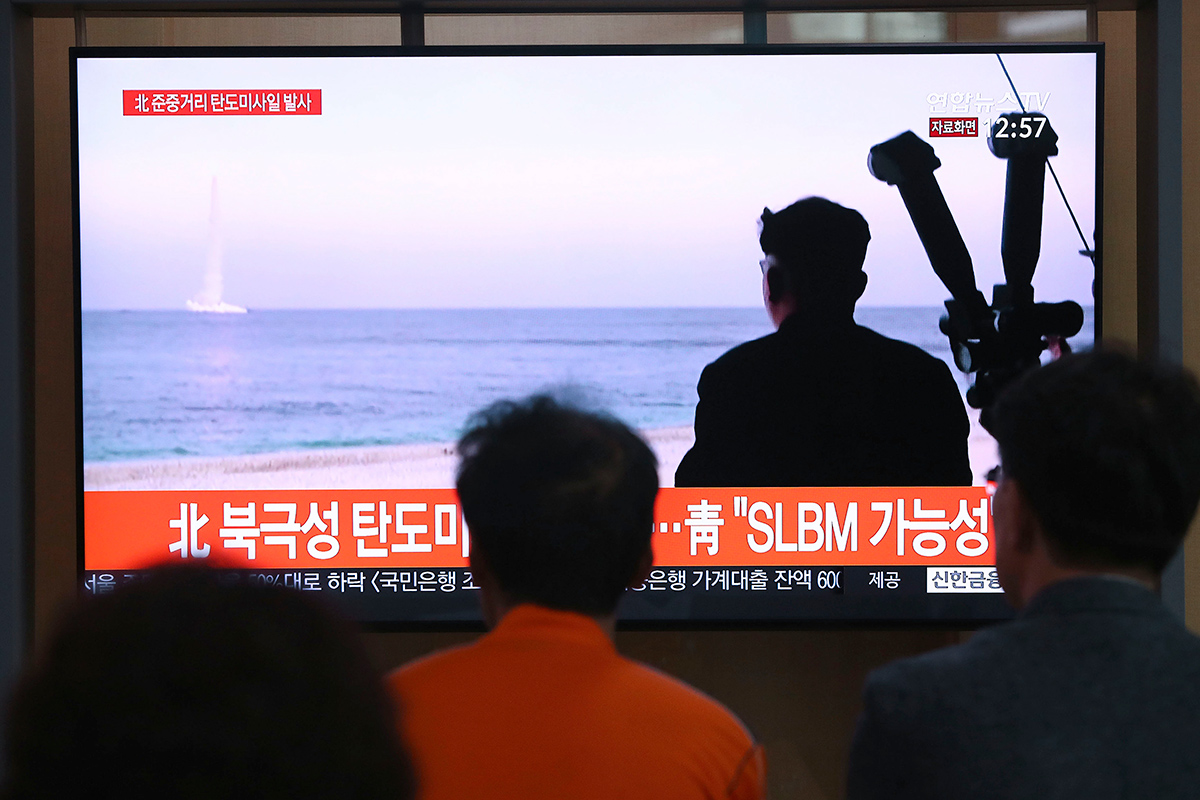 People watch TV footage, showing a file image of a North Korean missile launch, at the Seoul Railway Station in October 2019 in Seoul. South Korea’s military said at the time that the missile was an SLBM.
Image credit: Chung Sung-Jun/Getty Images
For more information, please see Special Report: North Korea’s new submarine to reshape underwater warfare in Northeast Asia