Operation Spiderweb: Covert Drone Strike Inside Russia
Activity analysis: SBU FPV drone strike damages and destroys Russian combat aircraft at four airbases
On 1 June 2025 the Security Service of Ukraine (SBU) executed co-ordinated strikes using first-person view (FPV) drones primarily targeting Russian Aerospace Forces (VKS) long-range bombers and special-purpose aircraft at five airbases deep inside Russian territory. The airbases targeted were Olenegorsk, Belaya, Ukrainka, Ryazan-Dyagilevo, and Ivanovo-Severnyy. The planned strike on Ukrainka was unsuccessful as munitions exploded en route to the airbase.
Operation Spiderweb: Ukraine’s Covert Drone Strike Deep Inside Russia
The operation, known as ‘Spiderweb’ (‘Pavutyna’), was the culmination of 18 months of planning, involved smuggling drones and explosives into Russia and employed special, purpose-built wooden containers assembled in Russia. According to official Ukrainian statements, 117 drones were transported by truck to staging locations near the targeted airbases. The containers, engineered with remotely opened roofs, enabled the rapid and simultaneous deployment of the drones. Video footage with smoke in the background matching the area of Belaya airbase corroborated the description of the operation.
Released control footage indicated that the FPV drones were operated using ArduPilot Mission Planner software, which is capable of transmitting telemetry data over 3G/4G cellular networks to pilots located remotely, suggesting that operators may have flown the mission from within Ukrainian territory. The software also supports pre-programmed autonomous flight to designated waypoints, a capability visibly demonstrated in the screen-grab. Upon reaching their mission areas, operators likely assumed manual control to guide the drones precisely towards specific targets.
AI-Guided Drones and Russian Aircraft Losses
While Ukrainian President Volodymyr Zelensky has emphasised the role of individual FPV operators, Ukraine was also prepared for potential signal disruptions caused by Russia’s extensive employment of electronic warfare. According to the SBU, “During the flight, some drones lost signal and switched to performing a mission using artificial intelligence along a preplanned route. After approaching and contacting a specifically designated target, the warhead was automatically activated.”
Russia’s Ministry of Defence issued a statement claiming that the drone attacks were successfully repelled in the Amur, Murmansk, and Ivanovo regions, corresponding to Ukrainka, Olenegorsk, and Ivanovo-Severnyy airbases respectively, but conceded that strikes in Murmansk and Irkutsk, corresponding to Olenegorsk and Belaya airbases respectively, resulted in fires affecting multiple aircraft. Additional Russian reporting on the incident has been limited, and it remains unclear how Russia will respond.
To better understand Russian losses, Janes analysed video footage of the attack and satellite imagery pre- and post-attack. Based on the available evidence, including the ability to correlate video footage to aircraft on the ground visible in imagery, Janes assesses that the FPV drone attack destroyed 12 aircraft, damaged two, and possibly damaged eight others. Seven Tu-95MSs (‘Bear-H’), four Tu-22M3s (‘Backfire-C’), and one An-12 (‘Cub’) were destroyed. One Tu-22M3 and one Tu-95MS were confirmed damaged. Two A-50s (‘Mainstay’), five Tu-22M3s, and one Tu-95MS were possibly damaged.
Olenegorsk Military Airbase
Olenegorsk airbase is located approximately 30 km northeast of Monchegorsk on the Kola Peninsula. Olenegorsk is home to the 40th Composite Aviation Regiment (SAP), operating Tu-22M3 bombers, An-12 transports, and Mi-8 (‘Hip’) helicopters. 121st Guards Heavy Bomber Aviation Regiment (GvTBAP) Tu-95MS bombers deployed from Engels airbase also operate from Olenegorsk.
Five aircraft were destroyed at Olenegorsk during the 1 June FPV drone strike, with two aircraft possibly damaged. Planet imagery captured on 29 May shows the position of two 40th SAP Tu-22M3 bombers possibly damaged in the attack. Video footage showed FPV drones landing on the two aircraft.
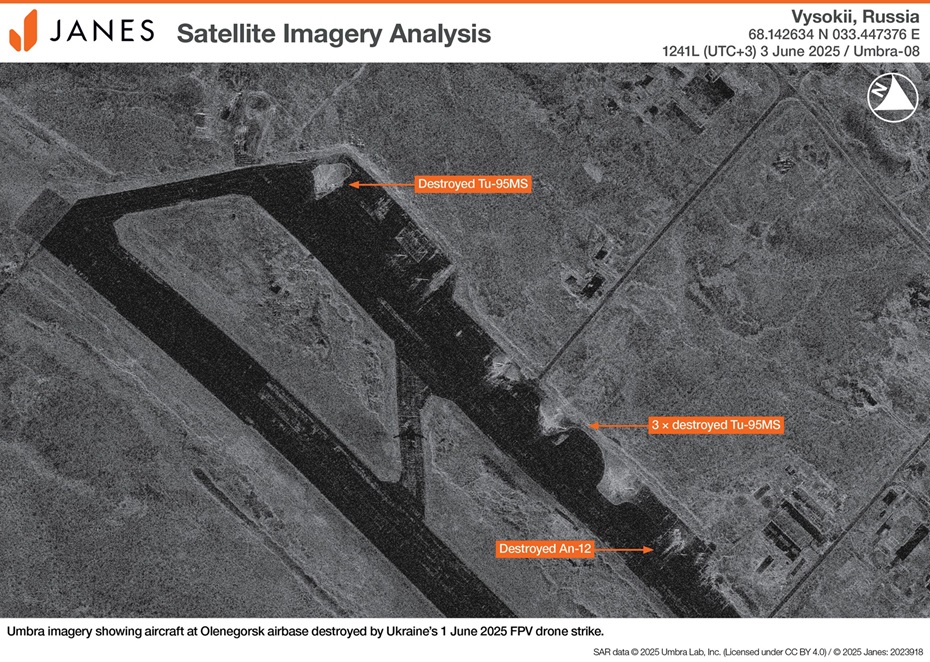
Umbra synthetic aperture radar (SAR) imagery captured on 3 June shows four destroyed 121st GvTBAP Tu-95MS strategic bombers and a destroyed 40th SAP An-12 transport. Video footage showed one drone flying underneath a Kh-101 (AS-23 ‘Kodiak’) cruise missile mounted underneath the port inner wing of one of the Tu-95MS bombers.
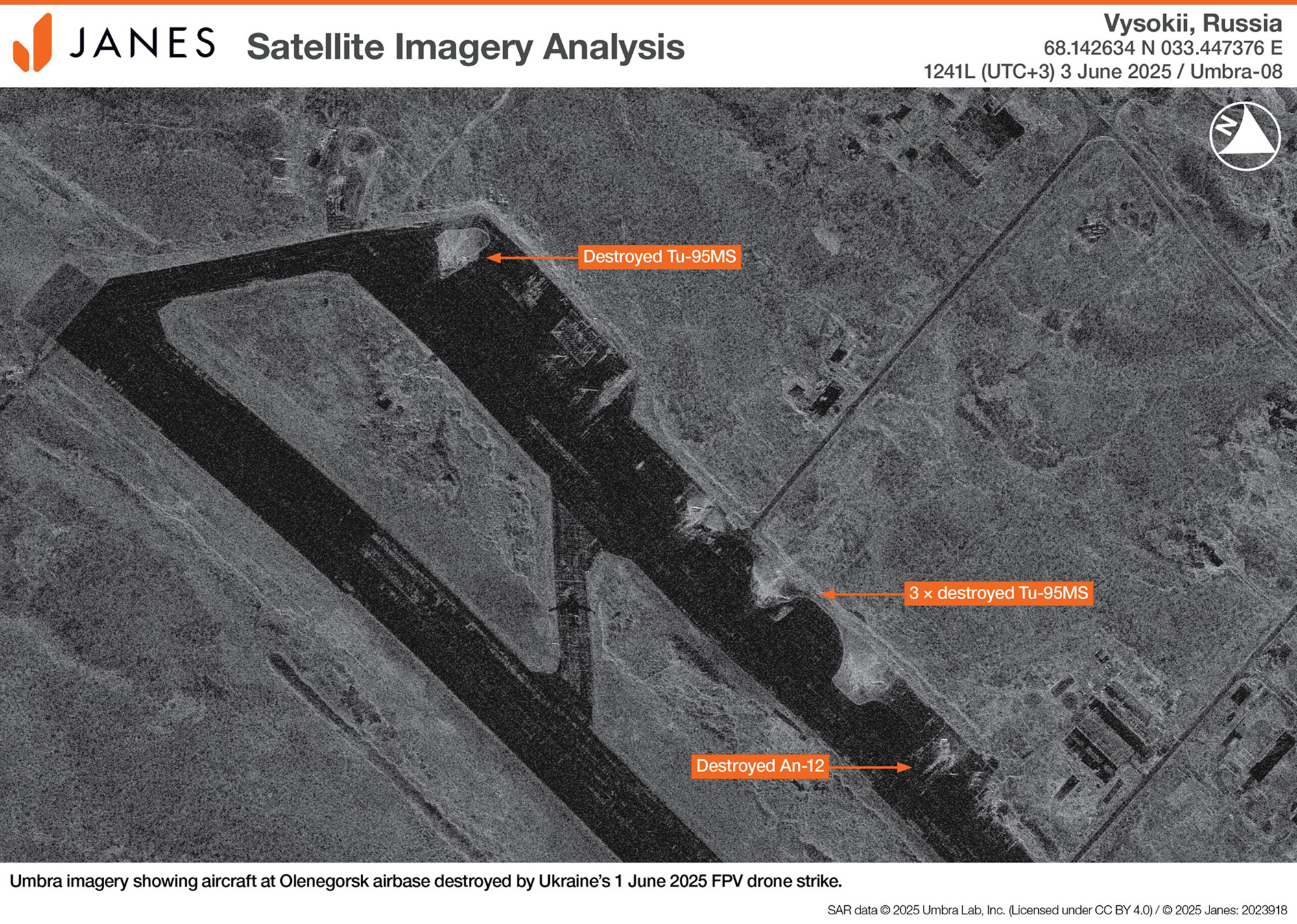
Image caption: Umbra satellite imagery showing military aircraft at Olenegorsk airbase destroyed by Ukraine’s 1 June 2025 FPV drone strike.
Image credit: SAR data © 2025 Umbra Lab, Inc. (Licensed under CC BY 4.0)/© 2025 Janes
© SAR data © 2025 Umbra Lab, Inc. (Licensed under CC BY 4.0)/© 2025 Janes
To read more, please see Operation Spiderweb: Covert Drone Strike Inside Russia