Russia almost certainly intends to use US peace plan as stepping stone to solidify and expand territorial gains in Ukraine
Event
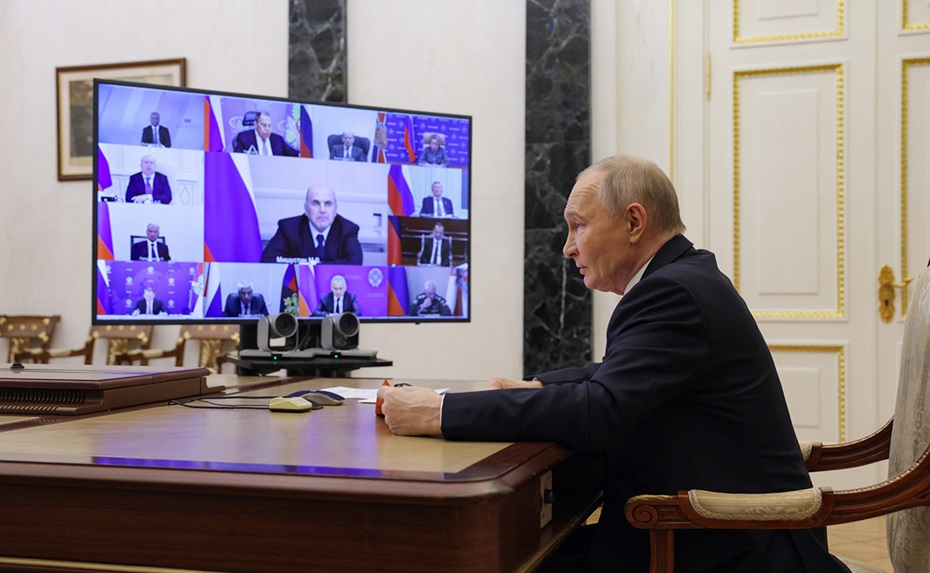
On 21 November Russian President Vladimir Putin held a meeting with the Security Council members to discuss the US-proposed 28-point Ukraine peace plan, signalling it could serve as a basis for a final peace settlement after “details” are agreed with Russia. The previous day, Putin, dressed in military uniform, visited the command post of the West Group of forces to hear and discuss the detailed battle reports with his military leadership.
Putin emphasised that earlier, after the US-Russia Alaska summit in August 2025, the Kremlin had briefed all partner countries, including China, India, South Africa, and Brazil, that all partners had supported Russia’s potential willingness for a diplomatic solution to the Ukraine conflict.
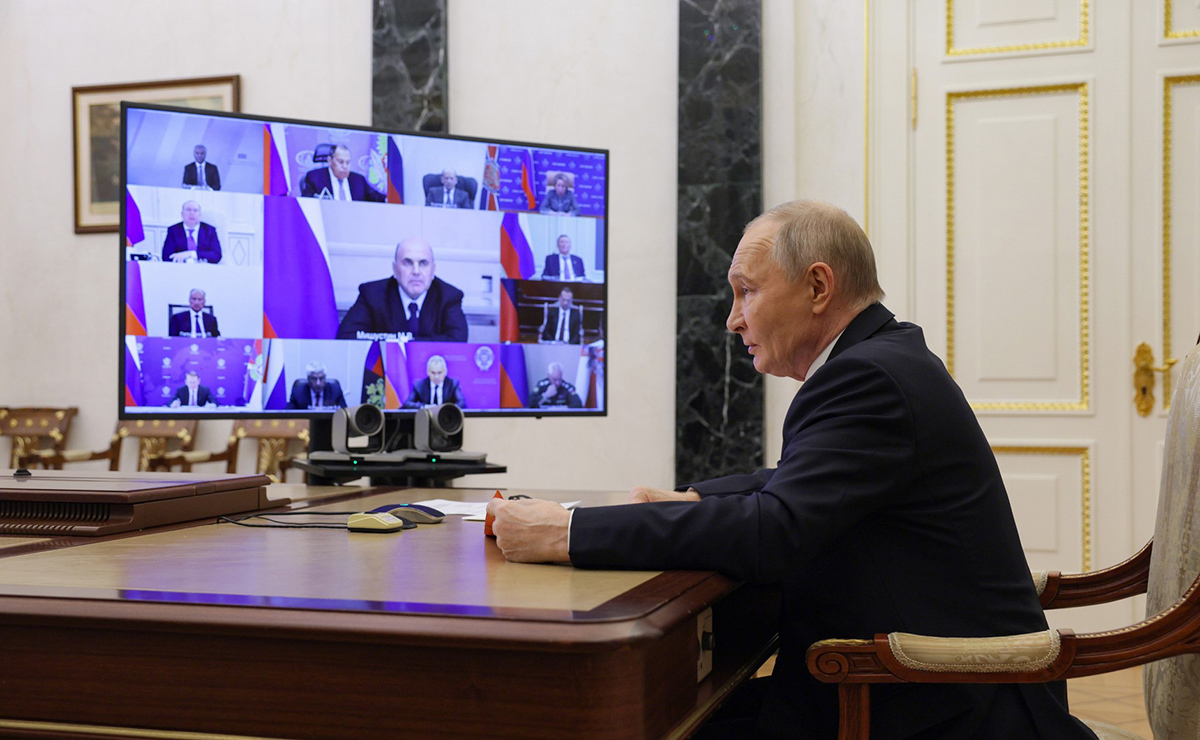 Russian President Vladimir Putin addressing members of the Security Council on 21 November 2025.
Image credit: Kremlin
Significance
In signalling Russia’s likely response to the 28-point peace plan, Putin used both televised opportunities – the meeting with the Security Council and the visit to military commanders – to discuss the Russian military’s advances, encirclements of Ukrainian forces, and future attack directions towards Ukrainian positions in Donetsk, Dnipropetrovsk, and Zaporizhzhia regions, as well as creating buffer zones in Kharkiv and Sumy regions.
In a speech on 21 November, Putin attributed the fact that the US had not yet discussed the peace plan with Russia in detail to Washington’s presumed failure to “secure Ukraine’s consent”. He asserted that “Ukraine and its European allies remain under the illusion of inflicting strategic defeat to Russia”, implying that this position likely stems from “lack of objective information from the battlefronts”.
On 20 November, the military commanders briefed Putin regarding the front-line situation, specifically:
- the towns of Kupyansk, Kupyansk-Uzlovoy, and the Oskol river’s eastern bank
- Russian attacks towards Krasnyi Lyman and Rubtsi and urban battles in the towns of Konstantinovka and Seversk
- Ukraine’s attempts to unblock its forces encircled in the Pokrovsk-Myrnohrad agglomeration.
The commanders asserted that the situation in Zaporizhzhia and Dnipropetrovsk regions is also developing in Russia’s favour, that the Russian military is successfully expanding its zone of control, pushing westwards by circumventing Ukraine’s main fortified strong points.
In an indication that Russia’s end goal is almost certainly capturing the entire Donetsk region, the commanders explained that Russian forces – in pursuing “the Kramatorsk direction” – are concentrating efforts to first capture the town of Konstantinovka. Kramatorsk, with a metropolitan area population of 200,000, remains the largest unoccupied settlement in the Donetsk region, which is still under Ukraine’s control.
Outlook
Janes assesses that Russia very likely intends to use the peace plan to reinforce and expand its territorial and diplomatic gains while avoiding significant concessions or agreeing to credible security guarantees for Ukraine. Over the next six months, Russia will almost certainly continue efforts – military or diplomatic – to secure control over remaining areas of Donetsk, Kherson, and Zaporizhzhia.
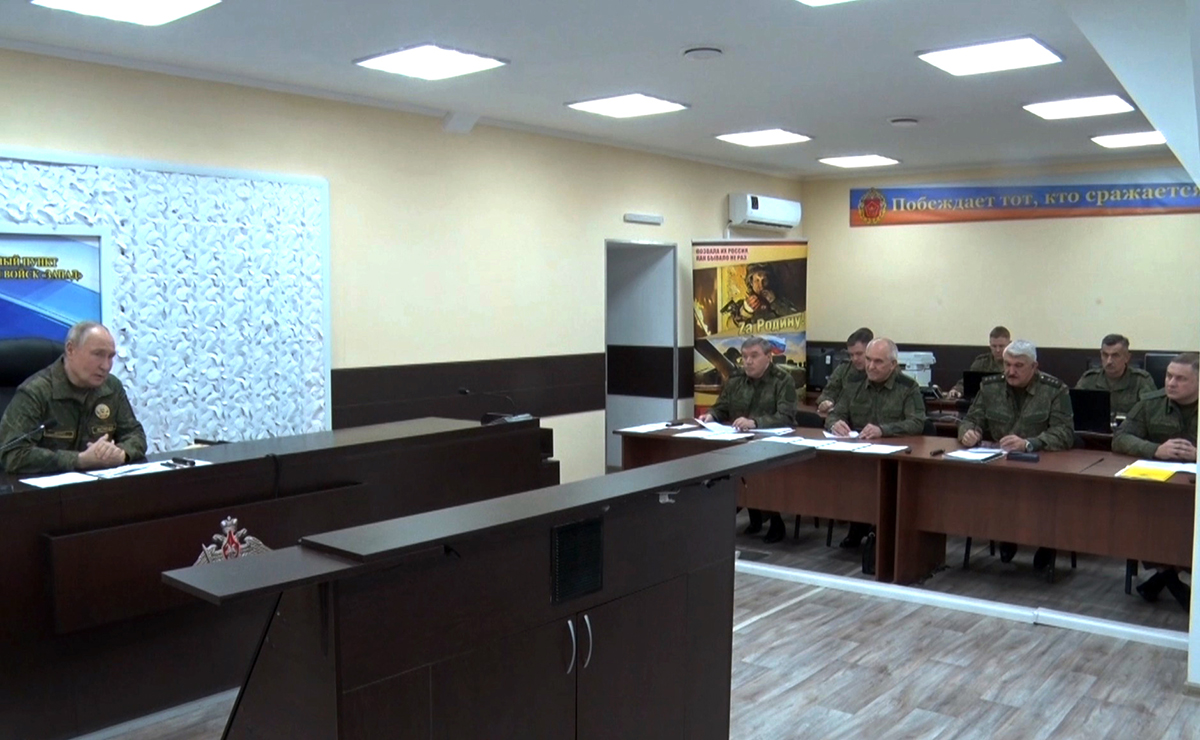 Russian President Vladimir Putin, as commander-in-chief, visiting the command point of the West Group of forces on 20 November 2025.
Image credit: Kremlin
Strong indicators of this are Putin’s regular, detailed, and highly public military briefings with the Russian military’s General Staff, such as those on 20 November or 25 October 2025. The Kremlin almost certainly considers itself in an advantageous position on the front line, while Kyiv struggles with financial, mobilisation, and corruption issues.
Putin reiterated the Kremlin’s commitment to achieving the objectives of the special military operation and “achieving the tasks set by the country and the people”.
In an indication that Russia will very likely insist on a change of government in Ukraine, Putin on 20 November 2025 insisted that Ukrainian leadership had lost legitimacy, and that since 2024 the Kyiv government had become “a criminal gang, an organised criminal enterprise, which had usurped power”.
Risk positive indicator
- There is genuine willingness for a diplomatic solution and territorial concessions also from the Ukrainian side.
Risk negative indicator
- Russia continues, or redoubles, its broad offensive attacks, successfully breaching Ukrainian defences in multiple areas.
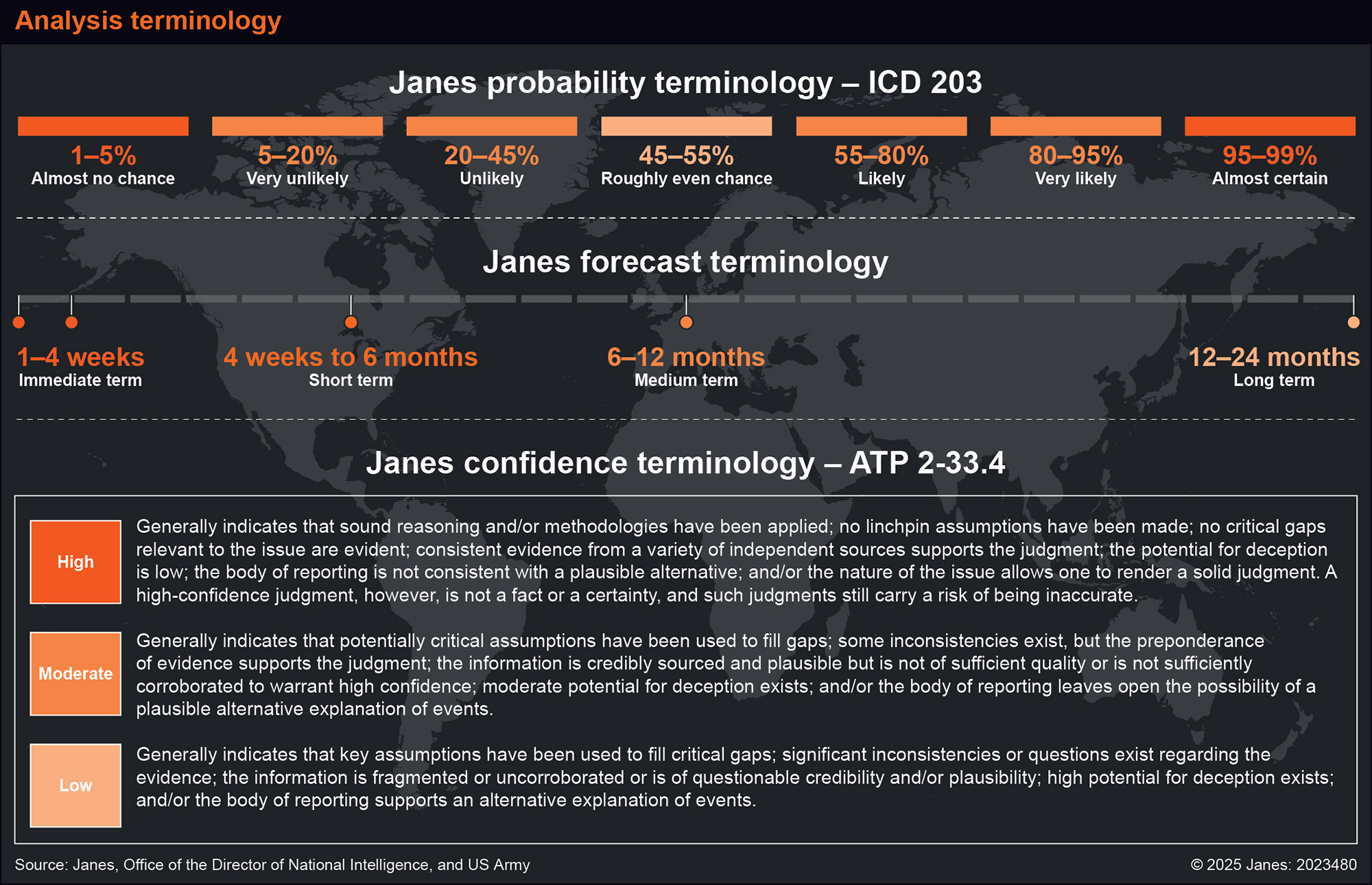 Image caption: Analysis terminology.
Image credit: Janes