South African withdrawal of UN peacekeeping force in DRC likely to increase instability risk from Islamic State affiliate
Event
President of South Africa Cyril Ramaphosa issued a statement on 8 February announcing South Africa’s intent to withdraw the remainder of its troops committed to the United Nations Organization Stabilization Mission in the Democratic Republic of the Congo (MONUSCO) by the end of 2026. This is likely because of reducing United Nations (UN) funding for peacekeeping operations.
The statement issued via the South African presidency website said Ramaphosa informed UN Secretary General António Guterres of the decision in a phone call on 12 January. This means the decision was likely made at least a month before the announcement.
The announcement followed a 5 December 2025 briefing by the South African National Defence Force (SANDF) to South Africa’s parliamentary committee on defence affairs, the Joint Standing Committee on Defence (JSCD), which cited reductions to UN peacekeeping funding globally to explain the withdrawal of SANDF contributions to MONUSCO over 2025. These withdrawals included a composite helicopter unit (CHU) and a quick reaction force (QRF). This explanation for the 2025 withdrawals indicates UN funding gaps very likely contributed to the decision to withdraw the last of the SANDF’s troops in 2026.
The briefing to the JSCD confirmed that the deployment to MONUSCO’s 2026 rotation comprised an infantry battalion attached to the Force Intervention Brigade (FIB), known as the Republic of South Africa Battalion (RSABATT), and a Tactical Intelligence Unit (TIU) attached to MONUSCO’s logistics and staff function, both of which have deployed alongside the CHU and QRF since 2014. Combined, this force is likely to have around 700 personnel, based on UN figures for the 2025 rotation.
The RSABATT has its main operating base (MOB) at Mavivi airport, near Beni, Nord Kivu province. Its 2025 rotation had deployed to the Democratic Republic of the Congo (DRC) at a reduced strength and returned to South Africa in early November, with the 2026 rotation due to deploy in December 2025. However, the SANDF had not confirmed the rotation’s deployment at the time of publication.
Significance
Janes assesses that South Africa’s contribution to MONUSCO has played an important role in security forces operations against the Islamic State – Wilayat Wasat Afriqiyya, also known as the Allied Democratic Forces (ADF), which threatens the stability of Nord Kivu province in the Democratic Republic of the Congo (DRC).
Janes has moderate confidence in this assessment because the RSABATT’s MOB at Mavivi airport means it has been at the centre of the geospatial pattern of attacks by the ADF over the last 12 months, with the unit’s likely area of operations around the MOB mainly focused on this group.
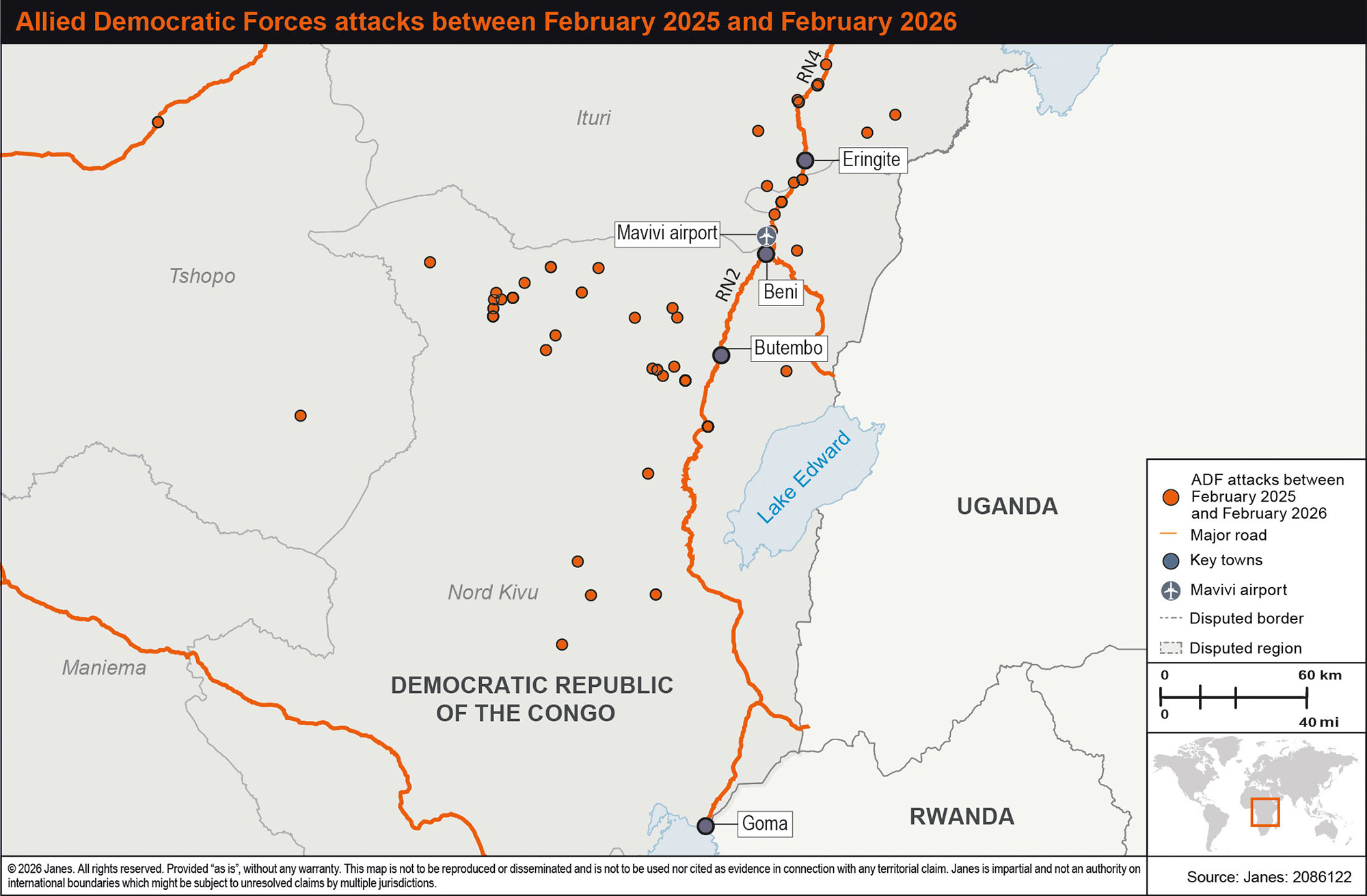 Allied Democratic Forces attacks between February 2025 and February 2026, Image credit: Janes
The ADF predominantly targets civilians, raiding villages and internally displaced persons (IDP) camps, as well as conducting ambushes and blocking roads, which the group uses to extort money from locals. Janes data indicate the ADF is particularly active along Route Nationale 2 (RN2) and Route Nationale 4 (RN4) between Butembo, Beni, and the border with Ituri province to the north.
Following the Mouvement du 23 Mars’s (M23’s) capture of MONUSCO’s former MOB at Goma airport in January 2025, RSABATT’s operational focus shifted towards Beni in northern Nord Kivu over the rest of 2025. Over the same period, Janes data indicate the Armed Forces of the DRC (Forces armées de la république démocratique du Congo: FARDC) became increasingly focused on operations against the M23 in southern Nord Kivu province and Sud Kivu province. As a result, the importance of the RSABATT’s operations against the ADF in northern Nord Kivu increased over 2025.
Outlook
The RSABATT’s withdrawal from its contribution to MONUSCO likely increases the risk of attacks by the ADF in the medium term (6–12 months) and increases the risk of the group expanding its source of revenue and area of operation in the long term (12–24 months).
The ADF attacks against civilians are likely to increase in the six months following the withdrawal of the RSABATT, if there is a reduction in patrols by MONUSCO.
The RSABATT’s withdrawal will also mean a more permissive environment for the ADF over the long term. This will allow the group easier access to major roads, which is likely to ease the ADF’s limited ability to transport militants and illicitly obtained minerals and timber, as well as enable the group to set up roadblocks more frequently to extort locals.
Risk positive indicator
- A reduction or maintenance of the number of attacks conducted by the ADF over the six months following the withdrawal of RSABATT. This would indicate that the withdrawal of RSABATT has not had a significant impact on the ADF.
Risk negative indicator
- An increase in the geospatial spread and number of attacks by the ADF over 2026. This would indicate that the RSABATT’s withdrawal has enabled the ADF to operate more freely within its usual area of operations.