South Sudan stability report, January-March 2025
Analysis
Significant events
| Date | Event type | Event summary | Assessment |
| 16–19 January | Social | Nationwide riots were sparked by the Sudanese Armed Forces’ (SAF’s) killing of South Sudanese civilians in Sudan’s Wad Madani city. Riots and looting affected Aweil, Bor, Juba, Kuajok, and Wau. At least 16 people were killed during the unrest with protesters targeting Sudanese nationals and Sudanese-owned businesses | Protests and riots subsided by the beginning of February. Therefore, this event almost certainly poses a low risk of driving unrest over the next reporting period, but Sudan-South Sudan political and inter-communal tensions are likely to persist in the short term |
| 10 February | Political | President of South Sudan Salva Kiir appointed the Sudan People’s Liberation Movement – In Government’s (SPLM-IG) Benjamin Bol Mel as vice-president – Economic Cluster and the South Sudan Opposition Alliance’s (SSOA’s) Josephine Lagu as vice-president – Service Cluster. No reasons for the reshuffle were given | Bol Mel replaced James Wani Igga who Kiir appointed as secretary-general of the SPLM. Janes assesses with moderate confidence that this was very likely an attempt to strengthen the political standing of Bol Mel within the SPLM-IG. On 5 April privately owned Chimp Reports, which Janes assesses to be usually reliable, stated that Bol Mel is Kiir’s “favourite successor” suggesting Bol Mel could be being lined up by Kiir to eventually accede to the presidency |
| 17 February | Organisational | Kiir appointed General Charles Chiec Mayor as permanent director general of the National Security Services’ (NSS’s) Internal Security Bureau (ISB) | The reason for Gen Mayor’s appointment remains unclear. However, Janes assesses with low confidence that his promotion to permanent director general of the ISB is very likely part of a wider power consolidation strategy by Kiir |
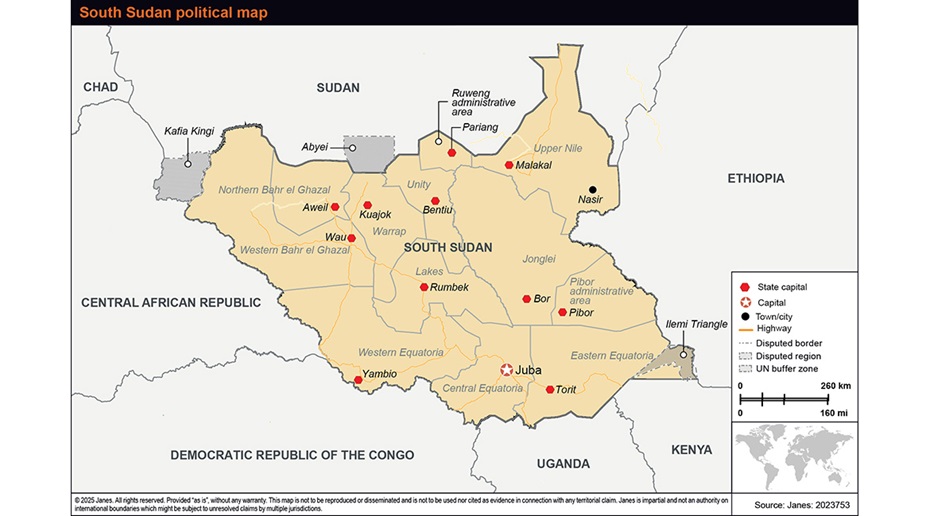
| 4 March | Operational | The ethnocultural Nuer White Army militia (which fought alongside the Sudan People’s Liberation Movement – In Opposition (SPLM/A-IO) during the 2013–18 civil war) seized control of Nasir town, Upper Nile state, and attacked Nasir’s South Sudan People’s Defence Forces (SSPDF) base | The attack almost certainly triggered a rapid deterioration in the political and security situation, which persisted throughout the remainder of March because it initiated a security force crackdown on SPLM/A-IO officials, which directly undermined the Revitalised Agreement on the Resolution of the Conflict in the Republic of South Sudan’s (R-ARCSS’s) stability |
| 7 March | Operational and political | United Nations Mission in South Sudan (UNMISS) facilitated an evacuation of SSPDF soldiers from Nasir. Two UNMISS helicopters, which Janes assesses to be Mi-8MTV-1, came under small-arms fire from the White Army, killing one Ukrainian UNMISS crew member and 28 SSPDF personnel. Two other UN crew were wounded. Kiir delivered a national address, also on 7 March, claiming that SPLM/A-IO commanded the White Army attack on Nasir and against UNMISS | The targeting of UNMISS personnel and equipment demonstrates the continuing threat posed to external actors from non-state armed groups (NSAGs). In addition, Kiir used both the 4 and 7 March attacks as justification for the subsequent NSS crackdown on SPLM/A-IO officials throughout March. This almost certainly exacerbated political tensions between the SPLM-IG and SPLM/A-IO |
| 5–11 March | Political | The NSS arrested senior SPLM/A-IO figures including Deputy Chief of the SSPDF (who is also SPLM/A-IO Acting Chief of Staff) Lieutenant General Gabriel Doup Lam and Minister of Petroleum Puot Kang Chol – both on 5 March. An 11 March SPLM/A-IO press release confirmed the release of eight SPLM/A-IO detainees but at least 18 members of the group detained between 5 and 11 March remained in detention | The detention of SPLM/A-IO figures by state security forces almost certainly further exacerbated political tensions between the SPLM/A-IO and the SPLM-IG in the immediate term |
| 17 March | Operational | South Sudan’s Minister of Information, Communications Technology & Postal Services Michael Makuei Lueth confirmed the deployment of the Uganda People’s Defence Force (UPDF) in Juba after denying its presence from 8 to 17 March despite Chief of UPDF General Muhoozi Kainerugaba confirming a Ugandan deployment to South Sudan in a post on X (formerly Twitter) on 9 March | The denial of the UPDF deployment very likely indicates an attempt to downplay the low military capabilities of the SSPDF and its need for external security assistance. Such an admission would have likely led NSAGs to perceive the SSPDF as being weakened, which could have encouraged increased NSAG activity and deteriorated the security situation further |
| 18 March | Political | SPLM/A-IO withdrew from national security mechanisms including the Joint Defence Board (JDB), the High-Level Political Committee, the Joint Military Ceasefire Committee (JMCC), and the Joint Transitional Security Committee (JTSC), according to SPLM/A-IO Deputy Chairman Oyet Nathaniel. However, on 25 March the SPLM/A-IO’s Acting Press Secretary for the Office of First Vice-President – Puok Both Baluang – published a statement stating the SPLM/A-IO “has not suspended its participation” but the arrest of members “resulted in paralysis of several mechanisms” | Janes assesses with low confidence that the SPLM/A-IO’s backtracking of its 18 March statement was likely an attempt to avoid being perceived as responsible for exacerbating political tensions |
| 16–21 March | Operational | The SSPDF, supported by the UPDF, conducted airstrikes against the White Army in Nasir on 16 March killing at least 21 civilians, according to several news articles published by Radio Tamazuj – a source assessed by Janes to be usually reliable. Airstrikes were also conducted in Ulang county on 21 March killing one civilian and wounding 12 others | The airstrikes very likely reinforced SPLM/A-IO perceptions that the SSPDF was targeting ethnic Nuer communities and entrenched the SPLM/A-IO’s belief that the SPLM-IG was engaged in “ethnic profiling of the Nuer”, as stated in the group’s 18 March statement. The SSPDF-UPDF operations are likely to increase inter-communal tensions between Nuer and Dinka throughout the next reporting period because the SSPDF is still likely to be viewed by Nuer communities as dominated by ethnic Dinka (Kiir’s ethnic group). |
| 26 March | Political | The NSS placed First Vice-President of South Sudan and SPLM/A-IO Chairman Riek Machar under house arrest | Machar’s house arrest almost certainly violated the R-ARCSS and destabilised the Revitalised Transitional Government of National Unity (RTGoNU) because it undermined the power-sharing balance outlined by the R-ARCSS. The targeting of SPLM/A-IO officials very likely demonstrates the extent to which Kiir holds the SPLM/A-IO accountable for the 4 March Nasir attack |
Assessment – internal stability
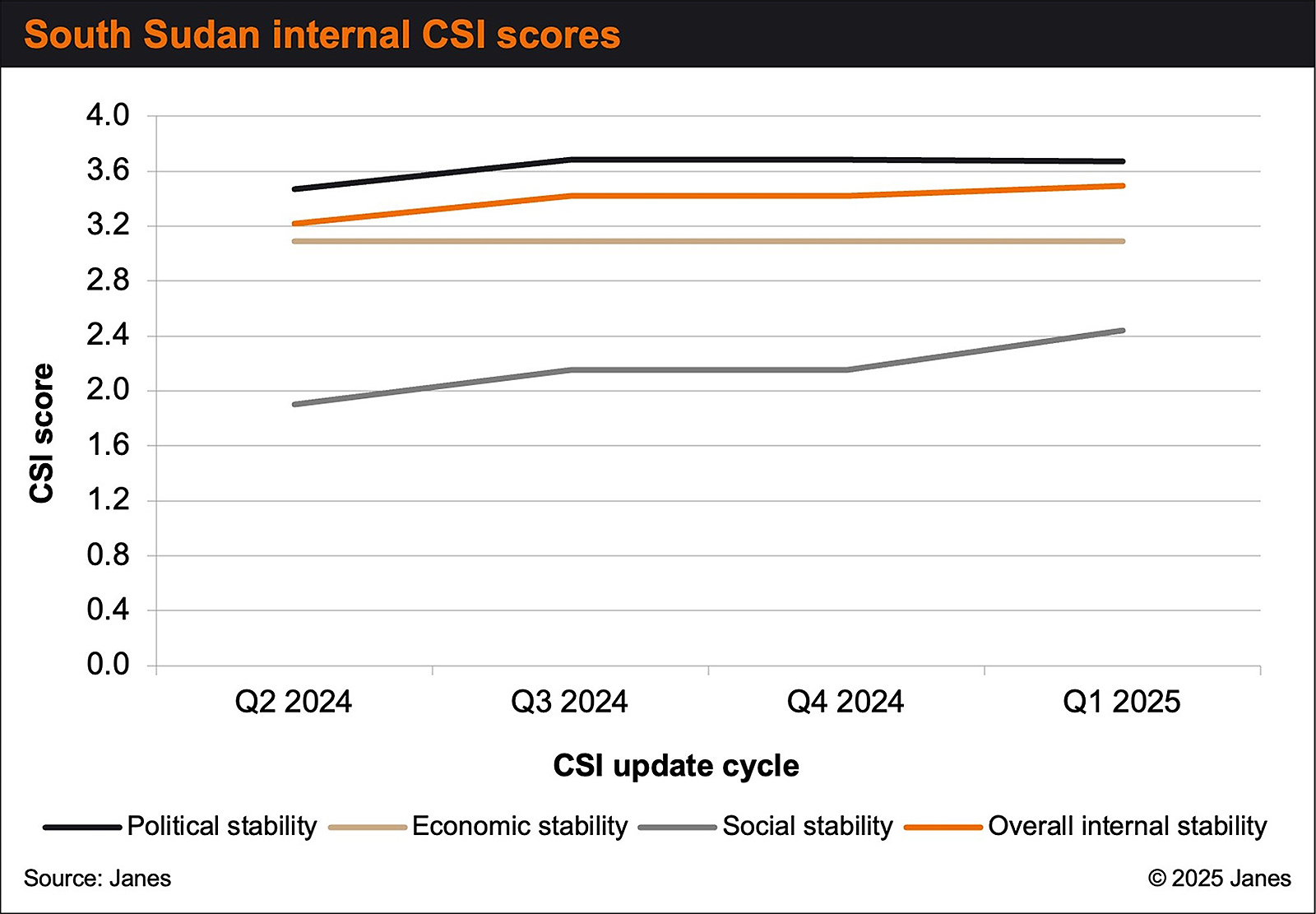 Image caption: South Sudan internal CSI scores
Image credit: Janes
© Janes
To read more, please visit: South Sudan stability report, January–March 2025
Analysis