Taiwan response to China pressure will likely increase tension
In this report, Sarbhanu Nath and F Xavier Casals examine the Taiwanese government’s responses to Chinese coercion. This piece is part of a warning intelligence project monitoring and assessing the likelihood of China invading Taiwan in the six- to 12-month period after publication. Janes published the most recent iteration of the report in July. The report identifies key developments among the indicators tracked, which Janes analysts will address in the form of deep-dive reports over the coming months.
For more information on the warning intelligence report, please see Warning intelligence report: China likely to continue to prioritise intimidation against Taiwan in the next six to 12 months despite PLA's aggressive rhetoric, exercises – June 2025 assessment.
Intelligence requirement/question
Is China going to invade Taiwan in the next six to 12 months?
How is the Taiwanese government responding politically and militarily to evolving threats from China?
To answer these questions, Janes published a warning intelligence report in July that focused on the following essential elements:
- Is China actively calling to remove the Taiwanese government?
- What are the political measures being taken by Taiwan to respond to China?
- What are the military measures being taken by Taiwan to respond to China?
This deep dive will focus on the measures being taken by the Taiwanese President Lai Ching-te’s government to improve its ability to resist Chinese pressure. The analysis will also provide an assessment on the most likely outlook for these trends in the next six to 12 months.
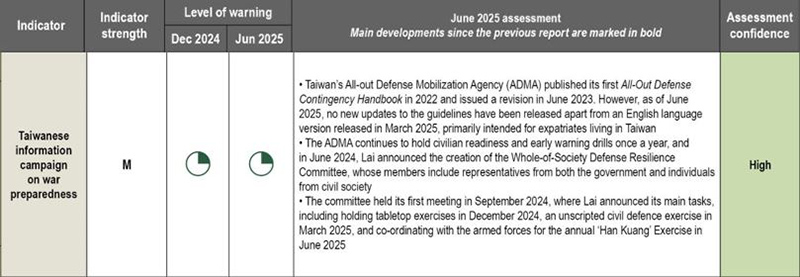 Indicator assessment from June 2025 of main developments in Taiwan’s response to China aggression. Image credit: Janes
Security assessment
In 2025, Lai announced multiple political and legal strategies and introduced new military means to respond to China’s pursuit of reunification. The announcement of these strategies likely indicates a desire to communicate to both internal and external audiences his government’s intent to oppose Chinese pressure. A comprehensive strategy and its implementation support the narrative that the Democratic Progressive Party (DPP) is committed to maintaining Taiwan’s independence and the status quo vis-à-vis China, while at the same time improving Taiwan’s ability to resist coercive actions from China.
The Communist Party of China (CPC) perceives the Lai government as a hindrance to its reunification policy and has retaliated with both hostile rhetoric and action against DPP-ruled Taiwan. Since the DPP came to power in Taiwan in 2016, the CPC has suspended high-level interactions with the DPP, and on 23 May 2024, just three days into Lai’s presidency, China launched a two-day military drill around Taiwan. Chinese state media announced that the drills were a “strong punishment” for Taiwan’s “separatist acts”. These drills were intended to show Beijing’s displeasure with Lai’s appointment and signal its intent to Lai that China would take escalatory measures in case of threats to the ‘One China’ principle – that there is only one sovereign state of China and that Taiwan is an inalienable part of it. The last time Beijing sanctioned such a major exercise was during then United States House of Representatives Speaker Nancy Pelosi’s visit to Taiwan in August 2022. The May 2024 exercise, for the first time, simulated a large-scale attack on Taiwan and included Taiwan’s outlying Matsu and Kinmen islands as well. In contrast, the 2022 drills in response to Pelosi’s visit simulated a blockade of Taiwan.
In April 2025, China’s People’s Liberation Army’s (PLA’s) Eastern Theatre Command (ETC) published a video depicting Lai as an insect infesting Taiwan with the audio referring to him as a “parasite poisoning Taiwan Island”. This marked a significant escalation with hostile rhetoric targeting Lai directly and dehumanising both him and the DPP. Before this, Chinese rhetoric against the DPP was mostly limited to accusations that the DPP was harming Taiwanese interests through its policies and contributing to the increase in cross-strait tensions.
Political responses
Since taking office on 20 May 2024, Lai has adopted a more assertive stance to defend Taiwan’s political autonomy against Chinese initiatives to advance unification with the mainland. Lai’s cabinet has focused on three axes to oppose the CPC’s coercion politically – clearer, stronger rhetoric; political and legal measures; and international outreach to partners and allies.
Compared with his predecessor President Tsai Ing-wen, Lai has opted for stronger statements on cross-strait relations, both through positive and negative messaging.
- Under Lai, the DPP has articulated positive messaging around the two key pillars of Taiwan as a de facto separate entity to the People’s Republic of China, and Taiwan as a champion of democracy against authoritarianism. For example, in his 10 October 2024 speech on Taiwan’s National Day, Lai said that “[China and Taiwan] are not subordinate to each other”. In June 2025, Lai launched a cycle of ‘10 Talks on National Unity’ around Taiwan, a series of speeches aimed at rallying the Taiwanese population around the idea of national unity and Taiwanese sovereignty. On 22 June, Lai said that “Taiwan is of course a country” during his first speech, which focused on the theme ‘country’.
- Lai’s government has also toughened negative messaging about China, including labelling the People’s Republic of China as a “foreign hostile force” in March 2025 under Taiwan’s Anti-Infiltration Act, following an increase in non-military, coercive activities from China. Particularly, government awareness campaigns related to countering infiltration and espionage have often led to the targeting of Taiwanese citizens born in China and those with ties to the People’s Republic.
For more information, please see Taiwan’s strategy to respond to Chinese pressure tactics very likely to lead to heightened tensions across the Taiwan Strait