Special Report: Applied Intuition UK progresses UAV swarming effort to boost British combat mass
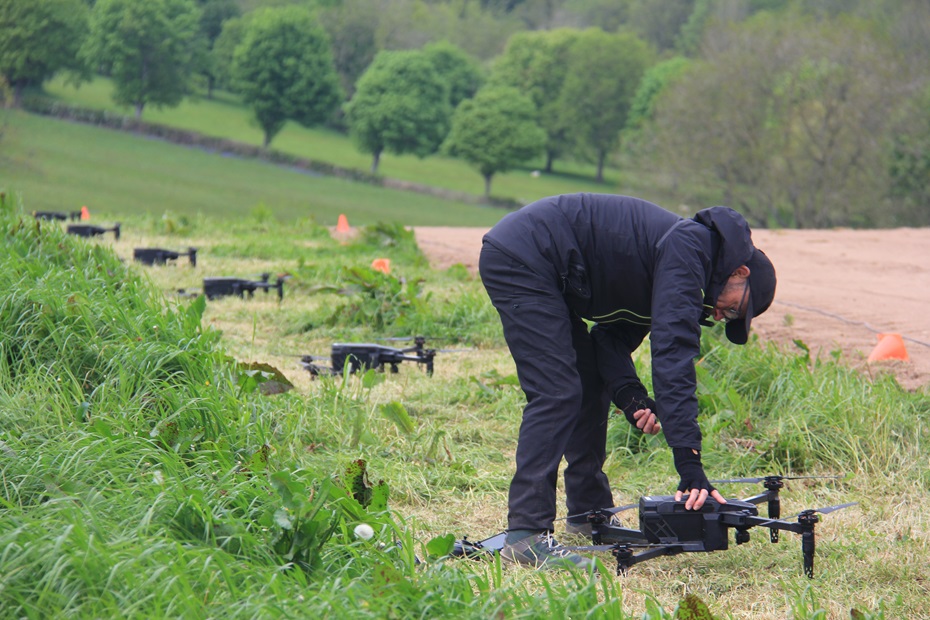
Applied Intuition UK is progressing work to develop unmanned aerial vehicle (UAV) swarming technologies for the Ministry of Defence (MoD) to add mass to British forces.
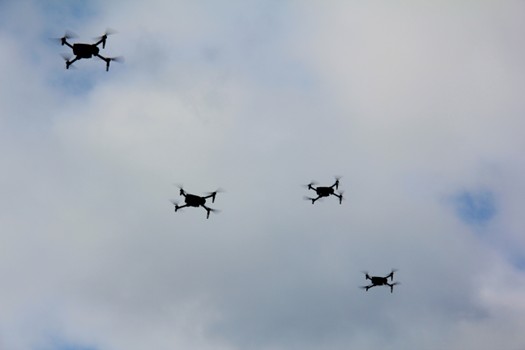
On 28 April 2026, a consortium lead by Applied Intuition UK demonstrated its drone swarming work for the UK MoD. Image credit: Gareth Jennings
Speaking at a demonstration of the consortium's work on 28 April 2026, Guy Hennings Haahr, land systems lead at Applied Intuition UK, told Janes of the effort undertaken so far, and what is to come as the UK military looks to unmanned technologies to build future capabilities.
Applied Intuition UK has been around for about a year [having been founded as a UK subsidiary of Applied Intuition in 2025], and is now leading autonomy development for the UK MoD. It is ultimately about achieving mass, and the demonstration [near Usk in southeast Wales] forms part of that effort,” Hennings Haahr said. He noted that, while the MoD programme itself remained largely classified, the purpose of the demonstration was to show how far the UK has progressed in autonomy and swarming development.
“The Chief of the General Staff [General Sir Roland Walker] has outlined goals aimed at tripling [British military] lethality by 2027, with unmanned systems expected to play a key role in helping achieve combat mass – it’s the clear direction of travel,” Hennings Haahr, a former British Army officer, said, adding that the effort forms a key tenet of the MoD’s new ‘20-40-40’ (20% survivable assets, 40% attritable and 40% expendable) philosophy as set out in the Strategic Defence Review 2025.
Software development
In February 2026 Applied Intuition UK was awarded a contract with the MoD's Defence and Science Technology Laboratory (Dstl) for the first phase of its Software Defined Swarms programme. Applied Intuition UK leads a consortium for the programme: this includes UK digital infrastructure company Rowden Technologies, UK artificial intelligence (AI) autonomy provider SAIF Autonomy, UK engineering and integration company Frazer-Nash Consultancy, Lancaster University, and UK UAV manufacturer Evolve Dynamics. Evolve Dynamics’ Wolfe-NATO was chosen as the consortium’s main UAV.
Together, the consortium is developing a sovereign autonomy test bed for ground-launched, near-surface UAV swarms. Hennings Haahr declined to provide further details of the contract citing MoD restrictions.
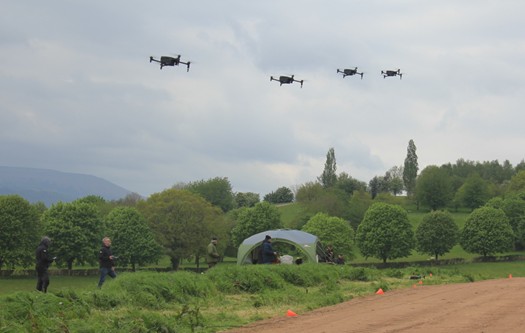
Photograph of Applied Intuition UK UAV pilots standby at an eight-vehicle swarm test in the UK. In an operational scenario the swarm would being controlled by AI, although humans would decide in the use of any lethal force. Image credit: Gareth Jennings
Hennings Haahr said it has required extensive effort for Applied Intuition UK to get to the point where it is demonstrating UAV swarms in a simulated real-world scenario.
“Building drone autonomy software is not trivial – it takes time, specialist engineering expertise, and extensive development effort,” he said. “A key accelerator is simulation – rather than repeatedly testing systems on a live range, engineers can use simulated environments to conduct thousands of iterations faster than real time. This enables teams to remove lower-level issues, integrate sensor suites, and validate autonomy behaviour before entering live testing. The purpose of simulation is to ensure that expensive range time is spent on the most important tasks. Once systems reach the live environment, testing can focus on mission-level autonomy rather than debugging basic behaviours.”
Operational scenario
The demonstration was framed around a brigade-level tactical scenario, with Applied Intuition UK placing Janes and other media within the context of an armoured brigade of the future.
“The challenge, as shown in the demonstration, is overcoming the traditional ‘one controller to one drone’ ratio. Instead, the ambition is to achieve ‘one to many’, allowing a single operator to supervise multiple autonomous systems,” Hennings Haahr said, adding that this shift would be needed to increase lethality and generate the mass required for conventional warfare.
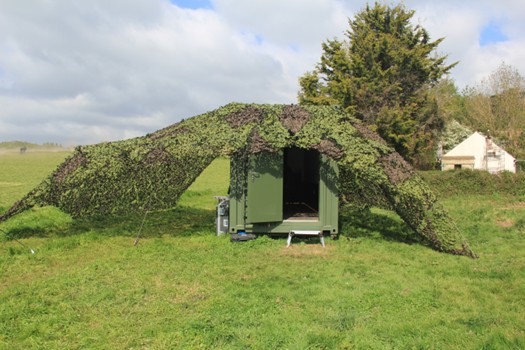
An ISO-container provides a behind-the-lines mission control centre, with operators inside using proprietary Applied Intuition UK software to direct and control one or more UAV swarms. Image credit: Janes/Gareth Jennings
With different UAVs assigned to different roles on the battlefield, the demonstration scenario featured both Event 38 E400 tactical-sized fixed-wing vertical take-off and landing (VTOL) and smaller Evolve Dynamics Wolfe-NATO quadcopter UAVs. The former are designed for long-range intelligence, surveillance, and reconnaissance (ISR) and strike missions out to about 80 km, linking divisional-level activity with sub-tactical units, with the latter used similarly at much shorter ranges.
A swarm of eight Wolfe-NATO UAVs was used for the demonstration (the E400 UAVs did not fly, as the notional scenario distances were much condensed for the purposes of the event). Hennings Haahr said that there should be no limit to the numbers of UAVs in a swarm. While the demonstration featured a human pilot per UAV, this was a safety requirement for the day and not something that would be repeated for a real-world operational scenario, he added.
The demonstration concept centred on collaborative autonomy, with information gathered by higher-echelon assets being distributed to smaller UAVs and tactical teams. This is intended to contribute to what the MoD refers to as the ‘digital targeting web’, a network designed to integrate information across formations and streamline kill chains in operations.
The demonstration mission was directed from an operations room in a shipping container some 80 km behind a notional front line, and from a similar vehicle-based unit located much closer to it.
To know more, please see Special Report: Applied Intuition UK progresses UAV swarming effort to boost British combat mass