Defense & Security 2025: Thailand to produce KB family of loitering munitions
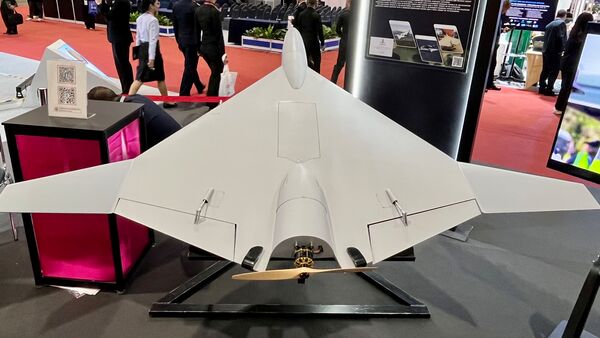

The RTAF-developed KB-5E loitering munition has a wingspan of 1.7 m and is integrated with a 5 kg warhead. (Janes/Jon Grevatt)
The Royal Thai Air Force (RTAF) has developed prototypes of two new loitering munitions known as the KB-10G and KB-5E kamikaze drones.
The KB-family munitions, which are about to be produced for operational deployments, were unveiled at the Defense & Security 2025 show in Bangkok, which concluded on 13 November.
The RTAF said that the systems are intended to provide capability to perform medium-range and long-range suppression of enemy air defence (SEAD) missions.
Intended targets for the loitering munitions, which are both integrated with a combined GPS/inertial navigation system (INS), include radar systems, armoured vehicles, airstrips, and “other significant military locations”, RTAF said.
The weapons were developed jointly by the RTAF's Research and Development Center for Space and Aeronautical Science and Technology; its Directorate of Armament, which is responsible for the warheads; and engineers at its Navaminda Kasatriyadhiraj academy.
An RTAF spokesperson told Janes that a total of 40 KB-10G/KB-5E units will be built following a series of evaluations undertaken by the RTAF over the past year. The munitions have been in development for about three years.
Janes understands that the loitering munitions will be produced by the RTAF's Thai Aviation Industries (TAI), starting from December 2025.
The KB-10G has a wingspan of 1.7 m and a total weight of 40 kg, which includes its 10 kg warhead. It is powered by a petrol piston-driven engine and can achieve a speed of 120 km/h and a range of 500 km. The RTAF said its terminal diving speed is 220 km/h and that it has a circular error probable (CEP) of less than 3 m.
Go beyond the headlines - with direct links to interconnected entities
Get full access to validated equipment, military capabilities, and market insights.