DSEI 2025: MARSS Interceptor C-UAS in advanced testing, NATO country evaluating
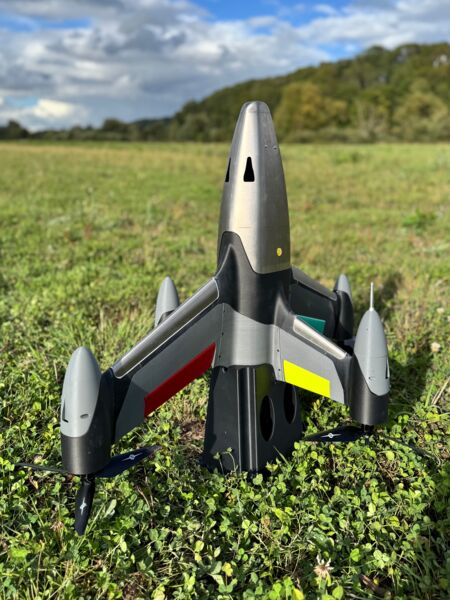

The MARSS Interceptor MR C-UAS seen during testing in the UK in September 2025. (MARSS)
Defence company Marine and Remote Sensing Solutions (MARSS) is in advanced testing of a ground-launched interceptor for shooting down unmanned aircraft systems (UASs), the company has told Janes.
Stephen Scott, head of MARSS Defence Labs, said the company has been testing the system, a UAS, which it has called “Interceptor MR” (medium range), since September 2023. The system has been downselected for evaluation by a NATO member country in the coming months, the company announced at the Defence and Security Equipment International (DSEI) 2025 exhibition held in London from 9 to 12 September.
Weighing 8 kg, with a 90 cm wingspan, the Interceptor MR has no warhead but is intended to destroy the target UAS with its nose or the leading edges of its wings or fins upon impact. These are made from titanium. The rest of the C-UAS is made from carbon composite.
With four carbon-fibre propellers, the Interceptor MR has a speed of around 80 m/s (290 km/h) and a range of up to around 8 km, Scott said. It is electrically propelled with vertical take-off and landing (VTOL), changing to a fixed-wing flight after launch. This adds to its range and speed, and means it can land if a mission is aborted, he added.
While a parachute is built-in for recovery, and Scott said the Interceptor MR could destroy a small quadcopter and then land, intercepting larger UASs would mean it was usually a one-way attack (OWA) system.
“If we break even one propeller, we have to deploy the parachute to recover it,” Scott said. “We're finding with target UASs in the sub-20 kg range, it has [a] percentage chance of survivability.”
Go beyond the headlines - with direct links to interconnected entities
Get full access to validated equipment, military capabilities, and market insights.