DSEI 2025: Thales plans LMM firing trial for Peregrine UAS
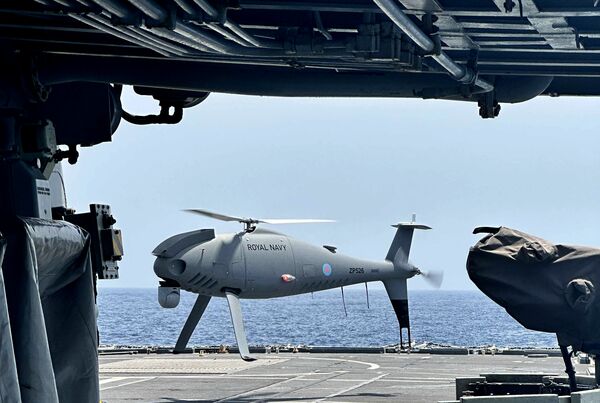

A Peregrine UAS (based on Schiebel's Camcopter S-100) on the flight deck of HMS Lancaster during trials on 29 August 2024. (MoD/Crown Copyright)
Thales plans to test its Martlet Lightweight Multirole Missile (LMM) from the UK Royal Navy's (RN's) Peregrine vertical take-off and landing (VTOL) unmanned aircraft system (UAS) in 2026 as part of efforts to demonstrate an expanded capability for intelligence, surveillance, and reconnaissance (ISR).
Speaking to Janes at the Defence and Security Equipment International (DSEI) 2025 exhibition held in London from 9 to 12 September, Matt Moore, Thales head of UAS strategy and product development, said the LMM firing was planned to demonstrate the growth potential of the system in the context of the navy's Maritime Aviation Transformation Strategy (MATX) “We've proved the concept of this for ISR,” he said. “What we need to do now is start evolving the capability, and ‘spiral' it into other maritime tasks.”
Initial operating capability for Peregrine – an ISR mission variant of the Schiebel Camcopter S-100 UAS primed by Thales to meet an Urgent Capability Requirement (UCR) – was announced on 10 September 2025. The current system – which comprises a ground station plus two S-100 air vehicles configured with the Thales I-Master radar, an L3Harris MX-8 electro-optic/infrared (EO/IR) turret, and an automatic identification system receiver – has been operating from the Type 23 frigate HMS Lancaster in the Gulf region under the parentage of 700X Naval Air Squadron.
Peregrine began operating from Lancaster
Go beyond the headlines - with direct links to interconnected entities
Get full access to validated equipment, military capabilities, and market insights.