EU launches second phase of ENGRT next-generation rotorcraft project
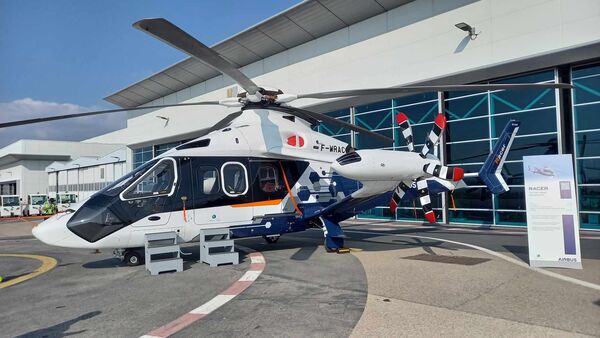

Airbus Helicopters is leveraging its Racer high-speed compound-helicopter concept for its contribution to the wider ENGRT programme, which is co-leads with Leonardo Helicopters. (Janes/Gareth Jennings)
The European Union (EU) has launched the second phase of its European Next-Generation Rotorcraft Technologies (ENGRT) programme, one of the two co-ordinating companies announced on 20 February.
Airbus Helicopters, which along with Leonardo Helicopters is co-ordinating the consortium of some 53 companies and institutions, said that ENGRT II will now run for three years as the EU progresses its effort to foster “strategic autonomy” in the development of future rotorcraft technologies.
“We are stepping up after the first phase of the project, transitioning from a research and technology project into a research and development project,” CEO of Airbus Helicopters Bruno Even said, adding, “More than ever we must ensure that our home nations can operate the most advanced technologies now and in the future.”
Launched in 2022, ENGRT is geared at paving the way for the future of military rotorcraft in Europe for the post-2035 timeframe, with the project exploring future technologies and also the conops of European militaries for their use in terms of the operational needs that will drive the technology development. Such needs could include, but not be limited to, speed, manoeuvrability, range, safety, survivability and ballistic tolerance, autonomy, stealth (radar, visual, and acoustic), connectivity, and manned-unmanned teaming (MUM-T). It also recognises the need to avoid complexity and maximise availability while controlling costs, weight, and size.
Go beyond the headlines - with direct links to interconnected entities
Get full access to validated equipment, military capabilities, and market insights.