Feature: UK seeks to futureproof unmanned air capability
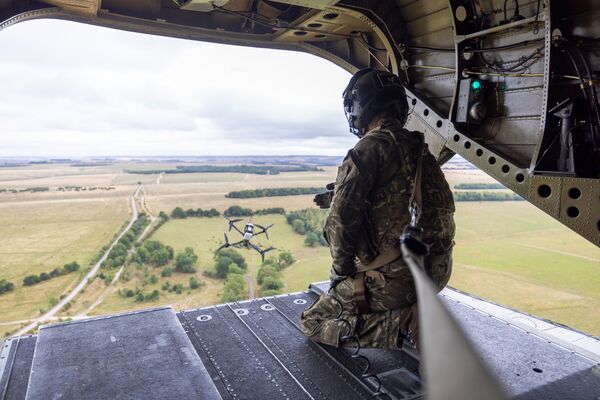

A small UAS is launched from the back of a CH-47 Chinook helicopter during Exercise ‘Hornets String' on 31 July 2025. (MoD/Crown Copyright)
Britain's armed forces are due to make major procurements of unmanned aircraft systems (UASs), as well as transform their operational doctrine and force structure to incorporate the extensive use of unmanned technology.
This is a major endeavour but to date the Royal Navy (RN), British Army, and Royal Air Force (RAF) have only taken the first steps on their unmanned journey. A crucial part of this journey is understanding the potential – and limits – of currently available unmanned technology.
While wars in Ukraine and the Middle East have provided many pointers to the future of unmanned warfare, each of the British armed services is trying to find its own solutions to suit its specific operational requirements. This has resulted in each service going its own way – at different velocities – in terms of force structures, missions, and tasks.
To move its drone capability to the next level, the UK Ministry of Defence (MoD) is facing several important choices in 2025 as part of its Defence Investment Plan (DIP) to divide future procurement budgets.
Army capability
The British Army is the largest user of UASs in the UK military and its track record of operating these systems goes back to the 1960s, when the Royal Artillery acquired its first turbojet-powered Canadair CL-89 target-locating UASs.
Go beyond the headlines - with direct links to interconnected entities
Get full access to validated equipment, military capabilities, and market insights.