Latvia develops Selonia training area
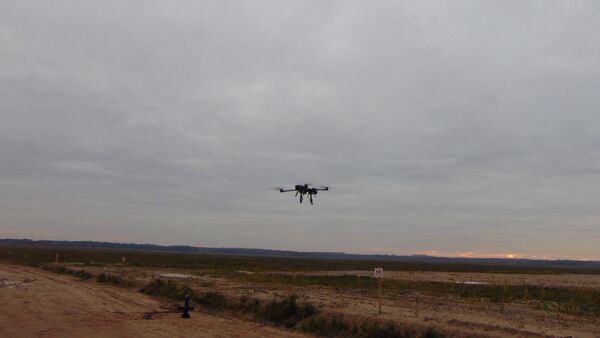

A Beak strike UAV flies past a Blaze interceptor UAV during the Origin-Defsecintel Baltic Drone Wall demonstration in the Selonia training area on 5 November. (Janes/Nicholas Fiorenza)
Latvian Air Force Major Modris Kairišs, head of Latvia's Autonomous Systems Competence Center, told Janes about the development of the Baltic state's Selonia training area during the Origin-Defsecintel Baltic Drone Wall demonstration held there on 5 November.
Maj Kairišs said the training area measures 25,000 ha with twice that amount of airspace and a control tower for unmanned aerial vehicle (UAV) operators and artillery observers. Janes also observed three bunkers when entering the training area, with small arms fire heard nearby.
He also spoke of Western companies using the test range, with others showing interest in doing so. He cited as an example these companies being interested in testing radars that they cannot do in their home countries. He added that feedback is shared with these companies.
He hoped eventually to see the national centre he heads with NATO and European Union (EU) flags flying from it.
Maj Kairišs expressed concern that after the Ukraine war is over UAV operator veterans could turn to crime, abusing their skills to extend assassins' ranges from 1 km for a sniper rifle to 20–30 km using UAVs.
For more information on the 5 November demonstration, please seeOrigin and Defsecintel hold Baltic Drone Wall demonstration in Latvia .
Go beyond the headlines - with direct links to interconnected entities
Get full access to validated equipment, military capabilities, and market insights.