Pakistan-Afghanistan conflict 2026: UAVs drive asymmetric air war
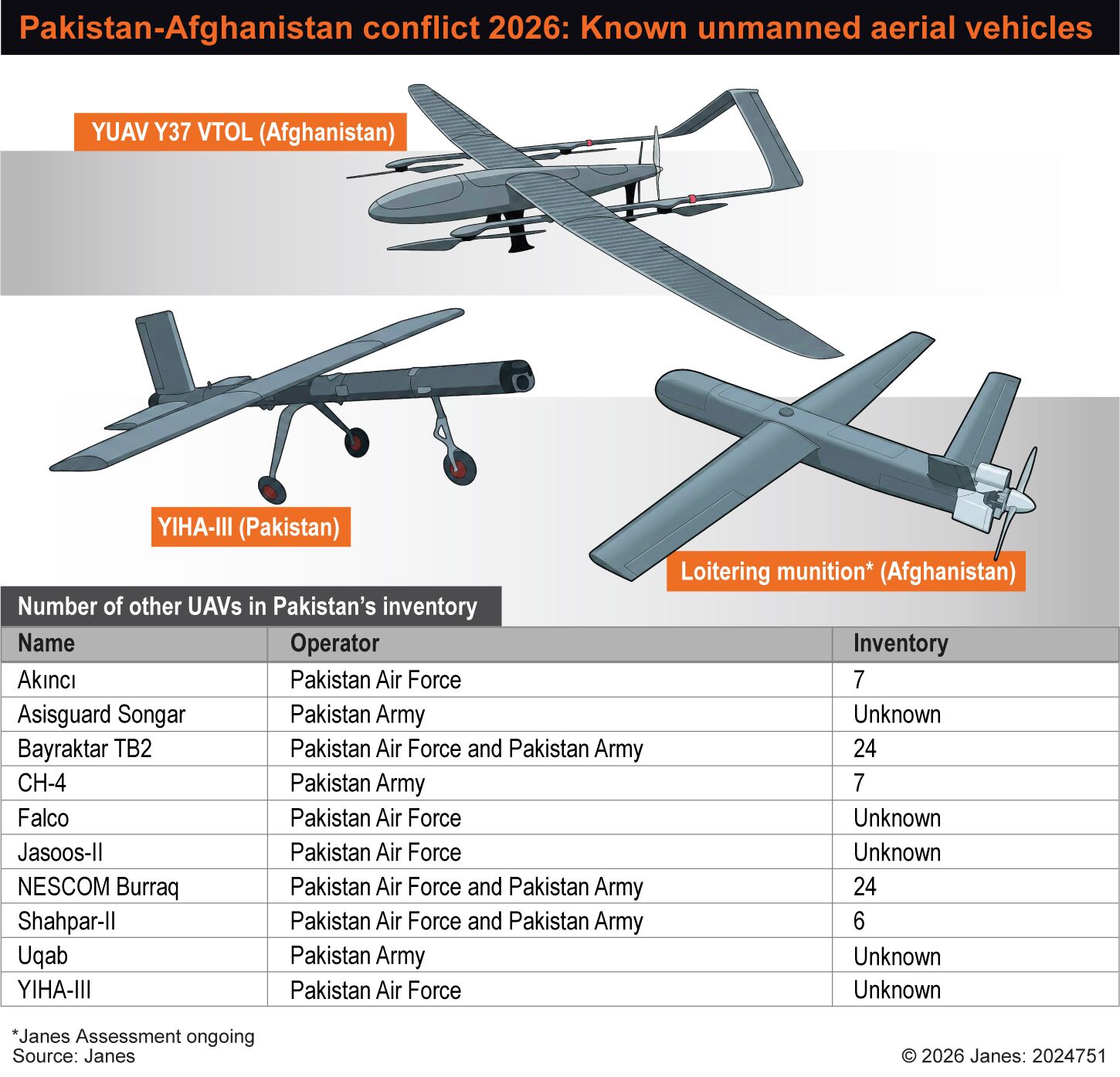

This infographic shows three known types of UAVs being employed in the conflict, including a loitering munition domestically produced by Afghanistan. The Pakistan Armed Forces operate several types of UAVs. (Janes)
Armed with commercially available unmanned aerial vehicles (UAVs) and locally produced loitering munitions, the Islamic Emirate of Afghanistan is conducting air operations against Pakistan as relations between the neighbours continue to deteriorate.
Afghanistan's shift towards UAVs for intelligence, surveillance, and reconnaissance (ISR) operations, as well as kamikaze-style strikes, is driven primarily by the Afghan Air Force's lack of operational manned combat aircraft. However, both sides are also increasingly becoming reliant on UAVs in the conflict, almost certainly for low-cost asymmetric warfare advantages in daily operations.
According to the Afghan Ministry of National Defense (MND), Pakistan began deploying UAVs against its territory from 28 February, following the Pakistan Air Force's (PAF's) initial airstrikes with fixed-wing manned aircraft one day earlier.
Afghan UAVs
Afghanistan also initially began long-range UAV operations against Pakistan on 27 February, after hostilities broke out between the two countries. In a video published on 2 March, the MND showed a new, fixed-wing V-tail-configuration loitering munition in operation. The UAV has an estimated range of 600 to 800 km.
The MND said the platform has been employed in “co-ordinated aerial operations against key military installations in Pakistan”.
Go beyond the headlines - with direct links to interconnected entities
Get full access to validated equipment, military capabilities, and market insights.