Proteus RWUAS completes ground runs ahead of flight tests
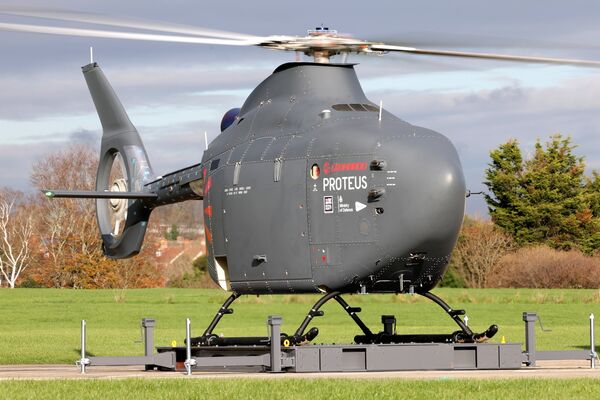

Leonardo's Proteus RWUAS technology demonstrator completed ground runs in November. (Crown Copyright)
Leonardo Helicopters UK has successfully completed ground runs of the rotary-wing unmanned aircraft system (RWUAS) testbed developed under the UK Royal Navy's (RN's) Proteus technology demonstrator programme.
According to a 2 December RN announcement, ground testing of the 3 tonne-class prototype was completed at Leonardo's facility in Yeovil, Somerset, during November ahead of forthcoming flight trials.
The Proteus technology demonstrator programme is being delivered under a four-year, GBP60 million (USD79.25 million) RWUAS Phase 3a contract awarded to Leonardo by the UK Ministry of Defence in June 2022. Sponsored through the RN's Anti-Submarine Warfare (ASW) Spearhead initiative, Proteus has been designed to generate evidence that a large autonomous and modular UAS can deliver or contribute to the delivery of military maritime effects with fewer people and at lower cost.
Janes understands that the technology demonstrator – a single-engine design strongly leveraging the Kopter AW09 light helicopter – is on course to perform first flights during December. According to Leonardo, the flight trial programme is designed to validate “the functions necessary to realise the vision of a fully autonomous uncrewed rotorcraft”.
For more information on the Proteus, please see Leonardo prepares for Proteus RWUAS flight-testing .
Go beyond the headlines - with direct links to interconnected entities
Get full access to validated equipment, military capabilities, and market insights.