REPMUS 2024: Portuguese Navy and NATO focus on counter-UAV systems
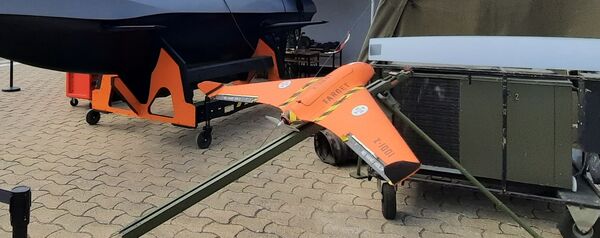

A Portuguese Navy target drone on display at REPMUS 2024 in Tróia, Portugal, on 24 September 2024. (Janes/Neil Dee)
Counter-unmanned aerial vehicle (C-UAV) systems have been tested as part of NATO's Exercise ‘REPMUS 24' (Robotic Experimentation and Prototyping with Unmanned Maritime Systems).
Responding to a question from Janes during an online media briefing at ‘REPMUS 24' on 23 September, Michael Stewart, United States chairman NATO Naval Armaments Group, said that NATO and the US are aware of the challenges of low-cost unmanned systems. “We can do the math of very expensive missiles going after cheap drones, so that is a huge focus for NATO and certainly for the US,” he said. While Stewart could not elaborate on the work being done, he said that several potential and promising technologies were being developed and “if you've heard the archer and the arrow analogy, the people were trying to shoot down the arrows, and the other people were trying to make sure the archer never shoots the arrows”.
Speaking the following day to media, Chief of the Portuguese Navy Admiral Henrique Eduardo Passaláqua de Gouveia e Melo echoed the challenges that low-cost systems present to expensive manned warships emphasising that using expensive surface-to-air missiles (SAMs) of which there is a limited stock is not an economical way of defeating this threat. Adm Gouveia e Melo said that a mix of systems would likely be used to destroy unmanned systems, using electronic warfare (EW) to cut command-and-control (C2) or damage the system using directed energy weapons, fragmentation shells, or possibly lasers in the future, alongside current systems.
Go beyond the headlines - with direct links to interconnected entities
Get full access to validated equipment, military capabilities, and market insights.