Special Report: MGI shifts from Formula 1 to one-way effectors
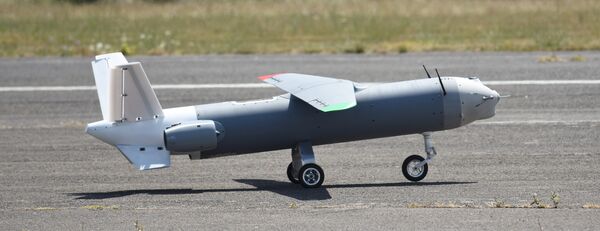

A prototype of MGI's SkyShark OWE, displayed in the UK in July 2025 and equipped with Argive's A300 single-stage micro turbojet. (Richard Scott/NAVYPIX)
One of the main lessons to have emerged from the conflict in Ukraine is the value of affordable mass. The most striking example is the use of swarms of expendable low-cost attack drones – more generically referred to as one-way effectors (OWEs) – to hit battlefield targets and critical infrastructure.
Cheap to build and easy to produce, OWEs enshrine asymmetry by combining low cost with volume and precision. More missile-like than one-way attack (OWA) unmanned aircraft systems (UASs), OWEs can attack targets and can be employed to saturate adversary air defences. These tactics are intended to improve the survivability of more expensive cruise missiles, and compel the inefficient expenditure of high-value air-defence interceptors.
Agility of production is the other attribute commonly associated with this new breed of ‘throwaway' launched effects (LE). While traditional guided weapons typically take years to design and deliver, the development cycle for OWEs is currently measured in months or even weeks.
The UK government's Strategic Defence Review 2025 referenced expendable “one-way effector drones” as part of a dynamic “high/low” mix in the land domain. Two notable requirements have already emerged from the Ministry of Defence (MoD) – UK company Modini was awarded two contracts in 2024–25 to supply its Dart 250 OWE to the British Army as part of Project Asgard, and Project Brakestop is pursuing the development of a ground-launched heavy OWE capable of delivering a 200–300 kg class payload to a range of 600 km at a speed of around 600 km/h.
Go beyond the headlines - with direct links to interconnected entities
Get full access to validated equipment, military capabilities, and market insights.