Special Report: UK's Project Brakestop spurs OWE Heavy developments
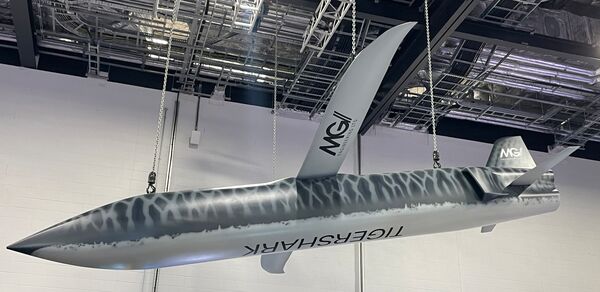

MGI Engineering unveiled a full-scale mock-up of its TigerShark OWE at DSEI 2025 in September. (Richard Scott/NAVYPIX)
Two UK companies at different ends of the engineering spectrum have revealed long-range one-way effectors (OWEs) shaped by the UK Ministry of Defence's (MoD's) ambitions to rapidly field a new low-cost deep-strike weapon on the battlefield.
Unveiling their designs during the Defence and Security Equipment International (DSEI) 2025 exhibition in London in September, MBDA and MGI Engineering provided insights as to their thinking on the accelerated development and mass manufacture of a cost-effective ground-launched capability able to survive in contested environments and hit targets at ranges beyond 500 km. What neither company will publicly confirm, but both give a nod to in private, is that their respective engineering development efforts have been largely driven by, and aligned to, the MoD's Project Brakestop OWE Heavy requirement.
Often referred to as ‘Kamikaze drones', OWEs can be thought of as ‘value-engineered' guided weapons. In particular, they have emerged from the commoditisation of unmanned aircraft system (UAS) components so as to come in at a price point significantly below that of more ‘exquisite' cruise missiles. Technologies that were once confined to military-grade systems – miniaturised sensors; high-performance autopilots; and compact, fuel-efficient engines – have now widely proliferated as commercial off-the-shelf (COTS) or military off-the-shelf (MOTS) items. Modular open architectures simplify what were previously complex hardware and software integrations. Modern computer-aided design and manufacturing techniques mean aerial vehicles and aerostructures can be iterated and produced much faster, and at much lower cost.
Go beyond the headlines - with direct links to interconnected entities
Get full access to validated equipment, military capabilities, and market insights.