UK fields StormShroud unmanned aerial decoy for suppression of enemy air defences
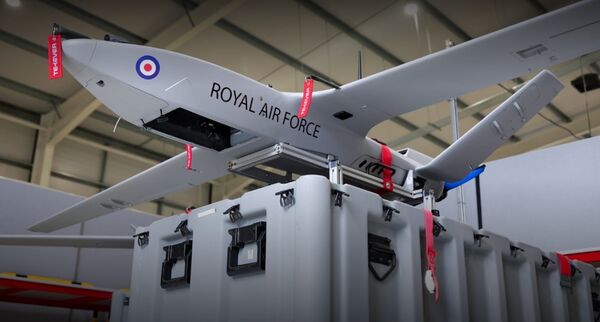

Combining the Tekever AR3 and the BriteStorm electronic warfare payload, the StormShroud will protect RAF fast jets against ground-based enemy air-defence systems. (Crown Copyright)
The UK Royal Air Force (RAF) is fielding the Tekever AR3 unmanned aerial vehicle (UAV), which it will equip with the Leonardo BriteStorm electronic warfare (EW) payload to create the StormShroud aerial decoy to protect its manned fast jets against ground-based air defences.
Announced by the RAF and Leonardo on 2 May, the programme covers an undisclosed number of the small (upper-end of Tier 1), long-endurance, Tekever AR3 UAVs, which when combined with the BriteStorm ‘stand-in jammer' will be used in the suppression of enemy air defences (SEAD) role as the StormShroud.
“The RAF has introduced a new uncrewed aircraft into operational service called StormShroud. It is the first of a new family of Autonomous Collaborative Platforms (ACPs) which will revolutionise the RAF's advantage in the most contested battlespaces,” the service said, adding, “StormShroud will support RAF [Lockheed Martin] F-35B Lightning and [Eurofighter] Typhoon pilots by blinding enemy radars, which increases the survivability and operational effectiveness of our crewed aircraft.”
The StormShroud is operated by 216 Squadron at RAF Waddington in Lincolnshire and supported by the RAF Regiment, comprising Regular RAF and Royal Auxiliary Air Force (RAuxAF) personnel, operating alongside other UK Defence personnel. To be effective in its SEAD role, the StormShroud would presumably need to be launched from the F-35s/Typhoons it is protecting. The announcement, however, did not refer to such a capability, and the nature of the UAV and the involvement of the RAF Regiment suggest that a different mode of operation has been decided upon.
Go beyond the headlines - with direct links to interconnected entities
Get full access to validated equipment, military capabilities, and market insights.