US Space Force, Boeing team up on Evolved Strategic Satcom
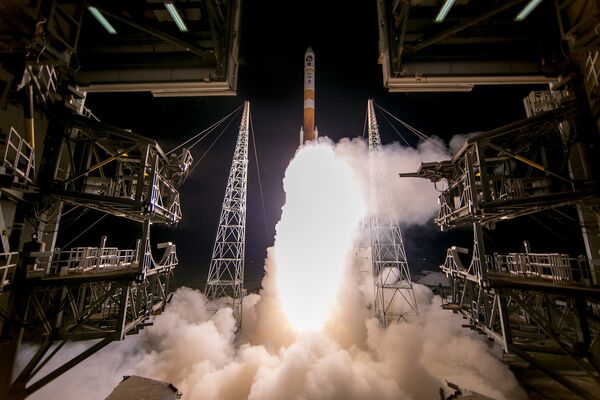

The US Air Force's Wideband Global Satcom satellite, attached to a United Launch Alliance Delta IV Evolved Expendable Launch Vehicle, takes off from Cape Canaveral Space Force Station, Florida, in 2017. (USAF)
The US Space Force (USSF) and Boeing have teamed up on the development of the initial tranche of Evolved Strategic satellite communications (satcom) satellites as part of a USD2.8 billion satcom development deal signed between the service and the defence company.
Under the terms of the deal, Boeing will develop and construct the first two space vehicles (SVs) for the Evolved Strategic Satcom (ESS) programme, with an option to develop two more follow-on SVs for the effort, company officials said in a statement in late July.
The initial two SVs guaranteed under the terms of the deal, as well as the follow-on SVs, will constitute the initial tranche of ESS platforms designed to support efforts to push the programme towards initial operational capability (IOC) status, Boeing officials said in the statement. Programme officials at Boeing anticipate deliveries of the first two SVs for ESS to take place by 2031.
USSF's Space Systems Command (SSC) is the primary contracting agency for ESS development. Programme officials within SSC's Military Communications and Positioning, Navigation, and Timing Program Executive Office will manage and distribute the ESS services to end-users once the system matures beyond full operational capability (FOC) status.
Once fully mature, the ESS constellation will be the primary satcom conduit for US nuclear command, control, and communications (NC3) operations at geosynchronous Earth orbit (GEO). The ESS system itself comprises three separate segments: cryptographic, ground, and space. Primary and enabling capabilities will be developed and procured by the USSF.
Go beyond the headlines - with direct links to interconnected entities
Get full access to validated equipment, military capabilities, and market insights.