USAF seeks advanced data fusion capability for PWSA
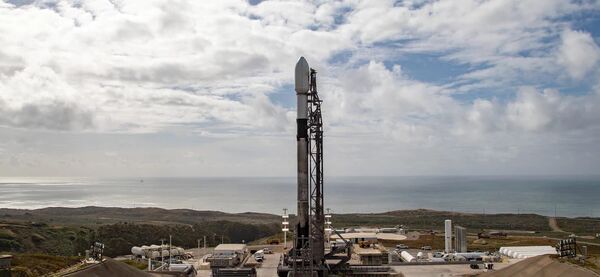

A SpaceX Falcon 9 loaded with a Tranche 0 payload variant for the Space Development Agency's PWSA sits on the launch pad at Vandenberg Space Force Base in California. (Space Development Agency)
The US Air Force (USAF) is looking to industry to develop a large-scale data fusion system and associated digital architecture that meet the massive information-sharing requirements for the Pentagon's Proliferated Warfighter Space Architecture (PWSA).
The effort “seeks innovative solutions to develop and demonstrate a secure, adaptable software environment capable of ingesting, integrating, and analysing high-volume, low-latency data streams from diverse space-based sources”, according to a presolicitation notice issued in November. The programme is scheduled to begin officially accepting proposals on 3 December.
“While various data fusion tools exist, few are designed to meet the scale, velocity, and multivendor integration demands of PWSA,” service officials wrote in the presolicitation notice. This [effort] seeks innovative solutions to develop and demonstrate a secure, modular, and extensible data fusion environment specifically tailored to support proliferated low Earth orbit (pLEO) space vehicles (SVs), they added.
In the end, USAF programme officials are aiming to develop “an extensible fusion platform that enables real-time situational awareness, advanced analytics, and dynamic mission adaptability” in support of PWSA command-and-control (C2) capabilities, the presolicitation noted.
The PWSA consists of several capability sections (or layers) within the architecture, each one supported by constellations of low Earth orbit (LEO) satellites. The sections include the tracking layer, the transport layer, the battle management layer, the navigation layer, the deterrence layer, the support layer, and the custody layer.
Go beyond the headlines - with direct links to interconnected entities
Get full access to validated equipment, military capabilities, and market insights.