Azerbaijan reveals long-range air surveillance radar acquisition
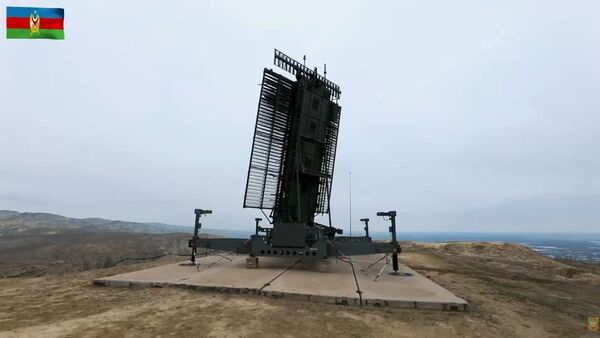

One of the Azerbaijani Air Force's Lanza LTR-25 surveillance radars. (Azerbaijan Ministry of Defence)
A long-range air-surveillance radar that was almost certainly a Lanza LTR-125 made by Spanish company Indra was seen in a video that Azerbaijan's Ministry of Defence (MoD) released on 14 February to mark the 34th anniversary of the country's air force.
This appears to be the first time an LTR-25 has been shown in Azerbaijan, although the MoD released a photograph of a smaller Lanza LTR-20 in October 2019, when it announced that a new radar control centre had been opened. It did not identify the radar but said it was made in Spain and was also in service with NATO members.
Indra says the LTR-25 has an instrumented range of 250 n miles (463 km), while the LTR-20 is available with various ranges from a gap-filling 60 n miles to 200 n miles.
The location of the radar seen in the video appears to match one that satellite imagery shows deployed at an existing radar station on high ground northeast of Salyan, putting it in a position to cover much of the southern Caspian and the Iranian border. It has been there since late 2022.
An apparent LTR-20 has been deployed about 130 km to the west to provide additional coverage of the Iranian border and possibly southern Armenia since at least October 2020. A second probable LTR-25 appears to have been deployed to a radar base northwest of Baku in the second half of 2023.
Go beyond the headlines - with direct links to interconnected entities
Get full access to validated equipment, military capabilities, and market insights.