C-UAS system trialled on 12 m FRISC at Exercise ‘Bold Machina 25'
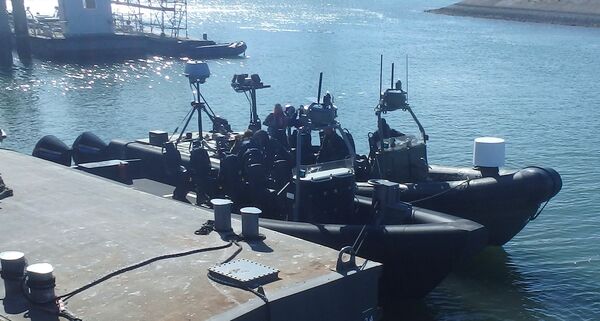

The Royal Netherlands Navy 12 m FRISC with the C-UAS system at Exercise ‘Bold Machina 25'. (Janes/Neil Dee)
A US Naval Postgraduate School (NPS)-developed counter-unmanned aircraft system (C-UAS) has been trialled on a Royal Netherlands Navy 12 m fast raiding, interception, and special forces craft (FRISC) as part of NATO's Exercise ‘Bold Machina 25' in Den Helder, the Netherlands. The C-UAS system was demonstrated to media embarked on the FRISC on 24 September.
The system has been developed by an NPS team consisting of a US Navy officer and a Swedish officer. The small form factor, standalone, omnidirectional C-UAS system is designed to detect Class 1 unmanned aerial vehicle (UAV) threats. The suite, as trialled at ‘Bold Machina 25', comprises several passive sensors provided by industry partners including the Dspnor Dronnur 2D low probability of intercept/detection (LPI/LPD) radar mounted at the bow, Mara Spotter short-range detection multisensor mast with electro-optic/infrared (EO/IR) and acoustic sensors aft, DroneShield DroneSentry-X Mk 2 radio frequency (RF) detection mast at the stern, Trakka Systems TC-300 EO/IR gimbal on the port side aft, and Silvus Technologies Filtering by Aliasing Spectrum Sensing Technology (FASST) radio frequency (RF) spectrum scanning sensor. However, it is intended that the system will be modular and vendor-agnostic allowing for other sensors to be integrated.
Go beyond the headlines - with direct links to interconnected entities
Get full access to validated equipment, military capabilities, and market insights.