DARPA's ‘Frosty' programme to develop new Arctic radar capability
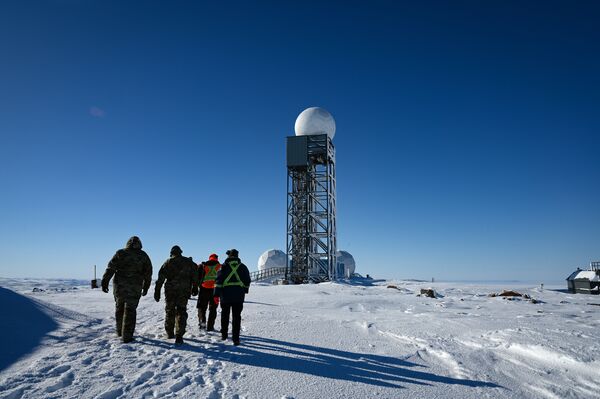

US Air Force personnel walk up to North Warning System Site CAM-5A, Cape McLoughlin, Northwest Territories, Canada, in April 2025. (US Air Force)
The Defense Advanced Research Projects Agency (DARPA) is exploring the development of advanced air and maritime radar technologies to address potential threats specific to the Arctic.
DARPA's Frosty programme is specifically geared towards producing “new sensing modes in the Arctic environment, enabling better detection and tracking of low-flying air vehicles and slow-moving maritime vessels”, according to a 6 January agency notice. “The Frosty programme will develop sensing modes to improve our awareness of activities in the northern latitudes as the Arctic opens to shipping and other uses,” agency officials said in the notice.
“Development of new radar and other radio frequency (RF) technologies [that are] designed to offset or counter some of the unique challenges the Arctic environment poses to current radar surveillance systems” would be beneficial to the United States and its regional allies, providing new ways to detect, track, and identify low-flying air vehicles or maritime vessels in Arctic regions,” DARPA officials added.
The current long-range, early warning radar capability fielded in the Arctic by the US and its allies is the North Warning System (NWS). Evolving out of the Cold War-era Distant Early Warning (DEW) Line, the NWS is operated by North American Aerospace Defense Command (NORAD) in conjunction with Canada and consists of 49 radar sites in total, made up of a mix of long- and short-range systems, according to a US Air Force (USAF) fact sheet.
Go beyond the headlines - with direct links to interconnected entities
Get full access to validated equipment, military capabilities, and market insights.