DSEI 2025: Italy, Japan to develop GCAP flying test aircraft to serve alongside UK's Excalibur
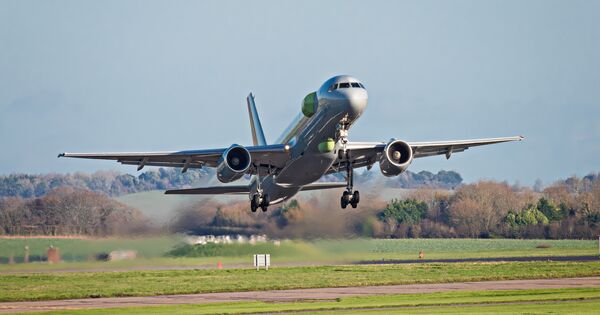

Seen departing MoD Boscombe Down on its first test flight, the UK's Excalibur FTA will be joined by flying testbeds from Italy and Japan. (QinetiQ)
Each of the three international partners for the Global Combat Air Programme (GCAP) is to field a flying testbed, with the disclosure at the Defence and Security Equipment International (DSEI) 2025 exhibition in London that both Italy and Japan will join the UK in developing a surrogate airframe for the inflight testing of the next-generation avionics and other systems.
Speaking to Janes and other reporters on 9 September, senior officials from the four companies that make up the newly formed GCAP Electronics Evolution (G2E) consortium confirmed that the UK Excalibur Flight Test Aircraft (FTA) will be joined by a similar aircraft from the other two partner countries as the partners look to develop and de-risk the sensor suite known as Integrated Sensing and Non-Kinetic Effects & Integrated Communications Systems (ISANKE & ICS).
“We recognise that the programme requires, as has been proven with the best practice on the F-35 and the F-22 [US combat aircraft programmes], a large integrated testbed for the testing of sensors in an airborne environment. We have in the UK invested in the [Excalibur] flight test aircraft – that is a [Boeing] 757 aircraft that's being converted by our partners at 2Excel,” said Andrew Howard, director Future Combat Air UK, Leonardo UK Future Combat Air System (FCAS), GCAP Senior Responsible Owner (SRO), adding, “There will be other flying testbeds.”
Go beyond the headlines - with direct links to interconnected entities
Get full access to validated equipment, military capabilities, and market insights.