MDA reports first flight-test tracking of ballistic missile for Long Range Discrimination Radar
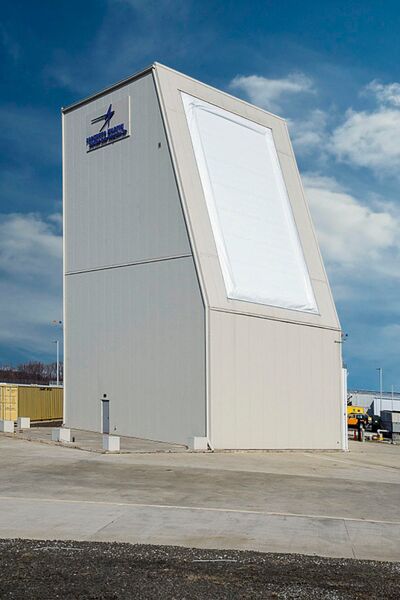

The Long Range Discrimination Radar, shown here during early testing at Lockheed Martin, recently tracked its first in-flight ballistic missile. (Lockheed Martin)
The Long Range Discrimination Radar (LRDR) at Clear Space Force Station, Alaska, acquired, tracked, and reported missile target data to the Command and Control Battle Management and Communications (C2BMC) system during the radar's first flight test tracking a live intercontinental ballistic missile (ICBM) representative target, the US Missile Defense Agency (MDA) reported in a 24 June release.
The MDA said it conducted the test with US Space Force and US Northern Command (NORTHCOM).
During this test – Flight Test Other-26a (FTX-26a) – the MDA said it developed a target that was air launched over the northern Pacific Ocean. The target flew over 2,000 km off the southern coast of Alaska where it was tracked by the LRDR and the Upgraded Early Warning Radar (UEWR) located at Clear Space Force Station. Sensor data was passed to Ground-Based Midcourse Defense (GMD) to support a simulated engagement.
“Initial indications show that LRDR, C2BMC, and GMD Fire Control met mission requirements,” the MDA reported, adding that programme officials will evaluate system performance based upon telemetry and other data obtained during the test.
“This was a key test in the development of the LRDR system and its integration into the C2BMC network,” Lieutenant General Heath Collins, MDA director, said in a statement.
The LRDR is part of the Lockheed Martin SPY-7 radar line.
For more information on other SPY-7 work, please see Lockheed Martin, Fujitsu Limited agree to MOU for SPY-7 component .
Go beyond the headlines - with direct links to interconnected entities
Get full access to validated equipment, military capabilities, and market insights.