UK's Blighter prepares automation function for BlighterNexus software with C400 coastal radar
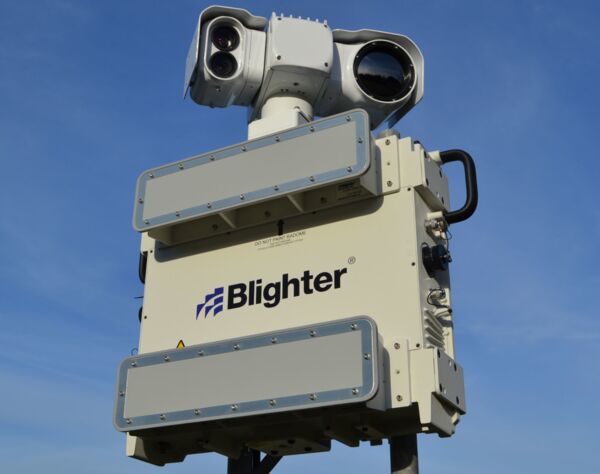
Blighter's C402-SP coastal security radar with antennas and camera. (Blighter Surveillance Systems)
UK's Blighter Surveillance Systems is preparing to roll out the automation function of its BlighterNexus software application in combination with its C400 coastal security radars, Blighter co-founder and chief technology officer Mark Radford told Janes in an interview on 19 September.
“The automation function, currently, is applying our human knowledge. As radar experts we know how to set up the radar for maximum performance in given conditions and so we can programme the automation functions in BlighterNexus to apply the correct settings as we would do,” Radford said. The company is also looking to expand the “smart function” into an artificial intelligence (AI) function, which will “learn what we [experts] do in setting up a radar” and it will also have the capability to “fine-tune that further” including adjusting the radar settings. The company is expecting to include automation functions in the near future, according to Radford.
Blighter's ground-based electronic-scanning (e-scan) frequency-modulated continuous-wave (FMCW) Doppler coastal radar is a dual-mode system, which can detect targets on land and at sea simultaneously. The C400 has software-switchable ranges including 8 km, 16 km, and 32 km. The 8 km and 16 km ranges are seen as “the sweet spot” for the coastal radar, Radford said. Typically, the radar is deployed at a minimum of 5–10 m above sea level and is mounted on an extendable mast on the rear of a vehicle for rapid deployment. The radar operates in the Ku-band at 16 GHz.
Go beyond the headlines - with direct links to interconnected entities
Get full access to validated equipment, military capabilities, and market insights.