UK's Cambridge Sensoriis plans to launch new air-to-ground radar this year
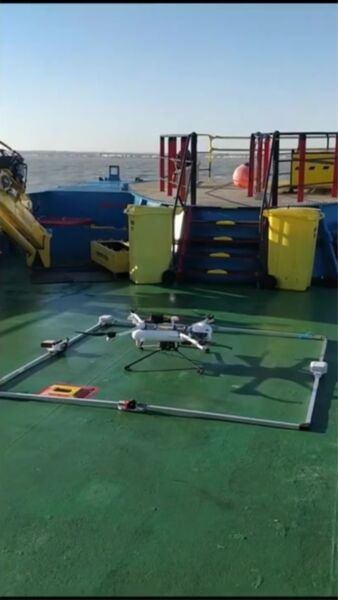

Image of a UAV mounted with a primary ARC-Landing radar and a network of secondary radars installed on a landing pad. (Cambridge Sensoriis Ltd)
UK-based radar and sensing company Cambridge Sensoriis Ltd is planning to launch its new air-to-ground radar for obstacle detection later in 2025, the company's CEO Steve Clark confirmed to Janes on 13 June.
Clark did not reveal any more details around the optical ground detection radar, citing commercial sensitivity around the new product during an interview on 9 June.
Cambridge Sensoriis currently has three different types of radars including landing, tethering, and air-to-air.
The Active Radar Cooperating (ARC)-Landing system involves integrating or attaching an ARC primary radar, which weighs tens of grams, to the unmanned aerial vehicle (UAV). Three secondary ARC radars are placed in a triangular formation on a vessel deck where the UAV will be landing. The primary radar measures each of the secondaries, which is used to calculate the UAV's position to the deck. Both the primary and the secondaries detect at a range of just over 100 m. The secondaries send the primary the roll, pitch, and relative yaw axes of the deck in relation to the UAV. The radars do not use global navigation satellite services (GNSS) measurements.
“There are two core pieces of intellectual property (IP), which are also patented. The first one allows the primary and the secondary [radars] to work together, and the other one is the IP that allows the relative of the yaw to be measured between the drone and the deck,” said Clark.
The IP on the primary allows for the UAV to detect and identify each of the three secondaries and land on the vessel.
Go beyond the headlines - with direct links to interconnected entities
Get full access to validated equipment, military capabilities, and market insights.