US Army seeks commercial solutions for airborne EW family of systems
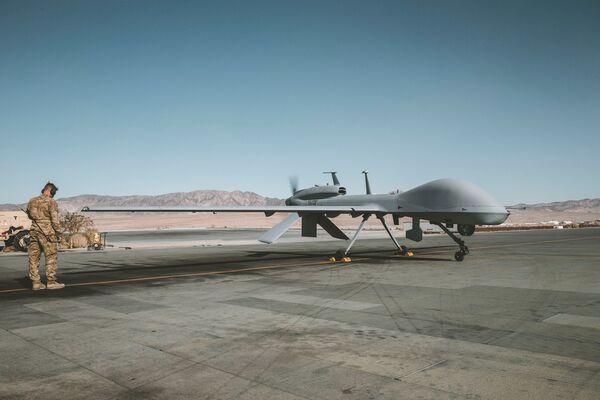

A US Army MQ-1C Gray Eagle prepares for take-off on November 2019 at the Air Combat Element landing strip at Twentynine Palms, California. (US Marine Corps)
The US Army's prime intelligence and electronic warfare (EW) directorate is shifting strategies on development of the Multi-Function Electronic Warfare (MFEW) family of systems (FoS), focusing on commercially developed platforms and subsystems to support programme requirements for drone-mounted EW payloads, service officials announced in July.
The decision to primarily pursue commercial off-the-shelf (COTS) and government off-the-shelf (GOTS) solutions for the service's MFEW – Air Large (MFEW-AL) variant was driven by a need to close “gaps in extended-range, persistent ground, and airborne EW assets”, programme officials from the army's Program Executive Office Intelligence, Electronic Warfare and Sensors (PEO IEW&S) said in a June statement.
As a result of the COTS and GOTS acquisition focus, service leaders will “utilize an incremental approach for delivery of capability that will evolve over time toward[s] the full Army's Airborne Electromagnetic Attack requirements”, with regard to the MFEW-AL, the statement said. To this end, successful integration of commercial platform solutions to the MFEW-AL programme “will be key in meeting recent [Pentagon] direction … [to] achieve electromagnetic dominance by 2027”, programme officials added in the June statement.
As designed, the MFEW-AL will provide “electronic attack and electronic warfare support capability” via an EW pod mounted aboard the ground service's MQ-1C Gray Eagle unmanned aircraft system (UAS), according to a US Department of Defense (DoD) fact sheet.
Go beyond the headlines - with direct links to interconnected entities
Get full access to validated equipment, military capabilities, and market insights.