US Fleet Forces Command cites need for increased cyber readiness focus
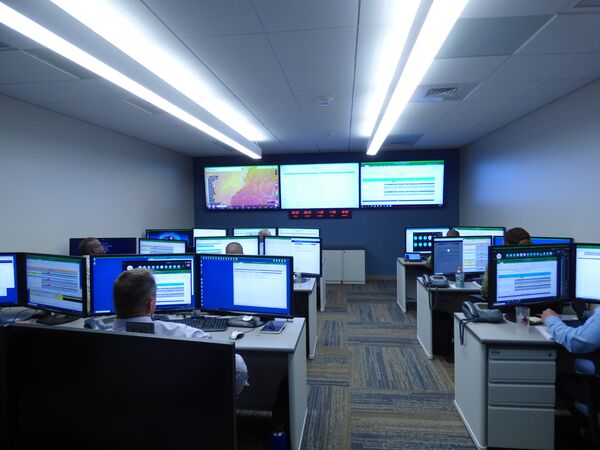

The US Navy's Maintenance Operations Center, shown here, provides maintenance data, which the service wants to use to create AI tools to improve performance. (Janes/Michael Fabey)
While US Fleet Forces Command will continue to focus on overall readiness, there will be additional attention paid to cyber and space system readiness, according to Admiral Karl Thomas, the command's new commander.
“We often overlook all the information systems that are so important in today's fight,” Adm Thomas told reporters on 1 December shortly after he officially took command of US Fleet Forces Command aboard aircraft carrier USS Harry S Truman in Norfolk, Virginia.
“We don't fight where we can see each other today,” Adm Thomas noted. “We fight over the horizon.”
US forces need a reliable “ability to communicate, provide tactical [data], [and] provide long-range fires, [and they] have to provide targeting for long-range fires,” Adm Thomas said.
To do this, forces need to ensure the “entire spectrum for today's fight”, he added. “That's a really important aspect.”
He said cyber and space readiness are becoming tactically important “like never before” in learning “how to understand the battlespace”.
The United States is deploying increasingly more sensors, Adm Thomas said, adding, “how we are stitching those sensors together is critically important”.
Adm Thomas said modern tactical warfare depends on “sensing the battlespace”, as well as using the information from that sensing in an efficient manner via technology such as artificial intelligence (AI).
Reliable data
However, he added, “AI is only as good as the data.”
If the data feeding into AI is corrupt, then so will any kind of analysis used for domain awareness, according to the new commander of US Fleet Forces Command.
Go beyond the headlines - with direct links to interconnected entities
Get full access to validated equipment, military capabilities, and market insights.