USN taps Northrop Grumman to integrate TACAMO nuclear C2 system aboard E-130J
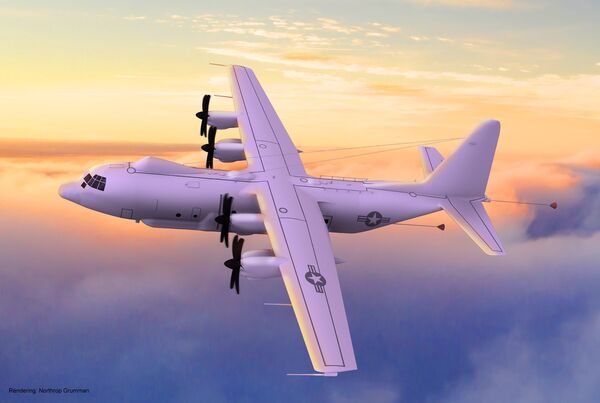

A depiction of the E-130J. (Northrop Grumman)
The US Navy (USN) awarded Northrop Grumman a USD3.4 billion engineering and manufacturing development (EMD) contract to integrate the Take Charge and Move Out (TACAMO) nuclear command-and-control (C2) system aboard Lockheed Martin E-130J aircraft.
Northrop Grumman is now set to integrate a Collins Aerospace very-low-frequency (VLF) antenna and deployment system with three government-furnished EMD E-130Js. The E-130Js will also require additional cooling equipment, hardening against nuclear blasts, and a secure communications suite, among other modifications.
Preliminary design review of the E-130J and VLF antenna is expected to begin in the third quarter (Q3) of fiscal year (FY) 2025. Six additional E-130Js are expected to follow the EMD aircraft, beginning in FY 2028.
The E-130J is derived from the C-130J-30 Hercules, an extended-fuselage version of the C-130J transport. The US Navy, Air Force, Marine Corps, and Coast Guard all operate versions of the C-130J, which although mainly used for transport has been adapted for search-and-rescue, aerial refuelling, and light strike, among other missions.
The award paves the way to replace the Boeing E-6B Mercury, which uses a deployable VLF antenna to signal US ballistic missile submarines.
The C-130 has been employed in the TACAMO mission before. The E-6s replaced EC-130Qs as the USN's TACAMO aircraft in 1992.
Go beyond the headlines - with direct links to interconnected entities
Get full access to validated equipment, military capabilities, and market insights.