Brazilian marines advance multimission UGV project
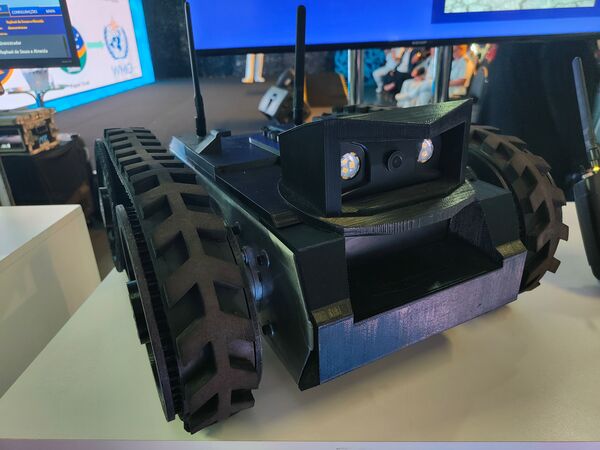

The Robô Expedicionário UGV was designed to mount tools for EOD, CBRN detection, and surveillance and reconnaissance missions. (Victor Barreira)
General Command of the Brazilian marines is advancing the in-house development of a small, lightweight, tracked multimission unmanned ground vehicle (UGV), a service official told Janes recently.
The self-funded UGV project, which was formally initiated in May 2022 through the Marine Corps Technology Center (Centro Tecnológico do Corpo de Fuzileiros Navais: CTecFN), seeks to locally develop a multimission UGV. It will be capable of significantly reducing risks in security and defence operations by the Marine Fleet Force of the Marine Corps, the commander of the CTecFN, Captain Alex Dantas Espirito Santo, told Janes in early August.
The Robô Expedicionário UGV (Expeditionary Robot) is a fully electric, all-weather platform designed to support both mounted and dismounted tactical operations, including explosive ordnance disposal (EOD); chemical, biological, radiological, and nuclear (CBRN) reconnaissance; and intelligence, surveillance, and reconnaissance (ISR) missions.
The Robô Expedicionário was designed for all types of terrain and climate conditions.
It can be customised with various payloads, including an EOD manipulator arm, CBRN detection, and ISR equipment.
It is also capable of accommodating provisions to deploy a micro rotary-wing unmanned aerial vehicle (UAV).
The CTecFN aims to build several prototypes for evaluation and to fund an industrial partner to serially produce the UGV, Capt Dantas Espirito Santo told Janes .
The Robô Expedicionário UGV weighs 11 kg and has a top speed of 10 km/h. It measures 461 mm in length, 235 mm in height, and 395 mm in width. It has autonomy that can last 120 minutes and offers a 400 W power output and a 13.76 Nm torque.
Go beyond the headlines - with direct links to interconnected entities
Get full access to validated equipment, military capabilities, and market insights.